Axios AI+

March 12, 2024
Hi, it's Ryan coming to you from SXSW — where AI is the new crypto, nothing runs on time, and the sun is extremely welcome. Today's AI+ is 1,051 words, a 4-minute read.
Axios' What's Next Summit returns March 19 to Washington, D.C., with trailblazing newsmakers on the topics defining our future. Ina will interview former White House OSTP director Alondra Nelson and Moms First founder and CEO Reshma Saujani. Full lineup and livestream details.
1 big thing: AWS everywhere, all at once

Amazon Web Services (AWS) CEO Adam Selipsky. Photo: Noah Berger/Getty Images for AWS
Amazon Web Services CEO Adam Selipsky has more than 10,000 organizations using his Bedrock service to build their AI applications — but that's only around 1% of the potential market, he told Axios.
Why it matters: AWS aims to expand from cloud computing market leader to running the world's biggest AI playground.
- Amazon's strategy is to bring millions of companies into that ecosystem while it works to improve its own AI models and chips and to increase its market share.
Catch up quick: Selipsky's AI tool chest runs from data centers and AWS purpose-built chips to helping Bedrock customers fine-tune AI models built outside AWS.
Driving the news: AWS expanded its collaboration with Anthropic on March 4, when the model developer launched its Claude 3 family, which includes Opus, Sonnet and Haiku.
- The Claude 3 family will be available through Bedrock, while Anthropic will use AWS Trainium and Inferentia chips to build, train and deploy its future foundation models.
- AWS announced around 40 generative AI "competency partners" — AWS-approved service and software partners — including Nvidia, Hugging Face, Anthropic, Deloitte and MongoDB, which AWS will help pair with their customers to build AI applications quicker.
- Mistral, another hot AI startup, was added to Bedrock on March 1.
Intrigue: Selipsky says AWS is the "best place in the world" to house and rent GPUs — the most sought-after AI chips — but the company is also working furiously to provide alternatives to GPUs.
- The AWS play is to offer better "price performance" and lower energy consumption with its chips, which it thinks are good enough to use for most tasks.
What's happening: Selipsky says AWS is collaborating with Anthropic to "help make their models better, " and in return, Anthropic helps improve AWS' chips.
- Data from Anthropic shows Opus outperforming OpenAI's GPT-4 in reasoning, math and coding, with Selipsky calling them the "leading models in the market right now" for those specializations.
- The 10,000 Bedrock users include golf's PGA Tour, which is creating fan content, and Genomics England, which is spotting previously unnoticed associations between genetic variants and medical conditions in peer-reviewed papers.
Selipsky thinks his customers are getting smarter about model choices — seeing "faster and less costly" smaller models as useful for low-risk tasks like meeting summaries where some loss of accuracy is acceptable.
- Those prizing accuracy need to think about bigger models and techniques such as retrieval-augmented generation (RAG) which enable models to cite their sources and provide more accurate answers, he said.
Reality check: AWS is still playing catch-up in several key markets — it's chasing OpenAI and Microsoft's models, as well as Nvidia's GPU chips.
What they're saying: Selipsky called Bedrock "essentially a safety harness" around AI models, and urged AI leaders to be "humble about our state of knowledge" and about "how much more we need to collaborate" to manage AI risks.
- Sheila Gulati, co-founder and managing director at Tola Capital, told Axios, "It's great to see mega caps having to get aligned with newer companies, and to have multiple models succeed as we go through this massive, massive societal shift."
What's next: Selipsky promised the next generation of Trainium chips will be four times faster than the current version, and is looking to continue to expand the number of models available in Bedrock.
- He predicts 2024 will bring more AI applications running on computing edge infrastructure and more demand from companies for customized AI models.
2. Western countries pessimistic about AI at work
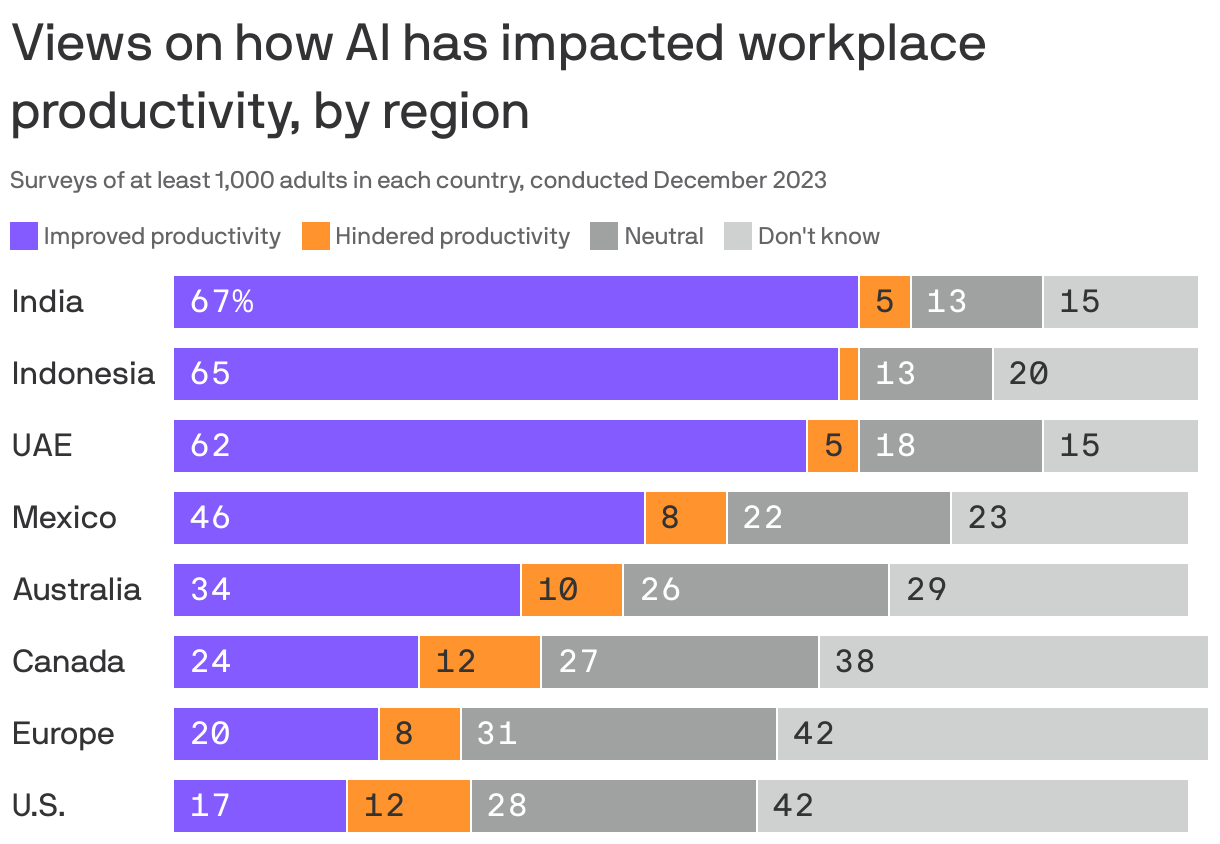
New data from 17 countries shows workers in Asia are embracing generative AI tools for productivity to far greater degrees than Western workers — with Americans among the least positive about AI's workplace uses.
Why it matters: Business leaders fear that pessimism about AI in the West could make the U.S. and allied countries less competitive.
- Experts say that the earlier companies and individuals experiment with generative AI, the quicker they will find ways to improve productivity and creativity.
By the numbers: Indians are the most likely (67%) to say that AI has improved overall productivity in their workplace over the last year, per YouGov, which conducted the poll.
- Indonesia (65%) and UAE (62%) closely follow.
- At the bottom of the list are Sweden (14%), the U.S. (17%) and the U.K. (18%).
- American, European and Canadian workers are twice as likely as workers in Asia to say they "don't know" whether AI helps productivity, suggesting lower levels of experimentation and stricter company rules about how AI can be used at work.
- Other groups showing enthusiasm for AI as a productivity tool are people ages 18-44 and men.
What's happening: Those working in their second or third language, or for a company based in another country, may find generative AI especially useful for checking their work and clarifying their communications.
An assistant with superpowers is how Peter Deng, OpenAI's VP of consumer product and head of ChatGPT, advised a SXSW audience to think about AI in the workplace.
- "My handwriting sucks, I can't really do arithmetic very well," Deng said. He recommended that anyone with a comparable weakness think about how AI can be used to help overcome it and "appear more professional."
- "Each individual will be able to do more with AI, but it's up to each individual to figure out how to apply it," he said.
What they're saying: "I'm using [Microsoft] Copilot to summarize meetings and track actions. It doesn't write my emails so well — I don't use it for that," said Lisa Su, CEO of chipmaker AMD.
3. Training data
- Midjourney banned users from the staff of rival Stability AI, accusing them of causing a systems outage while attempting to scrape Midjourney's data. (The Verge)
- The debates and minds of AI doomsayers are filled with uncertainty — but that's also why they think we all need to think harder about AI's development. (The New Yorker)
- Tensions between TikTok and lawmakers reached a boiling point on Capitol Hill ahead of a vote tomorrow on a bill that would ban or force a sale of the app. (Axios)
- In a court filing yesterday, OpenAI called the claims of Elon Musk's lawsuit against the ChatGPT maker "convoluted" and "incoherent." (Axios)
- Trading places: Twilio Communications announced Thomas Wyatt as president of segment (joining from people.ai), and Inbal Shani as chief product officer (joining from GitHub).
4. + This
Keep Austin weird: Visit the "cathedral of junk."
Thanks to Scott Rosenberg and Megan Morrone for editing this newsletter and to Carolyn DiPaolo for copy editing it.
Sign up for Axios AI+

Scoops on the AI revolution and transformative tech, from Ina Fried, Madison Mills, Ashley Gold and Maria Curi.
