Axios AI+
February 26, 2024

Hi, it's Ryan, coming to you from Barcelona, where Mobile World Congress has kicked off with the promise that more AI, running much faster, is the future of smartphones. Today's AI+ is 1,175 words, a 4½-minute read.
Join Axios' Maria Curi and Ashley Gold Wednesday at 6:30pm ET in Washington, D.C., for an event on government progress towards responsible AI guardrails with Sens. Mike Rounds (R-S.D.) and Cory Booker (D-N.J.) and NTIA administrator Alan Davidson. Register here.
1 big thing: AI's next act is autonomous agents
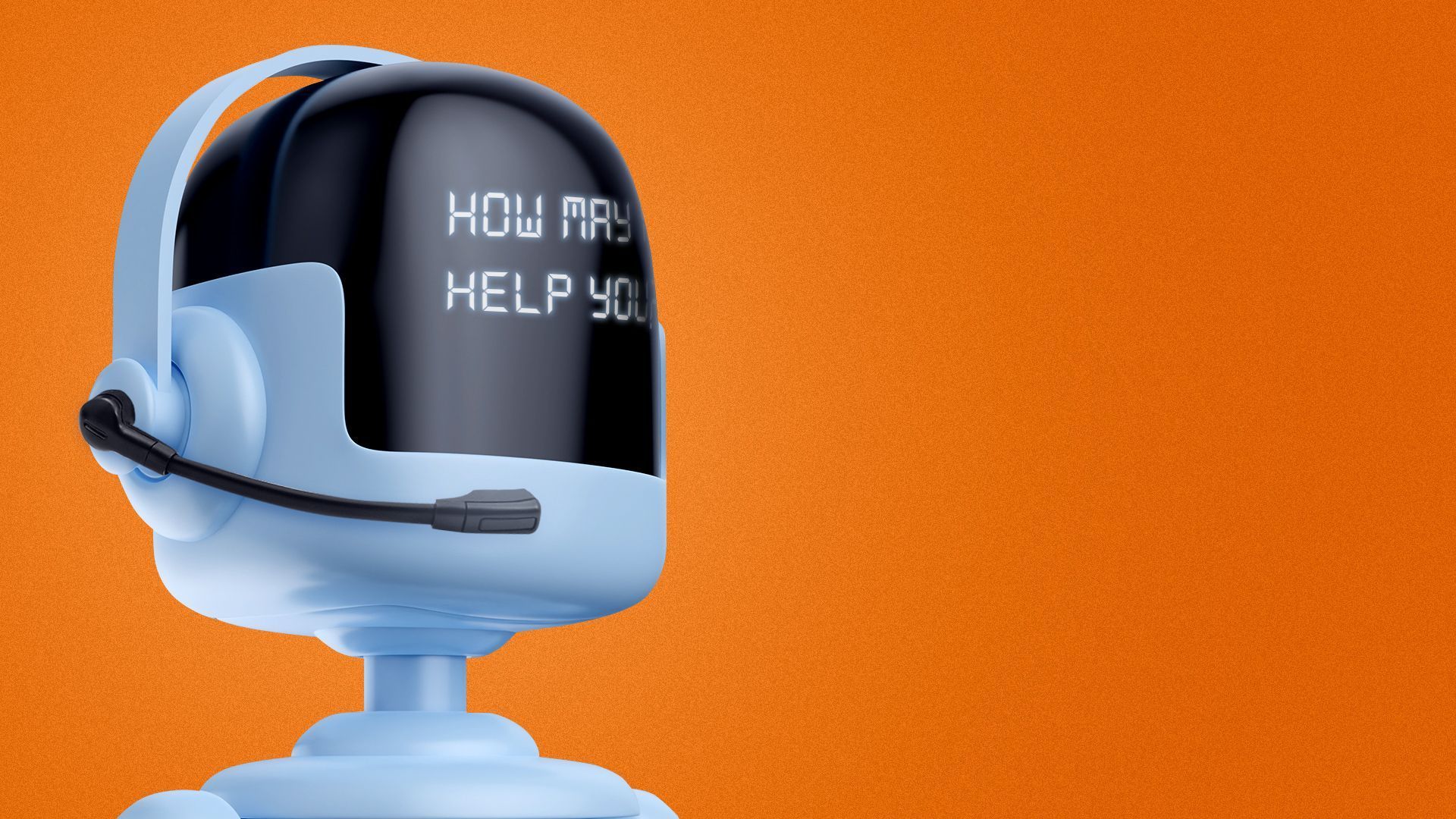
Illustration: Aïda Amer/Axios
AI's key brain trusts are already looking beyond today's popular chatbots to a world in which AI agents act on your behalf, Ina and Scott Rosenberg report.
Why it matters: As AI races from just saying things to doing things for us, its potential benefits and harms will multiply fast.
Driving the news: ChatGPT maker OpenAI is deep into development of AI agent systems, as the Information recently reported.
- Former Salesforce co-CEO Bret Taylor and former Google executive Clay Bavor have launched Sierra, a company that aims to fully automate a huge range of online customer interactions using AI agents.
Between the lines: Such "set and forget" systems that take care of things for you are convenient and wonderful — when you can trust them.
- But generative AI is still very young — and even at its best is still prone to making things up and going off the rails.
- In recent days, ChatGPT started spitting out gibberish, while Google was forced to halt image generation of people after its Gemini engine was generating images with a range of races even in queries where such diversity didn't make sense, such as an image of Nazi-era German soldiers.
The big picture: Moving to a world in which AI systems take actions rather than just provide insights will require a significant shift in both technology and human behavior.
- "Once we get agent-like systems working, AI will feel very different to current systems, which are basically passive Q&A systems, because they'll suddenly become active learners," Google DeepMind CEO Demis Hassabis told Wired.
- "Of course, they'll be more useful as well, because they'll be able to do tasks for you, actually accomplish them. But we will have to be a lot more careful."
Google researchers have been exploring the challenges presented by such a shift.
- "The 'agents' question really brings the philosophical question of value alignment to the fore," Iason Gabriel, a research scientist in the ethics research team at Google DeepMind, tells Axios' Alison Snyder.
- "It is also extremely important that the AI respects the needs and interests and well-being of other people."
Zoom in: Customer service has emerged as ground zero for the debate over how much autonomy to give to AI-based systems.
- Sierra's Bavor and Taylor tell Axios that full automation will make the biggest difference to companies' bottom lines.
- That can boost productivity gains from simply making existing human agents 10-20% more efficient to independently handling 70% of cases, Bavor says.
Sierra charges its customers only for each incident handled by its AI system. "We don't charge unless the AI fully resolves it," Taylor says.
- Bavor says early results are encouraging, with the system built for Weight Watchers able to resolve nearly 70% of customer inquiries while receiving 4.6 stars out of five for customer satisfaction.
The other side: Salesforce has largely focused on having "a human in the loop" with its early generative AI systems.
- "I feel like there's a reason why we're calling this generation of products copilots... and not autopilots," Paula Goldman, Salesforce's chief ethical and humane use officer, tells Axios.
- However, Goldman says the company is shifting its conceptualization to embrace a "human at the helm" approach — under which, for example, a person might not need to review all of the hundreds of similar e-mails crafted by an AI system.
- In many cases, though, Goldman says it still makes sense to have a human review each response.
What's next: Taylor says AI agents will expand beyond customer service and over time, become the dominant way that individuals interact with businesses. "It's going to be the digital version of the company," he says.
- "I have to imagine in five years it will be everything from commerce to even investor relations," Taylor tells Axios.
Yes, but: As businesses hand off more tasks to agents, their customers will, too — speeding us toward a world in which "my bot will talk to your bot."
- We could reap a bounty of saved time — and face a whole universe of new scams, cyberattacks and privacy violations.
2. Being nice to chatbots pays off

Illustration: Annelise Capossela/Axios
It pays to be nice to your AI: Large language models (LLMs) tend to give better answers when prompted respectfully — and failure to do that can "significantly affect LLM performance," per a new cross-cultural research paper.
Why it matters: Your prompt may affect the answer you get today — and also how well an AI model can answer everyone else tomorrow.
- "Impolite prompts may lead to a deterioration in model performance, including generations containing mistakes, stronger biases and omission of information," the researchers found.
What they did: The researchers tested a half-dozen chatbots against dozens of tasks, using up to 150 prompts per task.
What they found: LLMs mirror certain human communication traits, which means politeness toward chatbots tends to generate better responses, just as politeness does in human conversation.
- The thesis proved true across English, Chinese and Japanese prompts and with each chatbot tested.
- "Impolite prompts often result in poor performance, but excessive flattery is not necessarily welcome," the researchers found.
- One effect of excessively rude or flattering prompts was that they generated longer answers in English and Chinese.
Reality check: Chatbots are not sentient, and your politeness isn't making them feel good.
3. Battles over AI and crypto energy use heat up

Illustration: Shoshana Gordon/Axios
A new lawsuit and new essay signal intensifying battles over energy demand from AI and cryptocurrency mining, Axios' Ben Geman writes.
Why it matters: Both technologies demand electricity-thirsty computing at a time when most countries are failing to steeply cut emissions.
State of play: A federal judge on Friday granted crypto industry plaintiffs a temporary order blocking new Energy Department collection of the sectors' power usage data.
- Meanwhile, AI ethicist Kate Crawford writes in Nature that "we need pragmatic actions to limit AI's ecological impacts now."
- As a starting point, Crawford supports Democratic legislation that would create standards for assessing AI's impact and a voluntary reporting framework.
The big picture: An International Energy Agency report last month estimates that data centers, crypto and AI accounted for roughly 2% of global power demand in 2022 — and that could double by 2026.
- AI may also support climate benefits — thanks to improved battery materials, extreme weather forecasts and smarter management of complex energy grids.
The intrigue: Bloomberg reported that Google is "using software to hunt for clean electricity in parts of the world with excess sun and wind on the grid, then ramping up data center operations there."
4. Training data
- Kara Swisher, whose autobiographical "Burn Book" pubs this week, tells Mike Allen that tech's billionaire founders are cocooned by wealth yet seething with resentment. (Axios)
- A Democratic operative confessed to using AI to create a robocall that deepfaked President Biden's voice and said anyone can do it for $500. (NBC)
- So far in 2024, Jeff Bezos and Mark Zuckerberg have sold more than $9 billion in stocks in the companies they founded. (Axios)
- The EU launched its European AI Office, which will oversee the bloc's landmark AI Act. (EU, Axios)
5. + This
Ted Lasso's Hannah Waddingham took her 9-year-old daughter's homemade handbag to the SAG awards red carpet.
Thanks to Scott Rosenberg and Meg Morrone for editing this newsletter.
Sign up for Axios AI+

Scoops on the AI revolution and transformative tech, from Ina Fried, Madison Mills, Ashley Gold and Maria Curi.