Axios AI+

February 24, 2025

Sammy and Sadie wanted to write the introduction, but AI doesn't speak woof — yet. I did let them make an appearance in + This. Today's AI+ is 1,192 words, a 4.5-minute read.
If you're in Washington, D.C.: Join Axios' Maria Curi and Ashley Gold tomorrow at 8am ET for an event looking at the future of U.S. competitiveness in science and tech, featuring Rep. Brian Babin (R-Texas), Rep. Zoe Lofgren (D-Calif.) and Hugging Face head of machine learning and society Yacine Jernite. Register here.
1 big thing: Bot-race victor may not be born yet

/2025/02/24/1740357777019.gif?w=3840)
A hot startup that grew overnight into a billion-dollar behemoth is racing with established tech giants for supremacy in a new market that everyone expects will unlock a future of abundance and profit.
Flashback: That sounds like a description of OpenAI vs Google et al., but it's actually an account of the "browser wars" at the dawn of the web 30 years ago — when Netscape vied with Microsoft to control the software people would use to access the internet.
Why it matters: In 1996 or 1997, a couple years after forward-looking tech leaders first realized that "owning" the web browser would be a prize, Google — the company that would ultimately win the race — didn't even exist.
Today, as AI giants and challengers vie to build a better chatbot and seize mindshare and market share, there is similarly a good possibility that the winning bot (assuming there is only one) has not yet been invented, and the company that will make it has yet to be founded.
That's why tech's superpowers, despite their immense wealth and influence, have been running scared.
- It's also why VCs continue to pour money into new startups like Mira Murati's Thinking Machines Lab and Ilya Sutskever's Safe Superintelligence.
It can be baffling to watch the proliferation of these companies in a market that's already led by the likes of OpenAI's ChatGPT, Google's Gemini and Anthropic's Claude — with well-funded competitors like Elon Musk's xAI, open-source offerings like Meta's Llama and new contenders like China's DeepSeek also thronging the AI space.
The space's crowding leads some observers to see today's AI splurge as a bubble, and it almost certainly is. Many or most of these companies and products will fail — indeed, culling has already begun.
- But the logic of venture capital assumes that, even as most companies will fail, a few investors will hit the jackpot by getting an early piece of a company that grows unfathomably profitable the way Google or Facebook/Meta did.
No one knows how this will play out in AI.
- The jackpot company could be one of today's market leaders like OpenAI. It could be a dark horse that's still a back-of-a-napkin sketch on some founder's dining-room table. Or maybe one of today's established giants will end up owning the market.
The browser wars make an instructive parallel.
- In the '90s, Netscape was in the OpenAI position — it kicked off the new market with fast updates of its free Navigator browser and wowed the world with a skyrocketing initial public offering in 1995.
- Microsoft fought back with the introduction of the competing Internet Explorer, a flop at first that gradually improved and won users thanks to its integration with Microsoft's dominant operating system.
- Microsoft won the first battle — triggering a massive antitrust lawsuit by the Justice Department. But over the following decade IE lost ground to more innovative competitors like Mozilla.
Google didn't even introduce Chrome until 2008, and today it's by far the most popular browser in the world.
- But by that time, the victory didn't seem to matter as much. The smartphone revolution was underway, and apps were taking on much of the "gateway to the internet" role from browsers.
The bottom line: Tech's platform shifts may feel high-velocity, but they take a long time to unfold — and you should never feel too sure you know who is going to own the future.
2. Apple announces $500 billion in U.S. spending


Apple this morning announced plans to invest more than $500 billion in the U.S. and hire 20,000 people over the next four years, with expansion and construction planned from coast to coast.
- The new jobs will focus on research and development, silicon engineering, software development, and AI and machine learning.
- Apple plans to greatly expand chip and server manufacturing in the U.S., plus skills development for students and workers across the country.
Why it matters: Apple's announcement — which the company calls its "largest-ever spend commitment" — is precisely the kind of win President Trump has been looking for with his push to move manufacturing back to the U.S.
The backstory: Trump met with Apple CEO Tim Cook on Thursday in the Oval Office. Then Trump got so excited that he revealed the plans prematurely, saying on-camera while meeting with governors that Cook is "investing hundreds of billions of dollars. I hope he's announced it — I hope I didn't announce it, but what the hell? All I do is tell the truth — that's what he told me. Now he has to do it, right?"
The big picture: Apple says it now supports nearly 3 million jobs across the U.S. through direct employment, work with suppliers and manufacturers, and developer jobs in the iOS app economy.
- Apple already works with thousands of suppliers across all 50 states, including 24 factories in 12 states.
Reality check: Apple made a similar announcement four years ago. In 2021, Apple committed $430 billion in U.S. investments and 20,000 new jobs across the country over five years — including a new campus in Research Triangle Park, North Carolina, where development was paused last year.
Go deeper: Our full story has state-by-state details.
3. AI's global fight isn't just U.S. vs. China

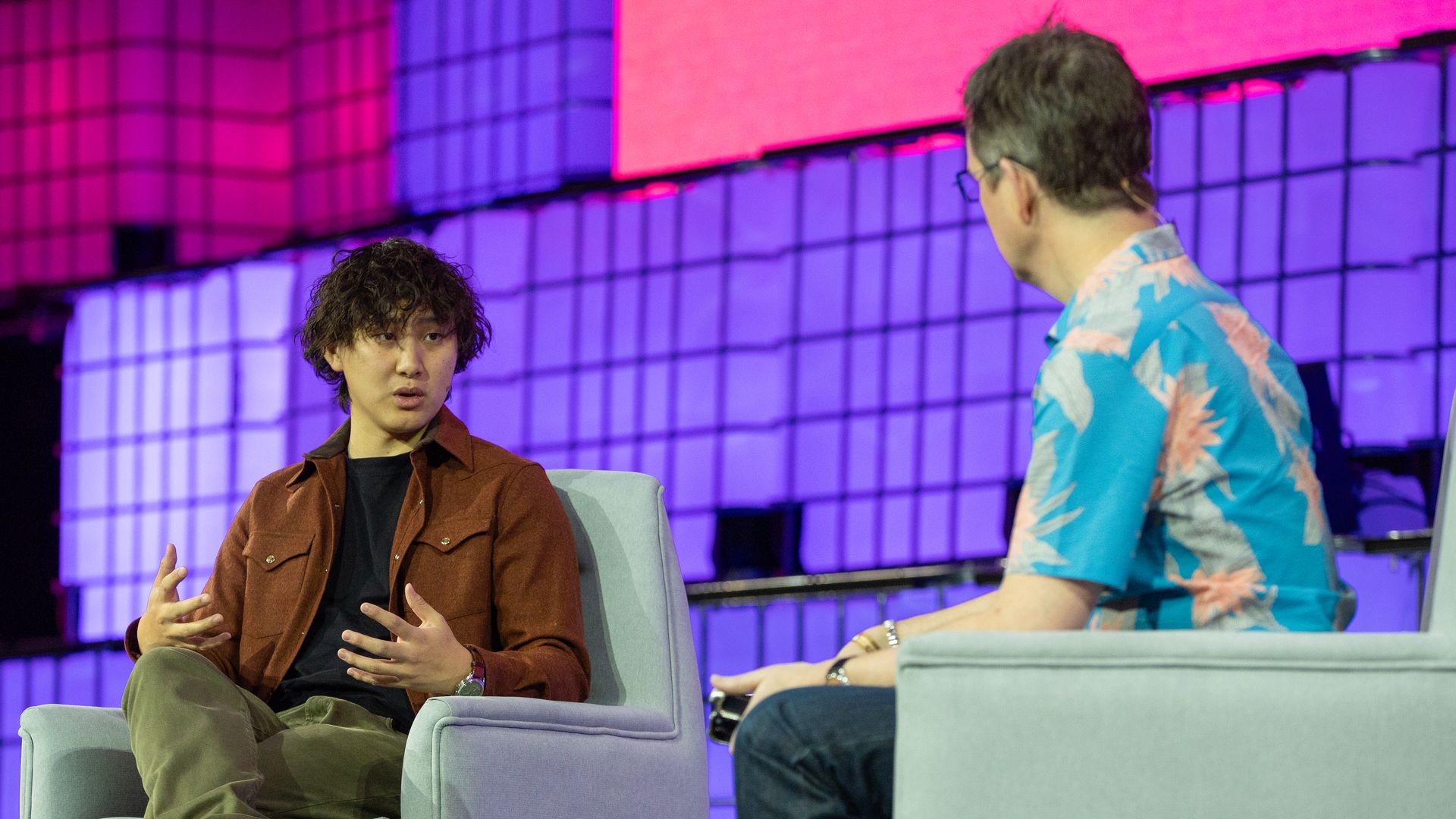
The idea that America must win the AI war no longer resonates internationally — if it ever did.
Why it matters: As U.S. companies, including Scale AI, ply their wares to foreign governments and corporations, they're increasingly aware that being American is no longer an advantage.
Flashback: Alexandr Wang, the founder of Scale AI, one of America's most valuable AI companies, last month took out a full-page ad in the Washington Post to proclaim that "America must win the AI war."
State of play: When Axios asked for a show of hands from thousands of international delegates at the opening night of Web Summit Qatar in Doha Sunday, almost everybody who voted disagreed with that statement.
- Less than half a dozen lonely souls said they agreed with Wang.
The big picture: "If you play the tape forward on AI," said Wang, "nearly every country in the world will ultimately likely build AI technology on top of either the U.S. technology stack or the Chinese technology stack."
- "The critical question is, what are the ideologies that are baked into the technology?"
Between the lines: Wang did make some concessions for his international audience. "AI technology should reflect, to a meaningful degree, the cultural differences between various countries," he said.
- "This is one of the things that we actually work on very closely."
The bottom line: American AI giants can no longer assume their nationality confers any kind of benefit of the doubt when it comes to trustworthiness.
4. Training data
- Apple is bringing Apple Intelligence to the next version of its software for the Vision Pro headset, along with an improved guest mode and other improvements. (Engadget)
- Apple has pulled its end-to-end encryption feature in the United Kingdom after the government there ordered Apple to give it a backdoor to its Advanced Data Protection system. (The Verge)
- After xAI's Grok started blocking sources reporting that Elon Musk and President Trump spread misinformation, xAI's engineering head blamed an unauthorized change by a single employee. (The Verge)
5. + This

Woof! Woof, woof woof.
Thanks to Scott Rosenberg and Megan Morrone for editing this newsletter and Matt Piper for copy editing it.
Sign up for Axios AI+
