Axios AI+
July 28, 2023

Ina here, bringing you today's newsletter and the first of the hands-on AI product reviews we're calling Prompt.
Axios Events is looking forward to bringing Axios AI+ to a live audience this fall, as we convene top newsmakers in the field for events exploring the opportunities and challenges of the AI revolution. We would love to hear from you about your interest in these events. Share your thoughts.
Today's AI+ is 1,226 words, a 5-minute read.
1 big thing — Prompt: How to attend two meetings at once
Screenshot: Axios
My grandfather had a saying that basically translated to "one tush can't be at two weddings." A new generation of AI tools, including ones I tested from Otter.ai this week, is on the cusp of making that family wisdom obsolete.
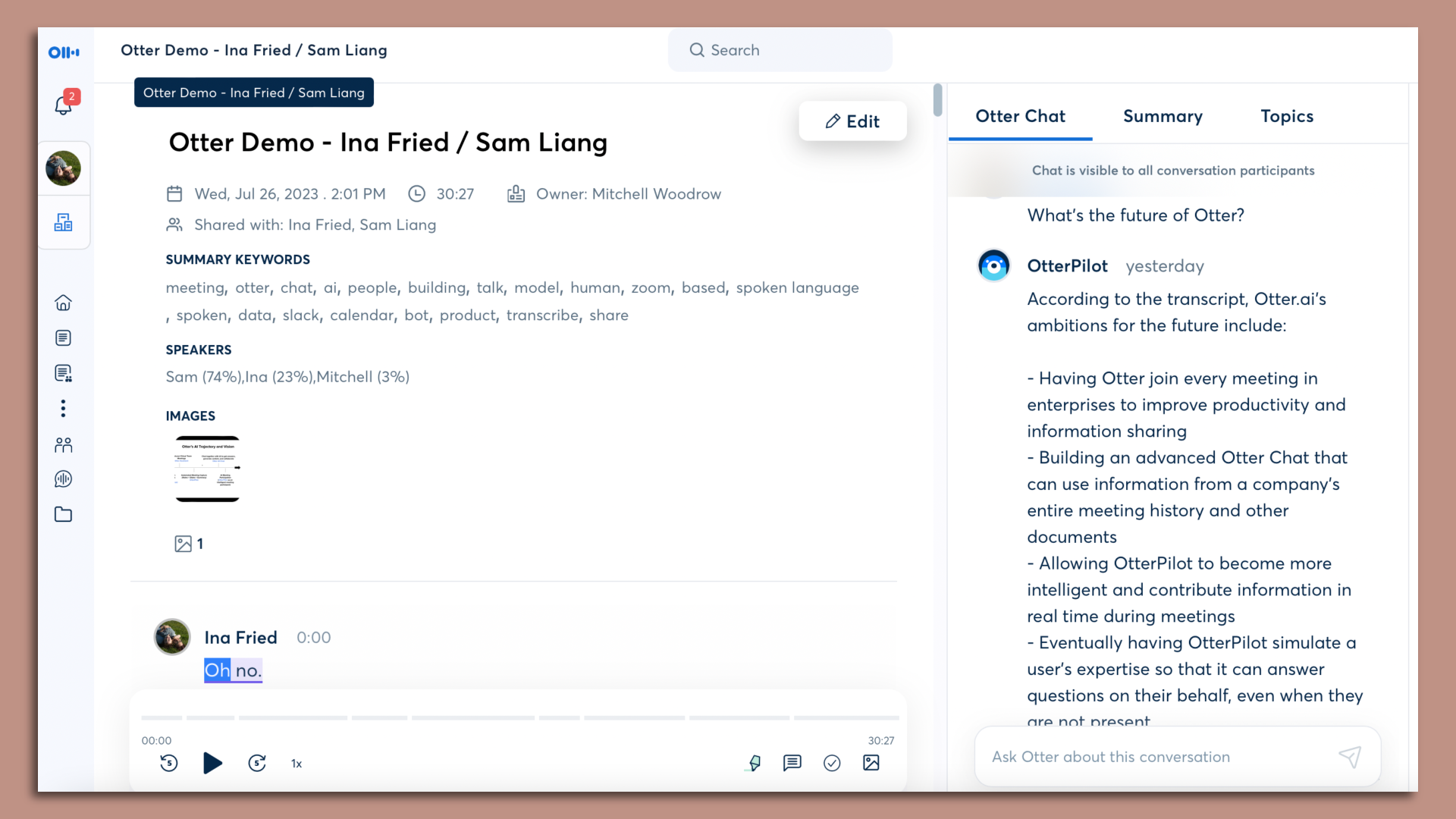
What's happening: While best known for its AI-powered voice transcription software, Otter now offers an AI bot, OtterPilot, that can join online meetings — with you or without you — and transcribe and summarize them in real time. Then another bot, Otter Chat, can answer questions based on what people have said in that meeting.
How it works: Once you connect an Otter.ai account to your Microsoft or Google calendar, the OtterPilot bot can automatically join an online meeting — in Zoom, Microsoft Teams or Google Meet — and start recording and transcribing it.
- I used OtterPilot yesterday to record a Disability Awareness Month Zoom talk here at Axios while I did a TV news appearance.
- I also used it to join and record our weekly newsroom-wide meeting, which was scheduled at the same time as the second half of the disability event.
Later in the day, OtterPilot accompanied me during an interview with Slack CEO Lidiane Jones over Google Meet, showing up as a separate participant labeled "Ina's OtterPilot."
- Once I was sure it had joined (and I could see in Otter's mobile app that it was recording and transcribing), I felt comfortable enough not to take notes during our meeting, freeing me to be more present and engaged.
The good: Otter did a great job of not only recognizing speakers and transcribing, but also summarizing the meetings.
- The paid version of Otter's service can take part in three meetings at once, and had no trouble joining meetings whether I was on the call or not.
- The Otter Chat bot is surprisingly good at answering questions, as long as they'd been addressed in the meeting.
- I was even able to watch OtterPilot transcribe a meeting in the mobile app while waiting for the TV appearance to start.
Of note: OtterPilot also saves the visuals presented in the meeting, and you can use Otter Chat to generate content after the meeting, such as a follow-up email or blog post.
- I asked it to write a news story based on my interview with Jones. I hate to admit it, but it did a decent job — aside from hilariously calling me Ina Fried of Protocol.
The bad: The transcripts are good, but not perfect.
- If you are a student or reporter looking to quote from an interview, you'd be well served by double-checking against the recording.
My bigger concerns, though, aren't about shortcomings in the product but rather with ethical issues that Otter's current and future products are likely to present.
- Companies can certainly get tons of value from having access to all the insights shared in their meetings.
- But there will be a lot of sensitive data in there, too — and having every meeting recorded and mined for data is a radical change in how organizations work. People may feel differently about what they share, too, when they know (or have to assume) they are being recorded.
- That makes it extra important for users to get Otter's settings right. If you aren't careful, you can end up sharing your recording, the transcript — and even the queries you make of the chatbot — with everyone in the meeting.
What's next: Otter eventually wants its bots to take part in the conversation rather than just recording and taking notes.
- Initially, that might be a generic bot trained on information from lots of company meetings.
- Over time, it could be a bot version of an individual worker that makes contributions based on relevant comments they have made in the past.
That will raise a lot of questions!
- Can I get in trouble for some wisecrack that this future hypothetical InaBot makes in a meeting?
- If I leave Axios, does InaBot come with me — or does the company own the right to the bot version of me, because so much of the data that it's been trained on is company-owned?
- Otter CEO Sam Liang acknowledges these are tricky questions that the company, its customers and society as a whole still need to sort out.
Details: Otter.ai has subscription plans ranging from a limited free account to several tiers of paid accounts (from $8 to $20 per month, paid annually) that include more hours of transcription and greater AI capabilities.
The bottom line: For all the tough questions Otter's new services raise about our bot-filled future, there's little doubt to me that they can make my job easier — and help anyone who's stuck on meeting overload.
2. New research: Facebook algorithm doesn't polarize

Illustration: Sarah Grillo/Axios
A series of four groundbreaking studies published Thursday in Science and Nature reveal new details about the role that the world's largest social media platform played in driving polarization during the 2020 election and beyond, Axios' Sara Fischer reports.
Why it matters: The study represents one of the largest data sets ever captured by researchers about the use of social media during an election. The findings may help regulators and tech firms better navigate future elections.
- One of the four studies relied on a sample size of 208 million U.S. Facebook users during the 2020 presidential election.
Key takeaways:
- Facebook's algorithmic feed "did not significantly alter levels" of polarization: The researchers surveyed users for the three months leading up to the election and found that while those who use a chronological feed see fewer posts, it doesn't make their experience less polarizing.
- Reshare buttons drive more political news consumption: Suppressing reshared content substantially decreased the amount of political news users were exposed to on Facebook, but it didn't affect people's political opinions.
- Conservatives live in a much deeper echo chamber on Facebook: As a result, they encounter more misinformation. "Our analyses highlight that Facebook ... is substantially segregated ideologically — far more than previous research on internet news consumption based on browsing behavior has found," the researchers wrote.
- Polarization surfaces mostly in Pages and Groups: The researchers say the groups "benefit from the easy reuse of content from established producers of political news and provide a curation mechanism by which ideologically consistent content from a wide variety of sources can be redistributed."
The big picture: The findings suggest America's growing polarization can't fully be blamed on social media.
- But the design of tech platforms can impact the exposure of users to misinformation and like-minded people and groups that may be more likely to pull them into "filter bubbles."
What to watch: More studies are set to be released about the research captured during this time period on Facebook.
3. Training data
- Chipmaker Intel returned to profitability and topped expectations, though it acknowledged its traditional data center chip business is facing challenges as customers spend more on other types of chips used more heavily in AI applications. (CNBC)
- I was particularly intrigued by colleague Stephen Totilo's write-up of Body of Mine, a new virtual reality experience where people can don a headset and body tracking sensors and see themselves from head to toe in a different gender. (Axios)
4. + This
I couldn't decide between:
1. Foolish scientists bringing back to life a 40,000-year-old fossilized worm despite decades of science fiction advising against it. Or...
2. Kevin Bacon doing a mash-up of the Indigo Girls and Matchbox Twenty.
Thanks to Scott Rosenberg for editing and Bryan McBournie for copy editing this newsletter.
Sign up for Axios AI+

Scoops on the AI revolution and transformative tech, from Ina Fried, Madison Mills, Ashley Gold and Maria Curi.