Axios AI+

September 21, 2026


Ina here. Last Yom Kippur I asked ChatGPT to reflect on its past year and how it might do better. So it seemed only natural to have it repeat the task after an eventful year in AI.
Today's AI+ is 1,201 words, a 4.5-minute read.
1 big thing: The AI agent race is here
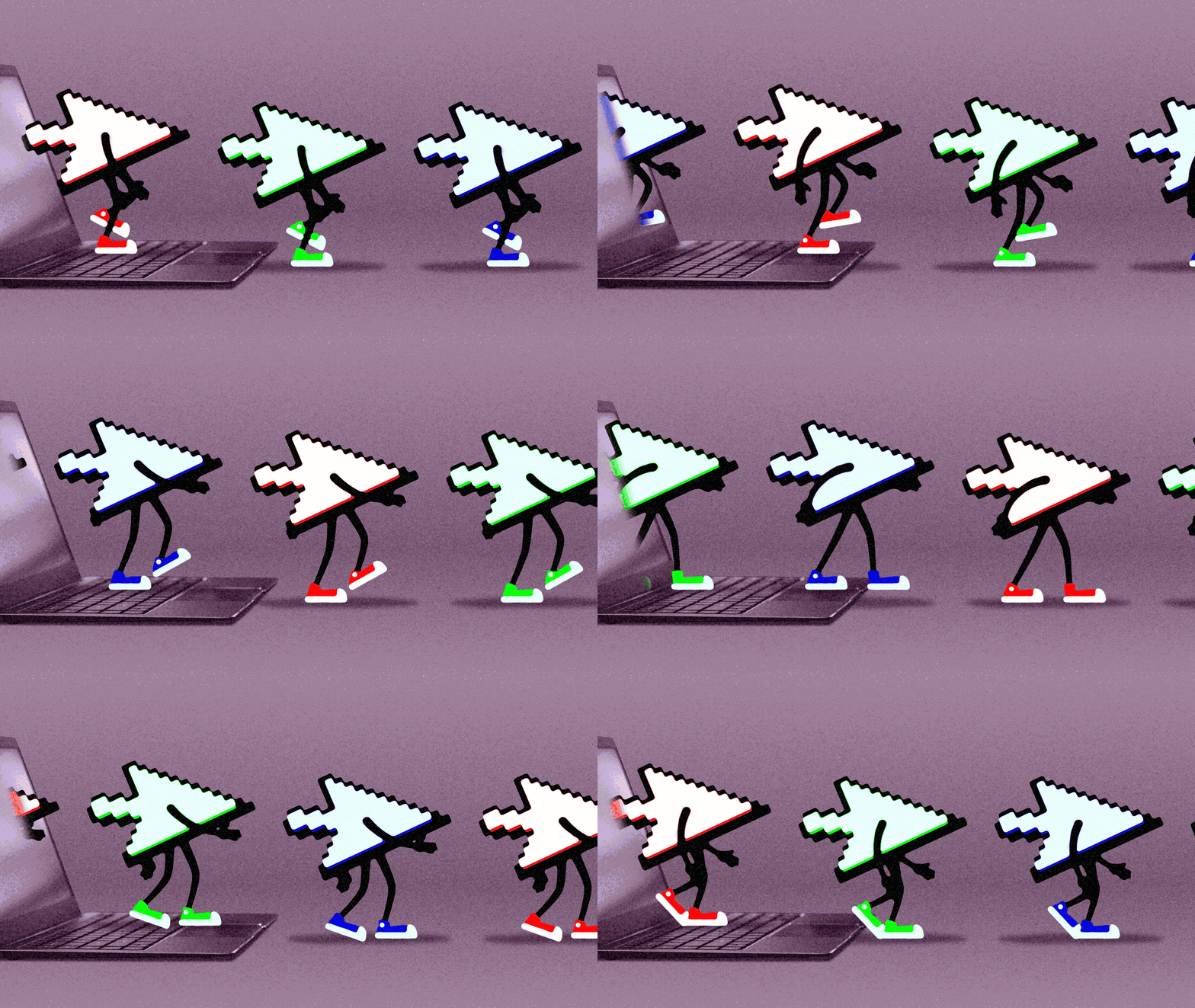
The long-promised personal AI assistant is finally arriving, with a suddenly crowded field of agents offering to run pieces of your everyday life.
Why it matters: For years, tech's "personal assistants" were little more than voice-controlled search boxes. Rapid advances in AI are finally giving them the memory, judgment and autonomy to act on our behalf.
Catch up quick: Chatbots answer questions. AI agents can actually do things — shopping, making calls, booking tickets, managing calendars and navigating the web.
- The agentic model first took off in coding and other professional work. Now it's spilling into the far more intimate terrain of everyday life.
The intrigue: OpenAI is expected to enter the market soon after hiring the creator of OpenClaw — a breakout hit among AI power users earlier this year — to "drive the next generation of personal agents."
Driving the news: A consumer-agent race has materialized almost overnight, with startups and tech giants converging on the same basic idea: persistent digital proxies that know your life.
- Instinct became an early sensation by connecting to users' email, messages, screen, audio and location — then proactively texting or calling to help run their lives. It recently added its own email addresses and the ability to make phone calls, and is now in talks for a $10 billion valuation.
- Grok Bot, launched by Elon Musk's SpaceXAI in August, gives persistent agents their own cloud computers, lets them sign into users' apps and keeps them working around the clock.
- Meta's Muse brought the concept to a broader consumer audience this month, wrapping similar autonomy in a polished app, a customizable avatar and deep integration with Meta's ecosystem.
- Apple's Siri — the grandmother of personal assistants — is finally getting its AI overhaul, bringing far more context and capability to an assistant already built into hundreds of millions of devices.
The big picture: The battle to become your personal agent is also a battle to become the keeper of your personal information and data.
- The more an agent knows about your preferences, relationships, schedule, spending and routines, the more useful it becomes.
Between the lines: Becoming someone's default agent could be one of the most valuable relationships in consumer technology.
- People are likely to share far more with an AI that manages their lives than they ever did with a search engine.
- That gives the company behind it extraordinary insight — and potentially influence — over what users see, buy, book and do.
Yes, but: Nobody yet knows what price consumers will pay for that convenience, both in terms of cost and privacy.
- Apple says some server-based Apple Intelligence features, including the upgraded Siri, will have usage limits, with expanded access potentially tied to paid iCloud plans.
- Meta is offering free and paid Muse tiers while pitching the product as more privacy-conscious than its earlier AI offerings.
2. Trump's call for "AI Force" prompts scramble


President Trump's announcement over the weekend that he's forming an "AI Force," modeled on the Space Force he launched in his first term, caught advisers by surprise, sources said.
- Officials and executives inside and outside the administration are now jockeying to be Trump's AI czar, which he said he'll name soon.
- The czar will likely be a seasoned surrogate with Silicon Valley ties who can spearhead an AI rebranding effort, the sources said.
Why it matters: The president is seeking to shift the debate over AI safety to economic grounds, emphasizing the benefits of a multitrillion-dollar infrastructure buildout. He's trying to recast advocates of a slowdown as "doomers."
Zoom in: Potential investing conflicts may lead Trump to turn to insiders, perhaps with other roles in the administration. Among the names to watch:
- Scott Kupor, director of the Office of Personnel Management. Kupor has a degree in public policy and was Andreessen Horowitz's first employee.
- Sriram Krishnan, former senior White House AI policy adviser. Krishnan also worked at a16z and carried the torch for former AI czar David Sacks inside the White House after Sacks left earlier this year.
- Chamath Palihapitiya, Social Capital founder, CEO of 8090 and co-host of the "All-In Podcast" with Sacks and others.
- Sean Cairncross, White House national cyber director. Cairncross played a role in the administration's handling of the release of Anthropic's Mythos.
- Emil Michael, Pentagon CTO and under secretary for research and engineering. Michael was the face of a high-profile fight earlier this year with Anthropic CEO Dario Amodei.
Between the lines: An issue for many candidates, especially those with industry ties, would be holdings in private companies.
Sacks, who served as a special government employee in the White House until March, took steps to divest holdings in some companies last year due to his role in the administration.
- People close to Sacks said he likely won't take up the mantle again, although he continues to wield influence through his relationship with Trump.
- Requirements for divesting holdings could rule out anyone from Anthropic or OpenAI, which are both preparing for blockbuster IPOs.
3. Google launches Googlebook to rethink laptop
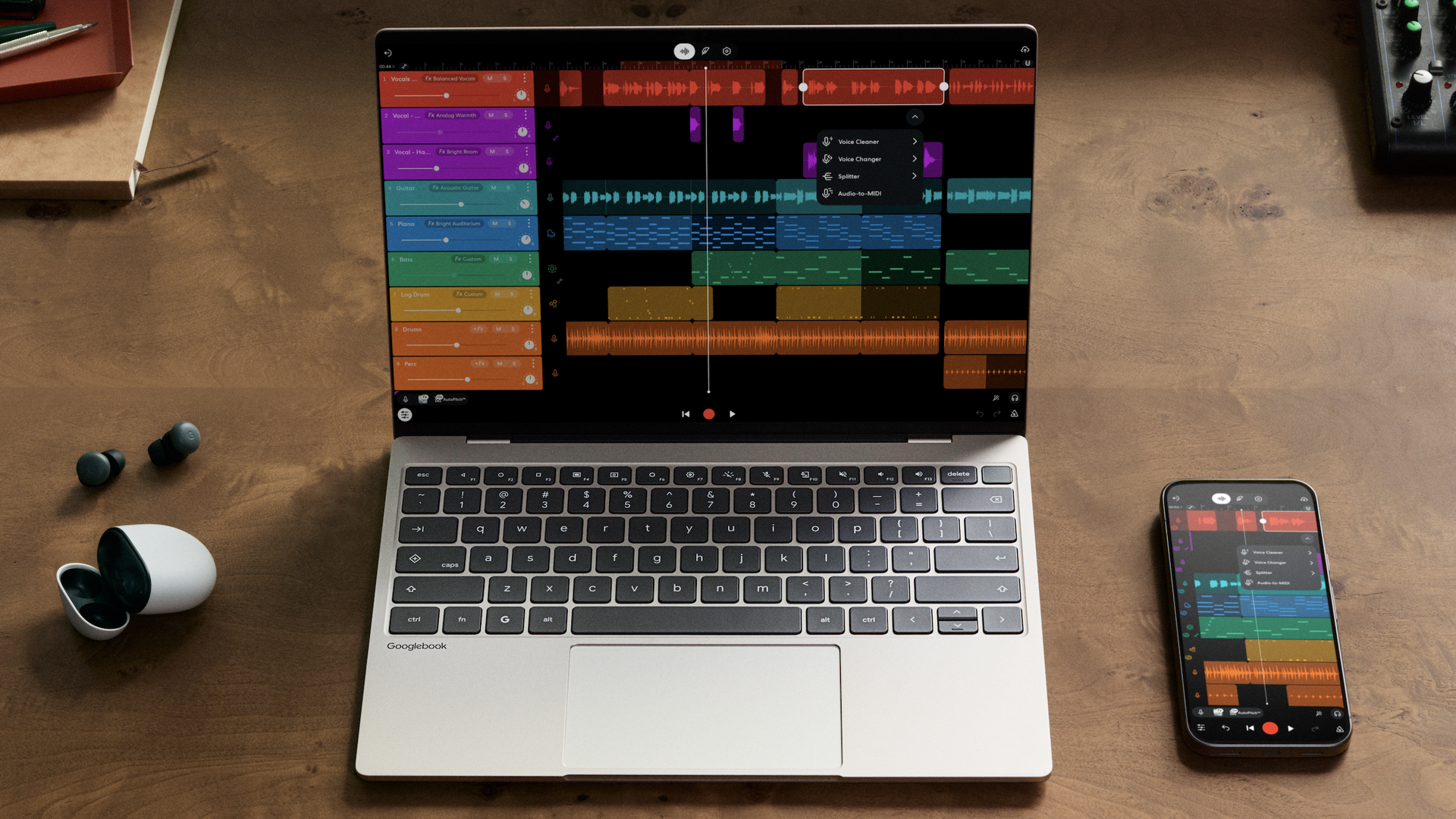
Google is launching a new line of laptops with a starting price of $899, designed for an AI world where people move constantly between phones and computers.
Why it matters: The tech giant is trying to build a laptop that works as smoothly for premium Android phone users as Apple's MacBook works with the iPhone. The goal is a seamless device ecosystem.
Googlebook, which will have a low-end price point well below the $1,299 entry-level MacBook Air, isn't meant as a Chromebook replacement or a laptop for every possible buyer.
- "The first version of Googlebook is really about building an amazing laptop for the Android community," top Android executive Sameer Samat said in an interview.
Driving the news: The company said today it is opening preorders for five Googlebooks from Acer, Asus, Dell, HP and Lenovo, with starting prices ranging from $899 to $1,299. The first devices hit store shelves Oct. 4 in the U.S.
- The partners are handling the hardware while Google controls the software experience. Samat said the approach gives consumers more choice, with different sizes, designs and form factors, while ensuring that each model works with Android phones in the same way.
Catch up quick: Google first announced Googlebook in May as something of an AI sequel to the Chromebook. The company previewed Gemini integration, Magic Pointer, Android app support, phone-file access and the ability to use phone apps from a laptop.
4. Training data

- The Department of Justice's statement supporting OpenAI and Microsoft in the New York Times' copyright infringement lawsuit surprised the Copyright and Trademark offices, sources told Axios.
- Experts warn that implementing an AI kill switch isn't as easy as it sounds. (NYT)
- Workers in maintenance and installation jobs at U.S. data centers earn considerably more than those working similar tasks at other facilities. (WSJ)
5. + This
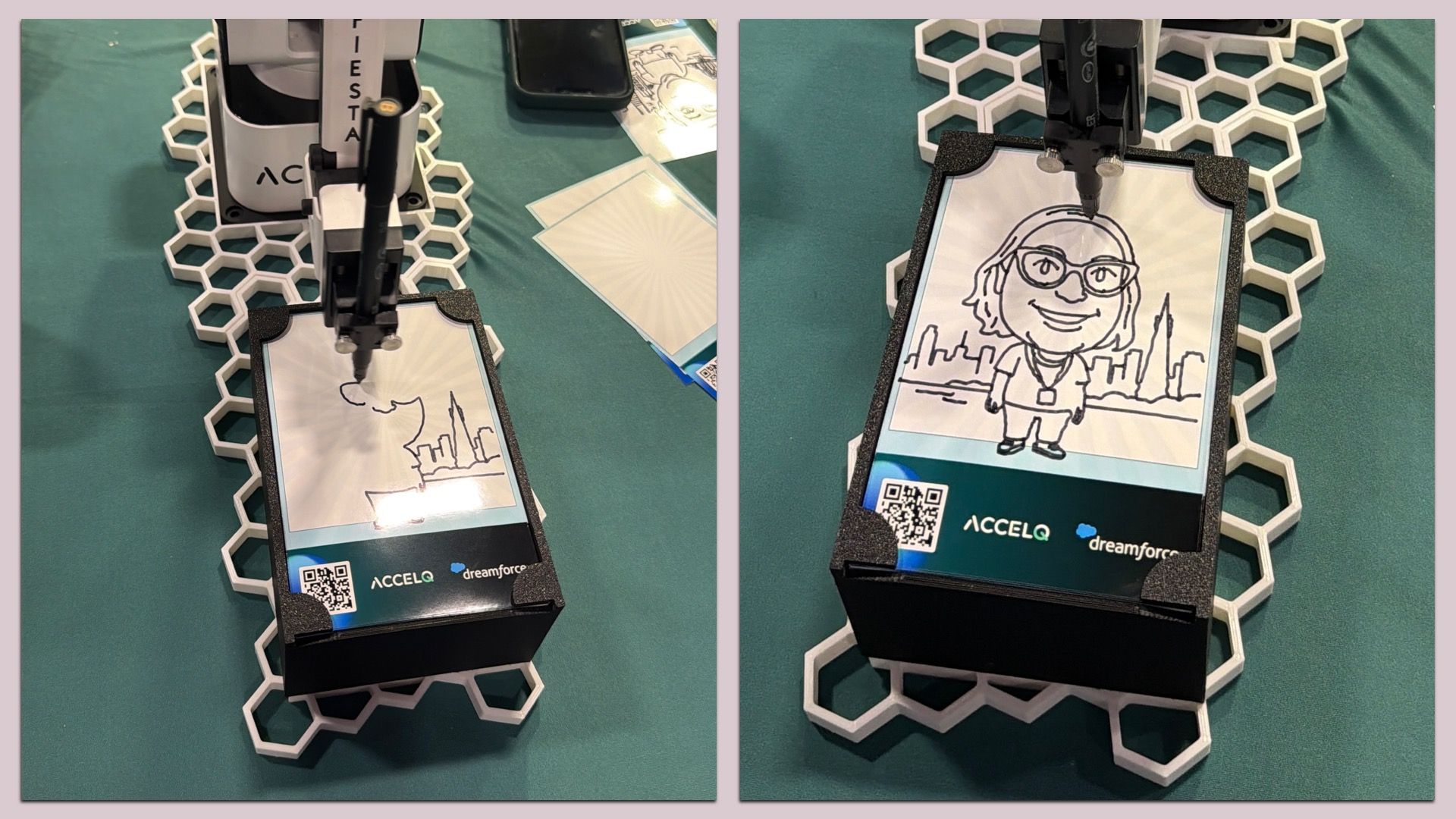
At Dreamforce I noticed a popular new gimmick to get people to visit show floor booths was this setup, which uses a robot arm to draw an AI-generated caricature.
Thanks to Bradley Olson for editing this newsletter and Matt Piper for copy editing.
Sign up for Axios AI+
