Axios AI+

May 20, 2026


🤔 Mady here wondering what defines higher-value human capital after Standard Chartered's CEO said AI wouldn't replace everybody. Just the "lower-value human capital."
Today's AI+ is 1,254 words, a 4.5-minute read.
1 big thing: Google reinvents search
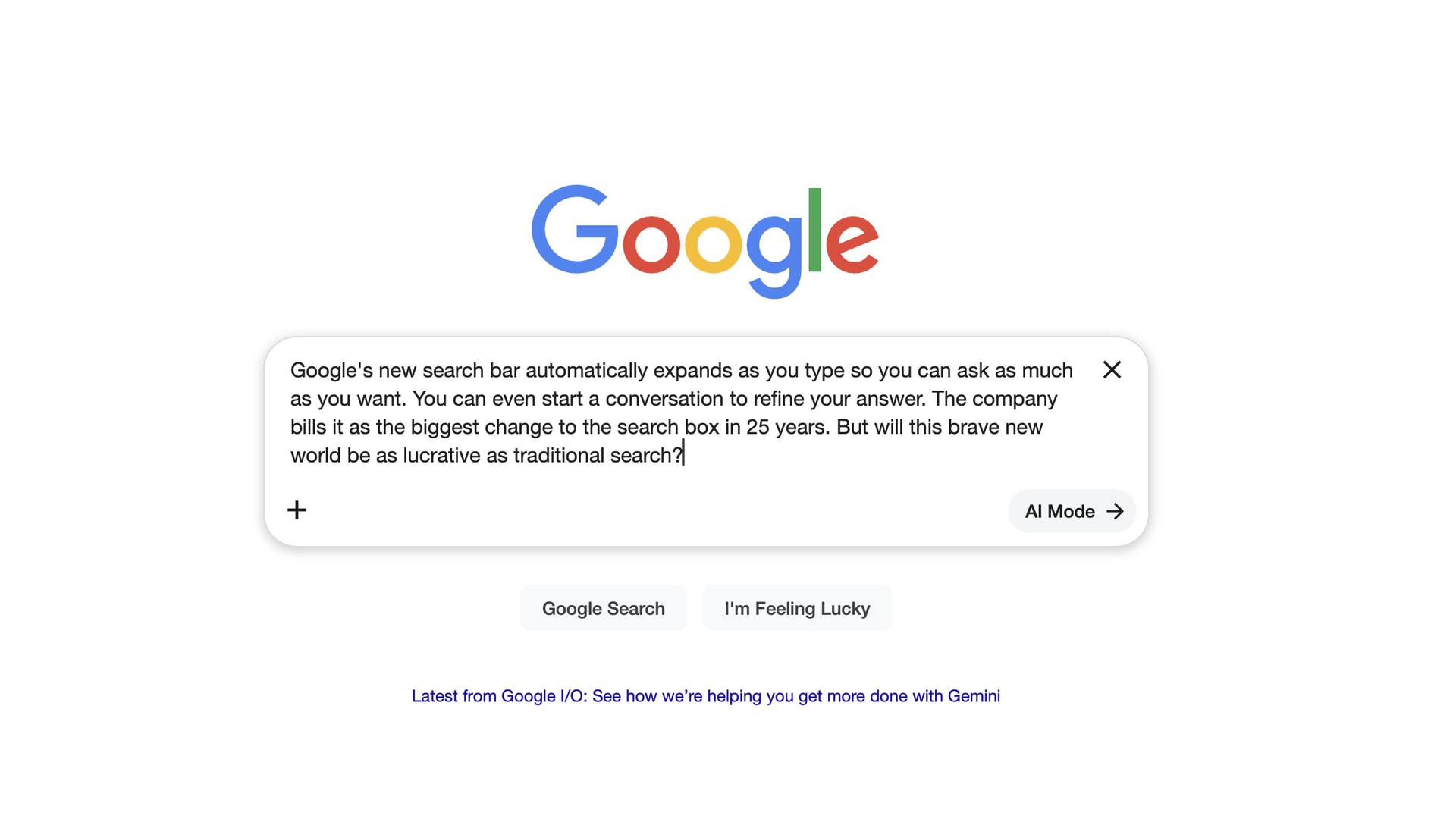
Google is reinventing the product that made it one of the richest companies in history: search.
Why it matters: Search is the cash cow that funds Google's sprawling empire. But it faces an existential threat from AI chatbots, so the company is moving proactively to upend its own core business before someone else does.
- It's also an acknowledgment that describing what you're looking for in conversational language is a better way to find information than guessing the right keywords.
Driving the news: In what it billed as the biggest change to the search box since its debut, Google announced yesterday that it is allowing the box to expand for longer queries and chat-style exchanges.
- Google has been headed in this direction for a while. It already puts AI-generated summaries at the top of search results and has a more chat-like experience known as AI Mode.
- But the company's announcement pushes that strategy much farther, signaling Google's determination to keep more users from drifting to standalone chatbots.
- As part of that effort, Google is bringing the hottest trend in AI — agents — into search. Instead of just finding out when your favorite band is coming to town, users can create a standing query that alerts them if any of the acts announce shows nearby. Similar "information agents" can help with recurring questions around shopping and news.
What they're saying: "Agents in search is the next step," Google DeepMind chief Demis Hassabis said in an interview. "One of the cool things we get to do here at Google is build technologies that get immediately deployed into multibillion-dollar products."
The big picture: Google's AI infusion goes far beyond search. It's betting that AI is breaking free from the chatbot and will find a home in virtually everything it makes, including new types of hardware, such as wearables.
- The company is putting AI wherever it thinks customers might want it. For example, a new "Ask YouTube" feature lets people ask a how-to question and get both a text answer and a video that contains the answer.
- The Gemini app has been designed for those who want to use agents for a wider range of tasks. In addition to an updated model — Gemini 3.5 Flash — Google has added Spark, a personal assistant that will eventually also be integrated into the Chrome browser and other apps.
- On the hardware front, Google is finally moving forward with AI glasses, more than a decade after the flop of Google Glass. Meta has had success here with its Ray-Ban smart glasses, and Google sees its AI and search prowess as a way to stand out from its rival.
- Google said the audio-only version of the smart glasses it is co-developing with Samsung and eyewear makers Warby Parker and Gentle Monster will be available this fall.
- The company is also giving the first hands-on look at Project Aura, the wearable device being developed with Xreal. The product is something of a tweener, with a far wider field of view than the display-equipped glasses, but less fully immersive than the Galaxy XR mixed reality headset.
- "It's a really exciting use case for where AI can get out into the real world," Hassabis said.
What's next: Hassabis says his timeline on when to expect AGI is roughly the same as he's been estimating for the past few years. Expect it in 2030, "maybe plus or minus one year," he tells Axios.
- Axios' Mike Allen interviews Hassabis on stage at Google I/O today, and we'll feature more of my interview with the Nobel Prize winner soon.
2. Scoop: Trump's executive order

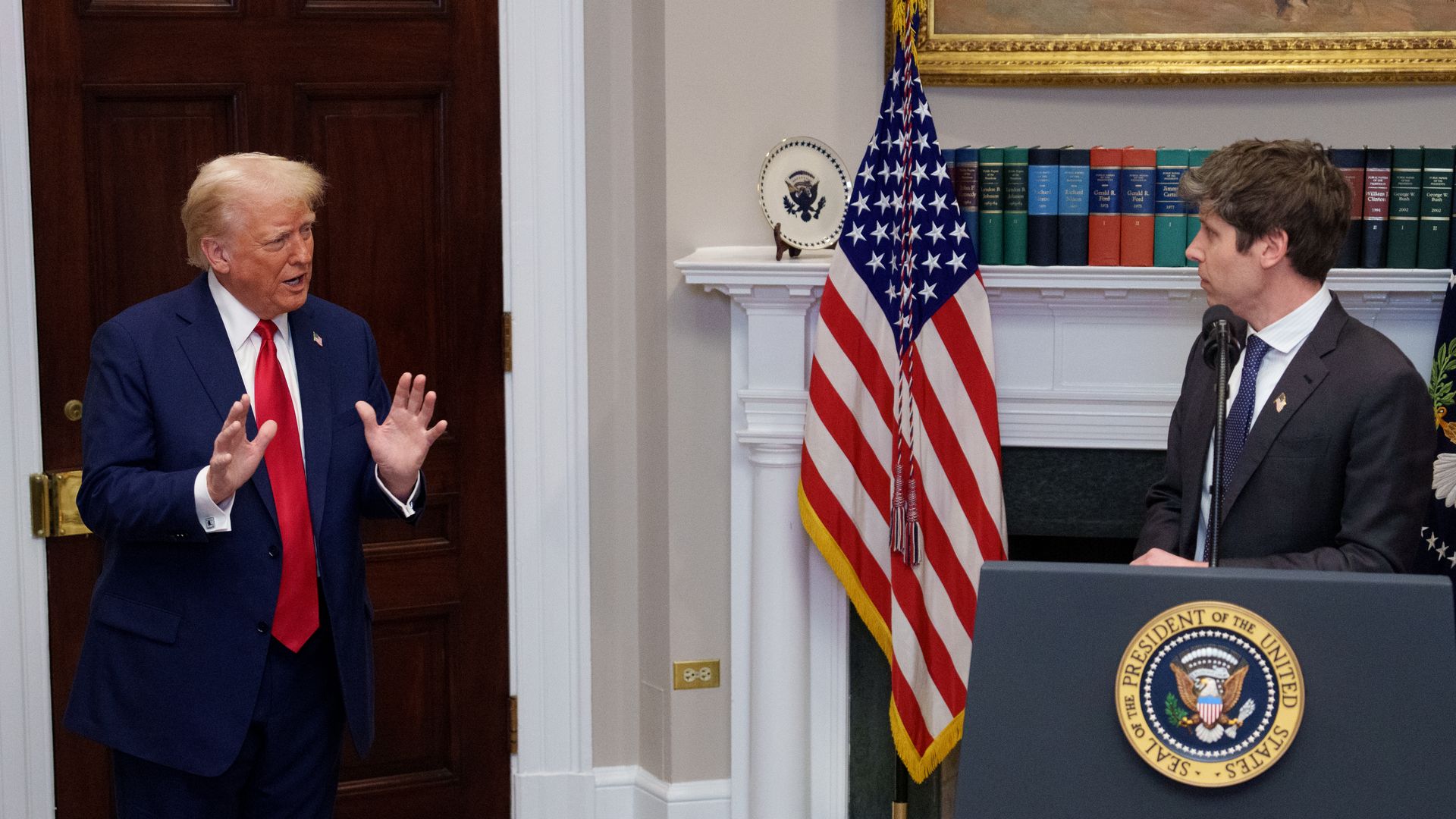
The White House plans to release its much-discussed executive order on cybersecurity and AI safety as soon as this week, sources familiar with the matter told Axios.
Why it matters: In its current form, the order seeks to bolster cybersecurity around advanced AI models and outlines plans for a voluntary framework for AI developers to inform the government about new releases, according to a readout shared with Axios and confirmed by a second source familiar with the plans.
The big picture: Should the plan work as intended, the Trump White House will have made good on its promise to address AI safety after the latest cyber-capable models like Anthropic's Mythos spooked the government.
- Still, the measures described to Axios are far short of what some more hardline voices in Washington and across the country have been pushing at a time when anti-AI sentiment is rising.
- The Mythos conundrum has softened the Trump administration's full-speed-ahead approach to AI, but the convoluted process around drafting the executive order has exposed how conflicted the administration is on the matter.
- "Any policy announcement will come directly from the president. Discussion about potential executive orders is speculation," a White House official told Axios.
What's inside: The executive order as described in its current form has at least two sections, the sources say: cybersecurity and "covered frontier models."
- The cybersecurity component aims to secure the Pentagon and other national security agencies, boost cyber hiring, shore up cybersecurity systems across the country at places like hospitals and banks, and encourage threat sharing about breaches between the AI industry and government.
- The frontier model component would involve multiple layers of government review to determine what qualifies as a "covered frontier model," and then to assess such models prior to their public release.
The intrigue: The draft, in its current form, calls for a "voluntary framework" to be established under which AI labs would share their models with the government at least 90 days before public release and also give access to certain critical infrastructure providers.
- It's not entirely clear which parts of the government would be involved in that framework, but both national security and civilian agencies appear to have roles in the EO's enforcement.
- Some details of what are expected in the order were previously reported by Bloomberg.
Between the lines: Cybersecurity was not initially a high priority for the administration. Trump significantly cut funding and staffing at the Cybersecurity and Infrastructure Security Agency, for example.
- But Mythos and OpenAI's latest model, GPT-5.5-Cyber, have raised alarm bells both inside and outside government due to their ability to find and exploit software vulnerabilities with unprecedented speed.
3. The new college graduation ritual: booing AI

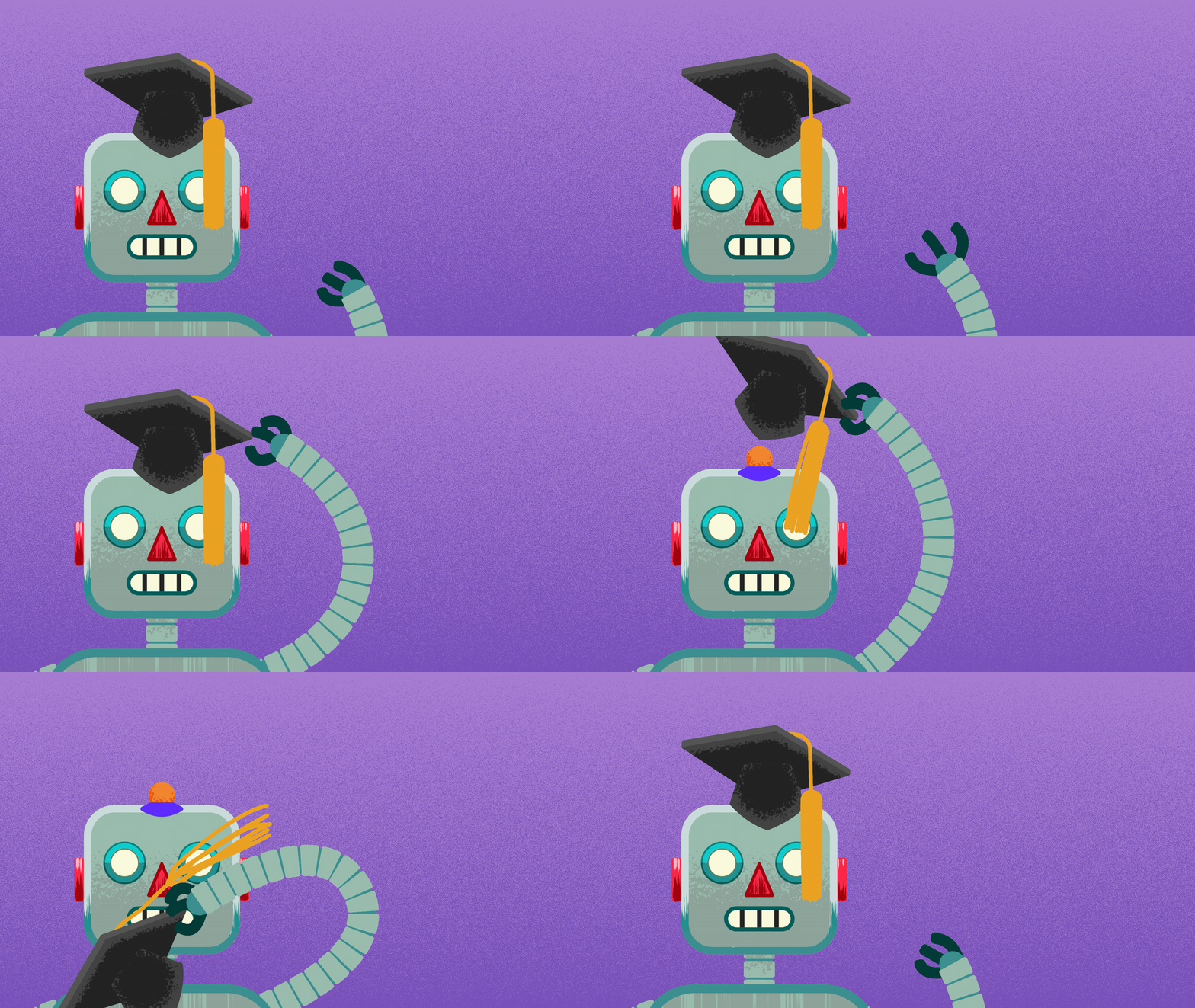
As artificial intelligence forces students to rethink their majors and reshapes the job market, it's clear that graduates don't want to hear about the technology on their big day.
The big picture: Several commencement ceremonies have been interrupted by boos and jeers when speakers have brought up AI, an indicator that while the tech is easing into many parts of life, not everyone is on board.
4. Training data
- OpenAI founding member Andrej Karpathy is joining Anthropic. (Axios)
- The Zuckerbergs are hiring what sounds like a lifeguard, but they're calling the role a "beach water person." (Wired)
- A founder gave advice on how to use AI to polish your writing without losing your credibility. (Forbes)
5. + This
After Anthropic hired Andrej Karpathy, founding member of OpenAI, timelines were flooded with jokes that celebs ranging from Sydney Sweeney to basketball star Victor Wembanyama were hired by the AI lab.
Why it matters: It sounds silly but it's also a signal of how Anthropic is being viewed in the AI race right now: as the company everybody wants to work for, even your fave athlete.
Thanks to Megan Morrone for editing this newsletter and Matt Piper for copy editing.
Sign up for Axios AI+
