Axios AI+

January 15, 2025

Ah, jet lag. I don't know whether it is yesterday or tomorrow, but whenever you are reading this I hope it is a good day. AI+ is 1,252 words, a 4.5-minute read.
Situational awareness: As the Supreme Court prepares to release a decision on a TikTok ban as soon as this morning, TikTok said it would immediately shut down the popular app on Sunday if the ban is upheld, multiple outlets reported.
1 big thing: Feds join tech firms to protect AI models


The federal government and top U.S. technology companies unveiled a new plan for reporting and trading details about ongoing security threats targeting AI models, according to materials shared with Axios.
Why it matters: Any company running an AI model in its own applications could be hacked if it doesn't properly patch newly discovered flaws.
Driving the news: A new playbook published yesterday by the Cybersecurity and Infrastructure Security Agency (CISA) includes guidance for companies on sharing information about system vulnerabilities and ongoing cyberattacks.
- The playbook is coming from the AI-focused arm of CISA's Joint Cyber Defense Collaborative (JCDC).
- Anthropic, Amazon Web Services, Google, Microsoft and OpenAI are among those who contributed to the playbook.
The big picture: Security flaws in AI systems could allow bad actors to poison models, steal confidential information and even control autonomous agents.
- "AI systems are evolving rapidly. There's no single entity that has all the information to manage AI-related risks," CISA director Jen Easterly told Axios. "This is an area where we have to work together and collaborate and share."
Zoom in: CISA's playbook, seen by Axios, includes two checklists for sharing new information, with one for reporting details about ongoing attacks and another about new vulnerabilities.
- The playbook also includes directions for various scenarios, such as reporting suspicious behavior or sharing new reports about new threat actors.
- CISA and its partners designed the playbook to be a resource for security analysts, incident responders and other technical staff.
Catch up quick: Much of the playbook was inspired by feedback collected at two AI tabletop exercises that the JCDC hosted last year.
- Microsoft hosted the first one in June in Northern Virginia, as Axios previously reported.
- Scale AI hosted another in San Francisco last fall that simulated an AI security incident targeting the financial services sector.
Between the lines: As with all JCDC efforts, companies and government agencies participate in this level of threat intel sharing on a voluntary basis.
Reality check: CISA and the JCDC's fate is unclear as the new Trump administration prepares to take office Monday.
- Republican Senate leaders have called for the agency's total elimination.
- Easterly and other top CISA officials are set to leave the agency on Monday as Trump is sworn in.
Yes, but: Alex Levinson, head of security at Scale AI, told Axios that the company plans to keep sharing intel with its JCDC partners and to assist the new agency leadership on these issues — even if this specific program is dismantled.
- "Scale didn't join this because one political party or another put it forward," Levinson said. "If policy changes, if priorities change, I don't think this work stops."
- Easterly added that only a few senior-level officials are leaving CISA, but most of the agency's 3,400 federal employees will still be in their roles next week.
2. OpenAI to fund four new Axios Local newsrooms


OpenAI will underwrite the expansion of Axios to four cities of its choice as part of a broader content-sharing and technology deal, the firms said today.
Why it matters: It's the first time OpenAI is funding newsrooms as a part of a publisher deal, although the idea isn't novel.
- Google struck a deal with McClatchy to fund the creation of three digital-only local newsrooms in 2019.
Zoom in: As part of the three-year deal, OpenAI will fund Axios' expansion into Pittsburgh; Kansas City, Missouri; Boulder, Colorado; and Huntsville, Alabama, the companies said.
- ChatGPT will use Axios journalism to answer user queries with attributed summaries, quotes and links to Axios stories. Axios can access OpenAI's technology to build its own AI products, processes and systems.
Zoom out: Axios CEO Jim VandeHei believes AI will play a key role in helping the company scale its local footprint to 100 or more cities.
- The technology won't be used to report stories, "but to help build a system for creation, distribution, and monetization of our journalism," he told employees in a memo.
By the numbers: Axios currently publishes local newsletters authored by on-the-ground reporters in 30 U.S. cities — soon to be 34.
- Those newsletters together passed the 2 million subscriber mark last year, executives told employees. The company expects five of its current local markets to be profitable this year.
The big picture: OpenAI has made deals with roughly 20 media organizations that span 160 news outlets and hundreds of content brands, it said.
- Several of those deals, like its agreements with Lenfest Institute and the American Journalism Project, focus on supporting local journalism.
- In a Wednesday blog post, OpenAI offered anecdotal evidence about how some of those investments are progressing.
- A development hub within Hearst Newspapers, for example, is using OpenAI technology to personalize local dining recommendations for the San Antonio Express-News and the San Francisco Chronicle.
Reality check: OpenAI says it wants to support a healthy news ecosystem while providing its users with quality information — but after feeling burned by tech companies, some outlets are being cautious about making agreements.
- The New York Times sued OpenAI and Microsoft for copyright infringement in 2023. That case will likely set a historic legal precedent for copyright in the AI era, but could take years to resolve.
What to watch: OpenAI has taken the lead on making deals with media publishers, but competitors are beginning to catch up.
- Meta struck a multiyear deal with Reuters last year. TollBit, a two-sided marketplace for publishers and AI companies, and Perplexity, a generative AI search engine, both announced news partners in 2024.
- OpenAI's minority owner, Microsoft, recently said it will pay news companies to feature their content in its Copilot AI assistant.
3. ChatGPT adds reminders and a task manager

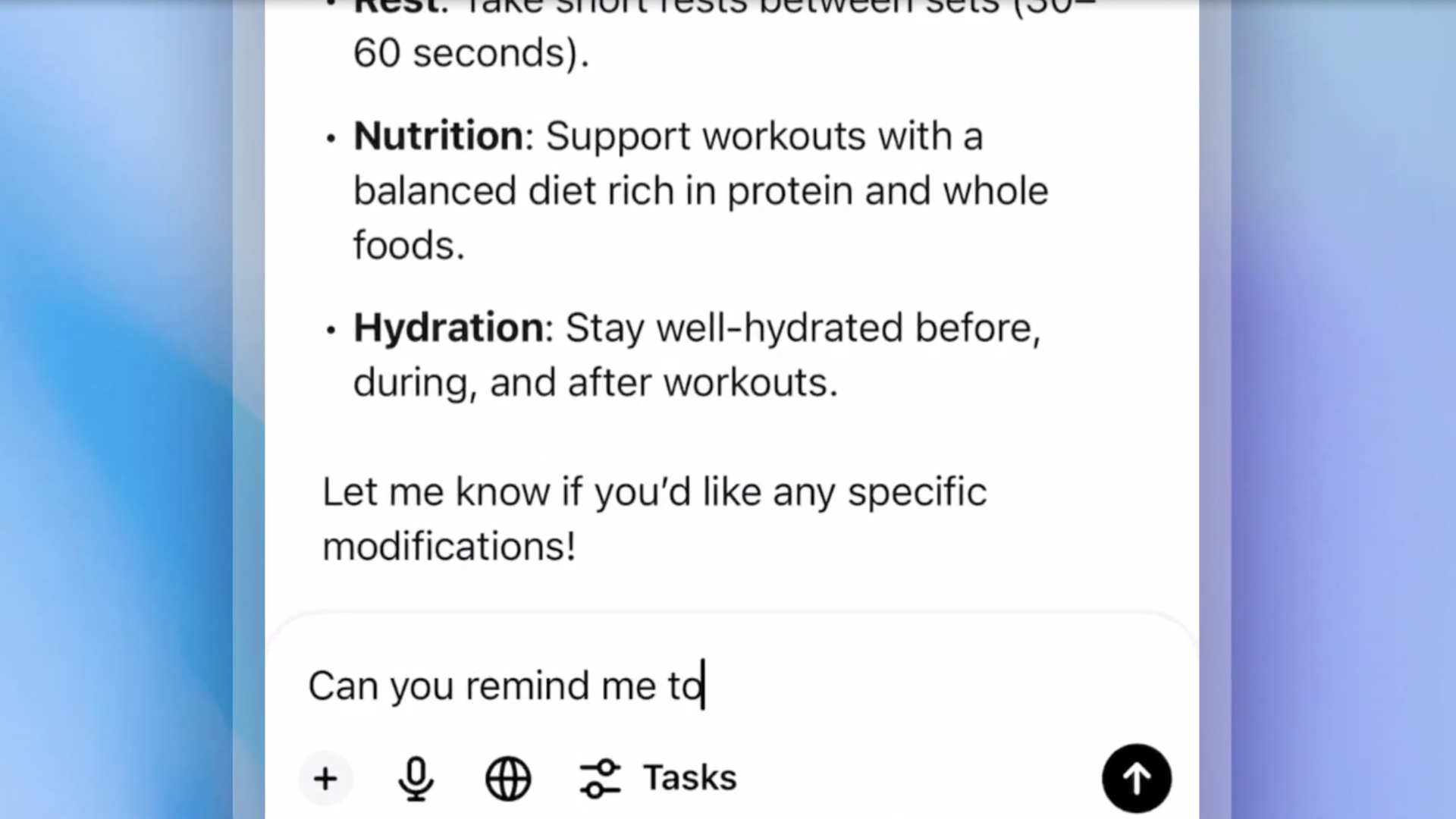
OpenAI is rolling out a beta feature called Tasks to ChatGPT that lets users schedule future actions and reminders.
Why it matters: Tasks is a step toward making ChatGPT a more helpful AI companion, reducing reliance on other apps such as Apple's Siri and Amazon's Alexa for reminders.
Zoom in: Tasks, which was made available to some ChatGPT Plus, Team and Pro users starting yesterday, lets subscribers schedule actions.
- OpenAI plans to roll out the feature to everyone with a ChatGPT account "eventually."
- If a free user asks ChatGPT to set a reminder, it suggests they use Siri, Google or Alexa.
How it works: Select the "GPT-4o with scheduled tasks" model from the menu and then send a message about what you'd like it to do and when. This will create the task.
- Some examples of tasks could be "give me a daily weather report for Queens, NY every morning at 7am" or "remind me three months from now that I have a dentist appointment at 4pm."
- ChatGPT will send push notifications on the web, desktop (macOS) and mobile. It also sends an email notification of the task.
- A user can have up to 25 active reminders at a time.
- Users can manage and name tasks by selecting the Tasks option in the profile menu on the web. ChatGPT may also suggest tasks based on a user's chats, and users can choose to accept them or not.
4. Training data
- A California court unsealed documents showing that Meta planned to use copyrighted data from book piracy site Library Genesis (LibGen) to train its open source AI models. (The Verge)
- LinkedIn is rolling out a new AI job match feature that lets users know how well they fit with any job posted on LinkedIn. (TechCrunch)
5. + This
Some medals awarded to last summer's Paris Olympians are already deteriorating. The French mint told the Associated Press that it will replace them.
Thanks to Scott Rosenberg and Megan Morrone for editing this newsletter and Matt Piper for copy editing it.
Sign up for Axios AI+
