Axios AI+

January 09, 2024

Hi, it's Ryan, coming to you from CES in Las Vegas, where seemingly everything is AI-branded but not much is conclusively AI-driven. Today's AI+ is 1,120 words, a 4-minute read.
1 big thing: AI turbocharges science experiments
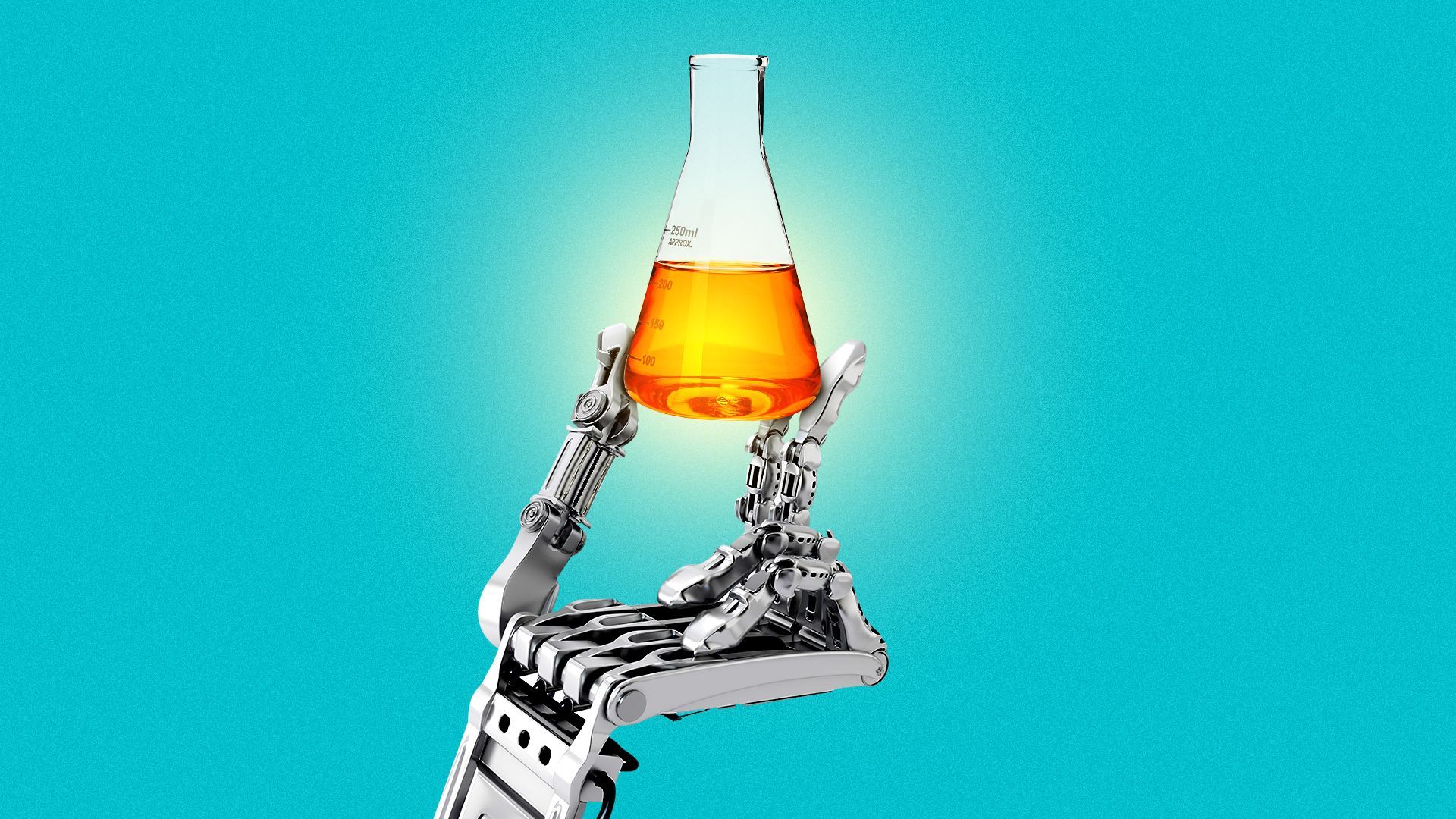
Illustration: Aïda Amer/Axios
Laboratory "copilots" and automated labs are AI's latest contribution to speeding up the development of new drugs, chemicals and materials.
Why it matters: Scientific discovery itself must speed up if the world is to address its challenges — from climate change to personalized treatments for cancer — fast enough to make a difference.
- In scientific research, "manual effort is not scalable," writes Microsoft Health Futures' Hoifung Poon in the launch edition of New England Journal of Medicine AI.
What's happening: AI has already proven useful in identifying possible new chemical and materials compounds. Now it's helping speed up and scale lab experiments.
- A new category of lab assistant — AI lab copilots — can now make suggestions for how researchers can advance their experiments. They can also spot patterns in scientific data that individual humans would be unlikely to notice.
- Noubar Afeyan, CEO of Flagship Pioneering and co-founder of Moderna, told Axios that AI lab copilots "help you do more in parallel" — and that he's aiming to go further, through AI "co-pioneering" to radically change scientific experimentation.
Ideas these copilots help shape can be tested in a new environment called cloud labs — automated labs that can be rented and controlled remotely, allowing experiments to be repeated with the push of a button.
- These experiments' results are fully traceable, helping identify errors.
- Biological and chemical samples still need to be shipped to cloud lab facilities, but nearly everything can be programmed remotely over the internet, with a small on-site staff maintaining machines and resupplying liquids to equipment.
- Strateos, a Menlo Park-based cloud lab provider, says it has been able to reduce the experimental time cycle of protein engineers at University of Wisconsin Madison from eight days to six hours by combining an "AI-driven protein design platform" with a cloud lab.
- Emerald Cloud Lab, whose staff includes many former Amazon warehouse workers, will open what its partner Carnegie Mellon University believes is the first remote-controlled university cloud lab in early 2024.
The big picture: Proponents of AI-driven research tools like copilots and cloud labs aim to compress the timeline of uncertainty that exists around experimentation and make it easier to identify the errors that have caused a replication crisis in science.
- They also aim to expand who can access top equipment by making it rentable and running it 24/7.
Go deeper: Carnegie Mellon researchers reported in December that an AI system known as Coscientist had designed, planned and executed a chemistry experiment, including chemical synthesis of compounds and the control of liquid-handling instruments.
- MIT's Zhichu Ren developed a lab assistant known as CRESt — for Copilot for Real-World Experimental Scientist — which suggests experiments, retrieves data, manages equipment and guides researchers to the next steps in an experiment.
- "It takes a lot of handholding and communication to teach a toddler to walk and one should expect the same with active learning and artificial intelligence-driven experiments," he said.
Driving the news: Health tech innovators are gathering this week for JP Morgan's annual health care conference.
- In his annual letter to investors Monday, Afeyan writes that "the nature of scientific discovery is changing and the necessary components for biotechnology company-building are diffusing globally."
Yes, but: AI systems today don't have the capacity to learn from failure, which has been the source of many human scientific discoveries.
- Penicillin, the original antibiotic which transformed medicine, was discovered through an unintended fungal contamination noticed by a human being in the lab. It took 15 years of trial and error before mass production of penicillin began in 1943.
- AI also isn't the only way to achieve personalized healthcare breakthroughs. The Mayo Clinic has pioneered the use of 3D anatomic modeling labs, which print 3D models of individual patients subject to complex surgeries and treatments.
Flashback: 2023 was a year of discovery, per Axios' Alison Snyder — and the overall trend is towards greater cross-border scientific collaboration.
What they're saying: "We have enough to do some pretty remarkable things," Afeyan said.
- "There are still monumental challenges," writes Poon, but multimodal generative AI will allow scientists to "drastically accelerate progress toward precision health."
- But the New England Journal of Medicine AI urges scrutiny: "AI must meet the same bar for clinical evidence that is expected from other clinical interventions," writes Isaac Kohane in the publication's launch edition editorial.
2. Qualcomm and IBM top the U.S. patent list

Illustration: Shoshana Gordon/Axios
Samsung remained on top of the list of companies obtaining U.S. patents last year, while Qualcomm's number of patents grew nearly 50%, making it the first U.S. company in three decades to surpass IBM, according to market intelligence firm IFI Claims.
Why it matters: Though not a direct proxy for innovation, the rankings do show trends in terms of which companies are investing in both research and seeking protection for intellectual property, reports Ina.
By the numbers: Samsung topped the list, followed by Qualcomm, Taiwan Semiconductor Manufacturing Co., IBM and Canon. Apple came in at No. 7, Intel was No. 10, Toyota was No. 12, followed by Google and Microsoft.
- IBM, a perennial patent powerhouse, received 3,658 patents in 2023, down from 4,398 the previous year—a result of what the company has said is "more selective" patenting, IFI noted.
The big picture: Overall, U.S. patents declined 3.4% and were at their lowest level since 2019.
Yes, but: Although the number of patents issued was down, patent applications are at an all time high and IFI notes that about half that number typically turn into granted patents over the course of three years.
3. Training data
- New York Gov. Kathy Hochul launched the Empire AI Consortium, to jump start AI in her state. Hochul also issued a state AI policy on acceptable government use of AI. (New York Times)
- OpenAI has responded to the New York Times' copyright lawsuit against its data training practices and model outputs, arguing that the New York Times manipulated prompts. (OpenAI)
- Fox is launching an open-source tool to help media companies better negotiate content licensing agreements with AI companies. (Axios)
- Meta has filed a new appeal seeking to block FTC efforts to prohibit the company from monetizing the data of teens. A D.C. court will hear the FTC's arguments for reopening a 2019 privacy agreement with Meta on Jan. 29. (Reuters)
- Researchers at the Center for a New American Security propose installing AI governance directly onto AI chips — hardwiring constraints such as relevant export controls or privacy rules. (CNAS)
- Sources say former Twitter CEO Parag Agrawal has raised $30M for his AI startup. (The Information)
- Longtime grievances about social media content moderation reach the Supreme Court in February with potentially dire election year consequences. (Axios Pro)
- Trading places: Ella Irwin is joining Stability AI as SVP of integrity.
4. + This
A human wouldn't survive falling out of a Boeing plane at 16,000 feet — but two phones did, including this iPhone, opened to an Alaska Airlines baggage claim web page.
Thanks to Scott Rosenberg and Meg Morrone for editing this newsletter
Sign up for Axios AI+

Scoops on the AI revolution and transformative tech, from Ina Fried, Madison Mills, Ashley Gold and Maria Curi.