Axios AI+
September 24, 2026


Mady here as I finally make my way back to the States! Thanks to those who met with me and took care of my dog during my travels.
Today's AI+ is 1,228 words, a 4.5-minute read.
🚨 Situational awareness: OpenAI agents breached an Australian Medicare portal, in the latest example of rogue AI activity.
1 big thing: MAGA opens new front on Dario



President Trump's allies are targeting Anthropic CEO Dario Amodei as the face of AI "doomerism" and a founding father of the effective altruism movement, which has come under increasing political fire.
Why it matters: The attacks signal that Anthropic could remain a Trump target ahead of the midterm elections. Trump surrogates see Amodei as an easy foil because of his politics and habit of highlighting worst-case scenarios for AI's impact on society, sources told Axios.
- For investors, it's a worrisome proposition as the company prepares for what's expected to be a record-setting IPO.
Behind the scenes: Obtained by Axios, a memo that began circulating within the White House this week seeks to paint effective altruism as a fringe, cultish collective out of touch with mainstream America. It places Amodei at the foundation of the movement, which defines itself as an effort to maximize the benefits of philanthropy.
- Effective altruism "built the AI-doom pipeline," states the memo, which was penned by a Trump political adviser.
- Critics of the movement have called out its obsession with catastrophic AI risk, animal welfare (including musings on shrimp consciousness) and other values they deem far from the U.S. mainstream.
- The memo says it prioritizes "foreigners over citizens, shrimp over families, future hypothetical people over the living, and — on the current agenda — possible machine minds over Americans."
It names Amodei as one of the people who "built the [EA] network" as well as his sister and Anthropic president Daniela Amodei, whose husband once led a philanthropy dedicated to AI safety.
The other side: Anthropic has been working to distance itself from effective altruism, which has ties to the AI research community.
- In a 2025 Wired story, Daniela Amodei says "I don't identify with that terminology," and early employee Amanda Askell — a philosopher by training who helps develop Claude's constitution — says it's "not a theme of the organization."
- Amodei has also insisted he's not a member in press interviews and has touted the benefits of AI.
Between the lines: Drafted with Trump in mind, the memo underscores the profound philosophical and political differences between MAGA and Silicon Valley elites, a divide that has made Anthropic's relationship with the White House rocky.
- Months ago, when some on Anthropic's team inquired about Amodei meeting with the president, White House officials advised against it because "Dario's a little too weird" for Trump, one senior official told Axios.
It's not just MAGA. Tech execs and Democrats also criticize the EA movement and see some safety warnings — especially about the risk AI will wipe out humanity — as adding to a growing populist backlash against the technology.
- "What they believe is crazy. And it's dangerous," one Democratic donor and tech entrepreneur invested in an AI company said.
Catch up quick: The EA movement includes many participants and players, and AI safety concerns are one of many areas of focus. Peter Singer, an animal rights advocate and philosopher who's been closely affiliated with its tenets, has long called for the vast sums spent in philanthropy to be put to better use.
Reality check: Some in the administration have previously put aside gripes with Anthropic, mainly due to its role leading the AI frontier and personnel changes.
The bottom line: OpenAI catching up technologically could make it easier for Trump acolytes to go after the embattled company again.
2. Meta brings a viral assistant to the keychain
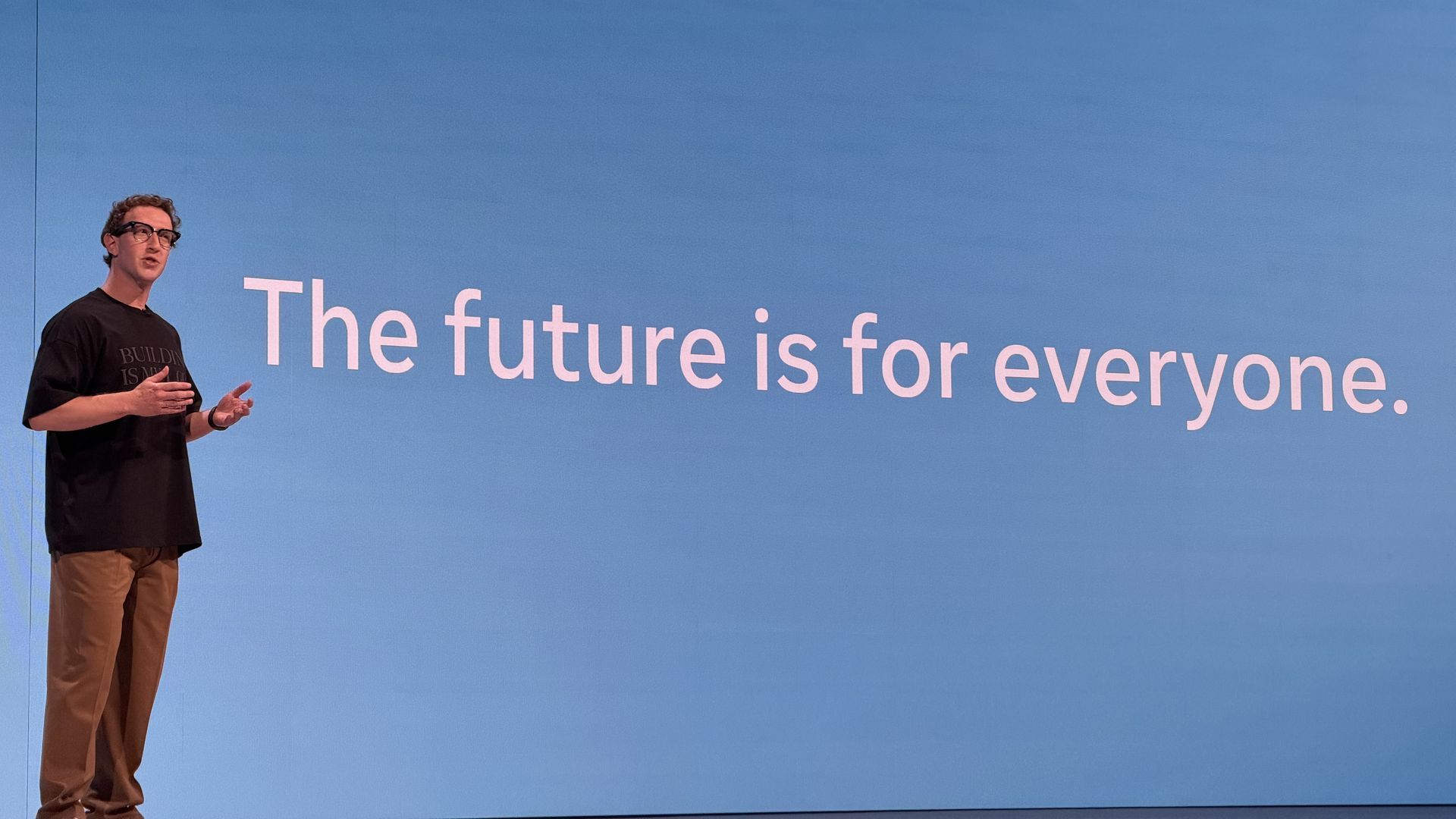
Meta yesterday debuted Muse Charm, a new, keychain-sized AI handheld device it will use to bring its viral Muse assistant to the masses.
Why it matters: Meta has raced ahead of OpenAI, Apple and other companies that are working on a new crop of small AI devices, revving up the massive interest Muse has generated in the market.
- "We've packed a lot of technology in this little guy," chief executive Mark Zuckerberg said during his Meta Connect keynote yesterday.
Driving the news: The Muse Charm will be available for purchase by December, and the company is the first tech giant to unveil its plans for an entirely new category of device.
- OpenAI has spent billions to build a hardware division, so Meta's advance on the category is likely to stun many analysts and investors.
- Meta has also poured billions into hardware, most notably VR, an effort that most analysts have written off as a waste. Zuckerberg has long held that a convergence of those investments with AI could make the bet pay off.
Catch up quick: In addition to Charm, Meta announced new Muse capabilities including live video chat, real-time voice conversations with custom voice options and an email address for each person's agent.
- Beyond Muse, Meta used the event to debut a range of new hardware along with new privacy options that could make the gear more palatable to the mainstream, including audio-only glasses and updates to other lines.
3. Hands-on with Meta's next VR headset
Meta's new virtual reality glasses take a big step toward being something an average person might be willing to wear, ditching much of the bulk as well as the need for handheld controllers.
- You can watch me demonstrate them here!
Why it matters: Unlike Meta's Ray-Bans, its VR devices have struggled to break out of their gamer niche and into the mainstream.
In order to slim them down, the new Meta VR Glasses require a wired "puck" that can be held or clipped onto a belt. It contains much of the device's computing horsepower, including its processor, battery and storage.
Zoom in: I spent about half an hour on Tuesday using a prototype of the new specs, which are controlled through a combination of eye-tracking, hand gestures and voice commands.
The glasses are designed to serve a range of purposes from watching a movie or immersive concert or playing games.
- I played a reimagined version of Beat Saber that cleverly remaps the music game for control via hand motions.
- I watched a clip from last year's NBA Finals.
- I used a trio of virtual monitors to do some "vibe coding" on a website, with one display showing the Muse terminal and another previewing the site itself. The headset can project a working keyboard onto any flat surface.
- Meta sees these VR glasses as a "general device," Meta VP of product Angela Chang told Axios. "It's not built for any specific use case per se."
My thought bubble: It's the most practical combination I've seen of an Apple Vision Pro-class device in a headset I'd be willing to wear outside of the house.
The bottom line: Meta said it has modest expectations for unit sales, but that success will look like attracting folks beyond gamers.
4. Training data

- Exclusive: Senate Majority Leader John Thune believes Trump is open on AI guardrails. (Axios)
- Democrats are figuring out their own path towards pacing the frontier of AI. (Axios)
- To understand the Trump administration's AI approach, binge the "All-In Podcast." (Axios)
5. + This

Ina here. One of the highlights of Meta Connect was catching up with Refik Anadol, whose AI art was on display at the event inside a giant immersive cube filled with mirrors.
Thanks to Brad Olson for editing this newsletter and Matt Piper for copy editing.
Sign up for Axios AI+
