Axios AI+
October 06, 2025

Today I'm at OpenAI's demo day. Meanwhile, on "The Axios Show," bestselling self-help author Mel Robbins explains to Axios CEO Jim VandeHei how people can keep their sanity in a world of chaos. Watch the clip and subscribe to our YouTube.
Situational awareness: OpenAI announced a massive deal with chipmaker AMD, in which OpenAI will spend up to "tens of billions" in return for gigawatts of AMD computing power and up to a 10% stake in the company.
Today's AI+ is 1,192 words, a 4.5-minute read.
1 big thing: OpenAI's big Sora test
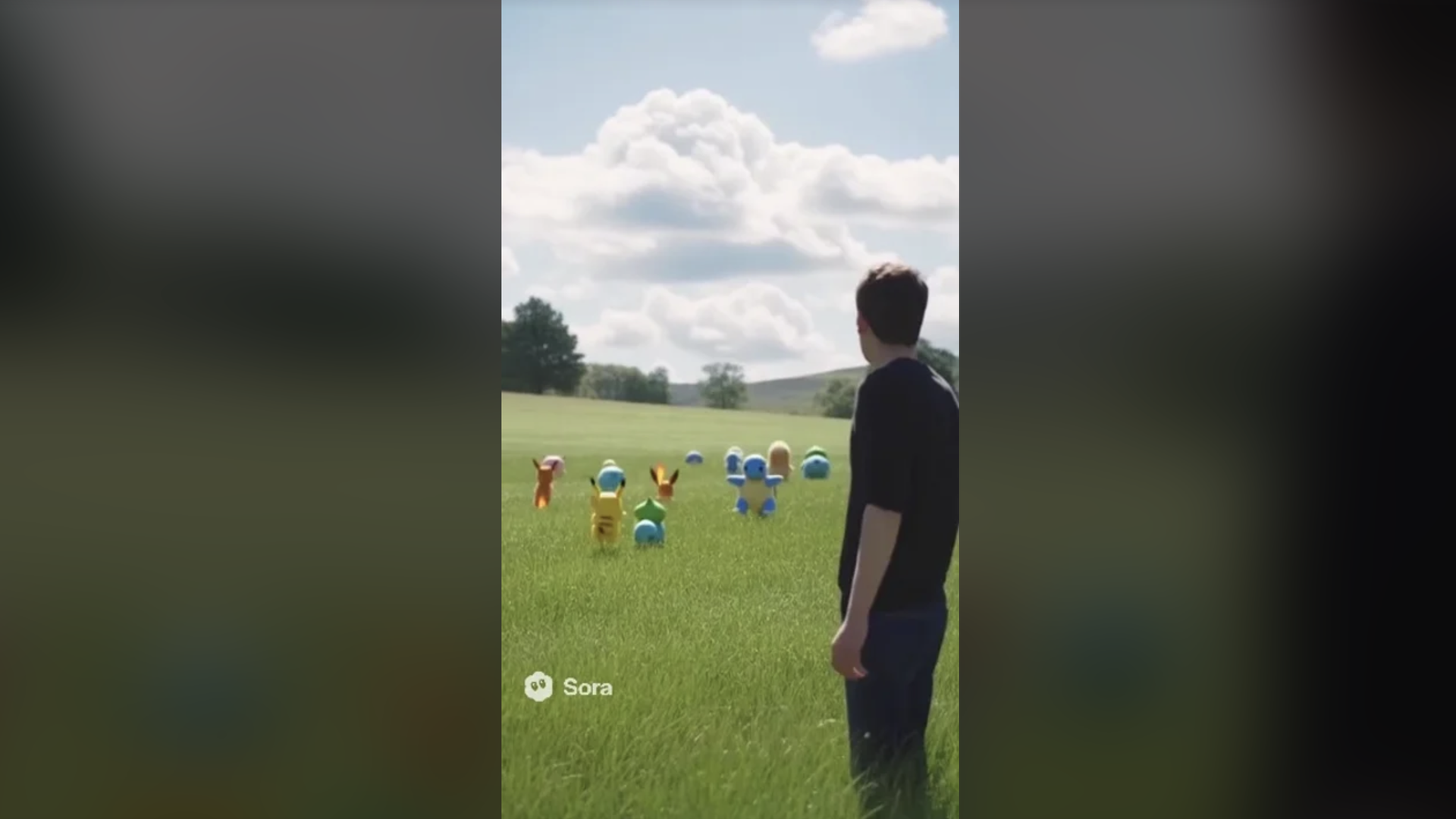
OpenAI's new Sora app is sparking intense reactions — delighting some users and alarming others who see it as another tool undermining truth and human creativity.
The big picture: Despite the polarized response, the Sora moment is likely to be another step in society's grudging adjustment to AI, akin to past reactions to ChatGPT's image generator and, three years ago, to the debut of the chatbot itself.
Driving the news: The Sora app, released last week, has risen to the top of Apple's App Store rankings, even as access to video generation remains by invitation only.
- In a late Friday blog post, Sam Altman said that the company is going to "give rightsholders more granular control over generation of characters," likening it to the way that individuals can choose how their own likeness is used in Sora.
- The company said it needs to monetize video generation.
- That could be a subscription model or an advertising model or both, with some revenue shared with copyright holders who allow their creations to be included.
- Altman did not offer timing or further details of how any of this will work, and OpenAI declined to comment beyond the blog post.
Catch up quick: Sora allows people to generate videos that mimic nearly any genre, including copyrighted content from movies and TV shows.
- The app allows people to describe a video they want and insert an AI version of themselves or their friends (with permission).
- Although Sora videos are labeled as AI-generated with both visual watermarks and digital content credentials, many see the app as a supercharger of effortless deepfakes.
- Among the early examples that have gone viral are clips of Sam Altman shoplifting GPUs from Target and another that has Altman watching a series of Pokemon march by, with Altman saying he hopes Nintendo doesn't sue.
What they're saying: Some users have been thoroughly enjoying the viral video tool, while others say it's a glorified slop spreader.
- Creating an instant meme maker seems at odds with Altman's "Abundant Intelligence" blog post last month that said without more compute the company might have to choose between curing cancer and teaching children.
- OpenAI's focus is centered on research efforts and the quest for AGI, Altman responded, but "it is also nice to show people cool new tech/products along the way, make them smile, and hopefully make some money given all that compute need."
Between the lines: By releasing Sora before coming to terms with copyright holders, Altman is allowing creators to see the potential market in action before deciding their approach.
- Altman warned of a bumpy road ahead. "Please expect a very high rate of change from us; it reminds me of the early days of ChatGPT," he wrote. "We will make some good decisions and some missteps, but we will take feedback and try to fix the missteps very quickly."
The bottom line: As with disruptive tech of decades past (Napster, Uber, Airbnb), the "ask forgiveness, not permission" ethos that powered the web's previous waves is back, this time moving at the speed of AI.
2. The jobs crisis is bigger than AI

New research shows that for all the hype, AI hasn't reshaped the job market yet.
Why it matters: Companies are spending big on chips, data centers and talent, but hiring weakness owes more to economic conditions and government actions than automation.
- Job seekers are struggling, especially entry-level applicants, but sluggish demand, inflation and restructuring are still bigger factors.
Zoom out: In the 33 months after ChatGPT's launch, researchers found no discernible disruption to the broader labor market, according to a report this week from the Budget Lab at Yale, a nonpartisan policy research center.
- Yale researchers measured "occupational mix" — the distribution of workers across occupations — and found that it looked similar to the birth of the PC in the 1980s and the early internet in the 1990s.
By the numbers: So far this year, job losses due to "technological updates" are far less than other factors, according to a report last Thursday from Challenger, Gray & Christmas.
- 20,219 jobs were lost as a result of "automation and possibly AI implementation" in 2025 through September, per the firm, which has tracked layoffs for decades.
- Just 17,375 cuts in 2025 have been explicitly linked to AI.
- In the same period the report attributed 208,227 lost jobs to "economic conditions" and another 293,753 cuts to "DOGE actions."
Between the lines: The numbers reflect what current AI tools can accomplish in comparison to humans.
- An OpenAI report released last month shows that today's leading models are approaching parity with human professionals on many tasks, but the results don't capture the cost of human insight required in a real-world setting.
- AI's productivity gains are likely to come as a complement, not a replacement, for most workers, OpenAI chief economist Ronnie Chatterji told Axios.
What they're saying: Economic leaders at the highest levels also have doubts.
- Federal Reserve chair Jerome Powell expressed "great uncertainty" at a recent press conference that AI is creating a lower labor demand.
- "I think my view — which is also a bit of a guess, but widely shared I think — is that you are seeing some effects, but it's not the main thing driving it," Powell said.
- "It may be that companies or other institutions that have been hiring younger people right out of college are able to use AI more than they had in the past," Powell said. "It's also part of the story, though, that ... job creation more broadly has slowed down. The economy has slowed down."
What we're watching: Deploying AI to replace entry-level workers could put us in a pickle down the road, especially in a world where humans work alongside AI.
- If workers can't get a foot in the door, they'll never make it up the ladder, and eventually that could mean that the bots outsmart us.
- "You cannot supervise an intern if you are less skilled than the intern," Stanford computer science professor Jure Leskovec told Axios.
The bottom line: So far, changes are incremental, not catastrophic.
Go deeper: AI job anxiety: It's real, and coming at the worst time
4. + This
For their home playoff games, the Philadelphia Phillies are offering a combo of nine mini hot dogs and nine beers so fans can enjoy one per inning.
- That 9-9-9 sounds so much better than the tech industry's 9-9-6, IMO.
Thanks to Scott Rosenberg and Megan Morrone for editing this newsletter and Matt Piper for copy editing.
Sign up for Axios AI+
