Axios AI+
March 11, 2026


Thinking about the responses to this quiz on whether people prefer human or AI writing.
Today's AI+ is 1,011 words, a 4-minute read.
1 big thing: Google rising
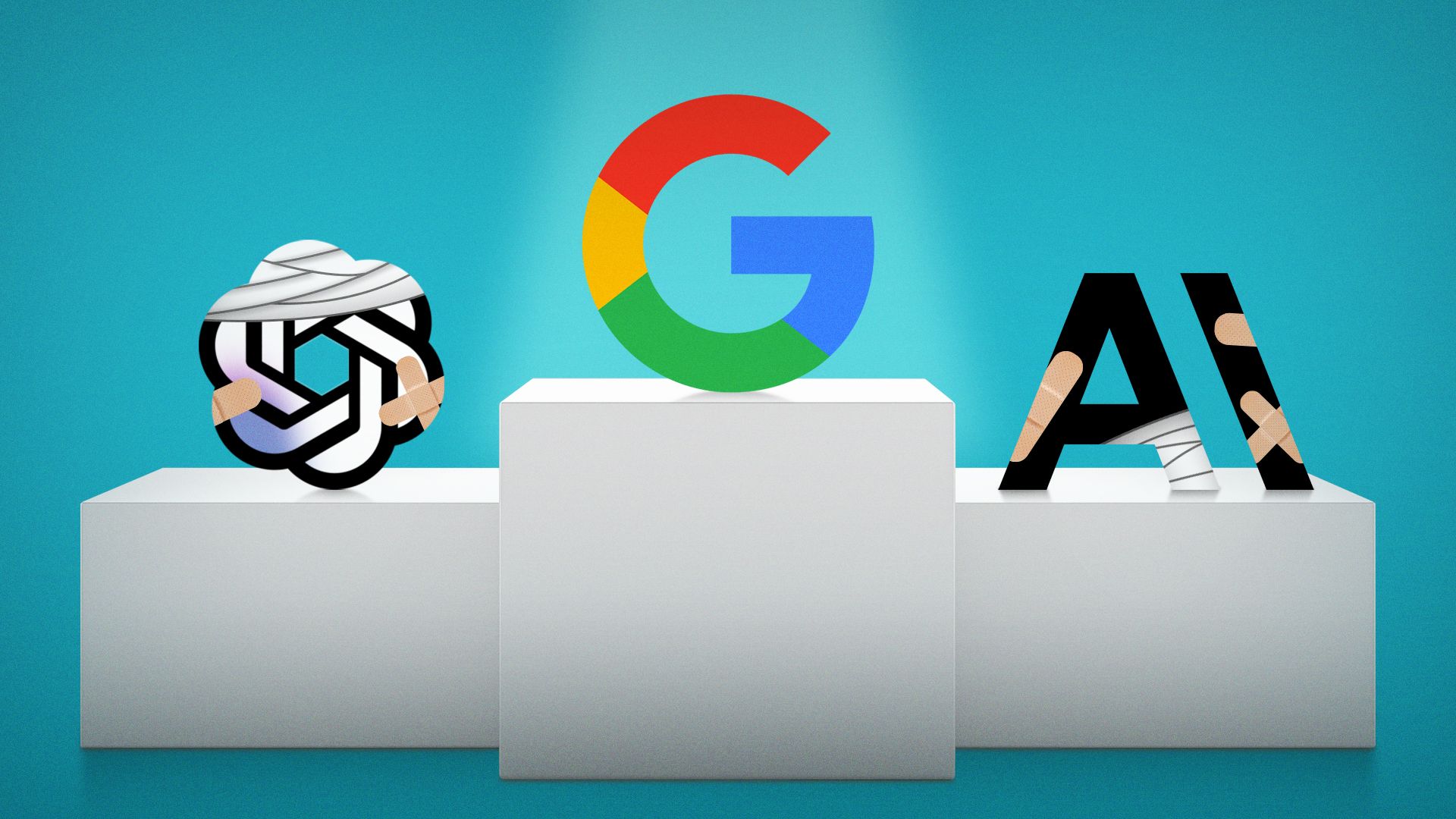
Google is quietly expanding its Pentagon work and growing users faster than rivals as Anthropic and OpenAI publicly feud over a contentious Defense Department contract.
Why it matters: Winning the AI race may depend on knowing when to stay out of the scuffles.
What they're saying: "When you have two major companies fighting each other, it is a good distraction for another company to come in and learn from their mistakes and just go all the way to the top," PitchBook's Harrison Rolfes tells Axios.
State of play: Google is set to provide AI agents to the Pentagon's 3 million-person workforce for unclassified work, according to Bloomberg.
- The news comes just one day after rival AI lab Anthropic sued the Pentagon for classifying the firm as a "supply chain risk," a designation sparked after a contract between the two fell apart over safety disagreements.
- OpenAI ended up landing the $200 million government contract, sparking backlash from consumers over safety concerns.
- Over 30 employees from OpenAI and Google signed an amicus brief in support of Anthropic.
Between the lines: Google largely stayed out of that entire tête-à-tête.
- "OpenAI looked opportunistic. Anthropic got blacklisted. Google gained the most ground and nobody's talking about it," Patrick Moorhead, CEO of Moor Insights & Strategy, told Axios.
- This comes after Google has already been steadily gaining its AI mojo back.
Yes, but: Google DeepMind's own chief scientist, Jeff Dean, signed the brief supporting Anthropic, and employees wrote letters to executives asking for broader support for Anthropic's safety goals.
- This shows Google isn't immune to the same internal dynamics pressuring its rivals.
Follow the money: The difference is that Google has the cash reserves to take bigger hits than OpenAI or Anthropic.
- Defense AI is "immaterial" to Alphabet's over $400 billion annual revenue base, but Moorhead also said the company needs to diversify its revenue away from consumer advertising to "balance the business."
- Anthropic is projected to break even by 2028, and OpenAI by 2030, according to The Information, though Rolfes adds that OpenAI doesn't offer much detail on how they'll achieve that.
Flashback: This isn't Google's first time facing this dynamic.
- Netscape and Microsoft defined the browser wars of the 1990s while Google was building its search business.
What we're watching: The AI race is far from over.
- Claude grew paid subscribers by over 200% year over year, Gemini 258%, with roughly 20% of weekly ChatGPT web users also using Gemini in a given week, according to January YipIt data compiled by a16z.
- OpenAI and Anthropic are "essentially cannibalizing each other," keeping prices low to take market share from one another, Rolfes said.
- While many enterprises are paying for subscriptions at both AI labs, neither is profitable.
- Google is "most lined up to take that top spot" as the infighting continues.
2. OpenAI bets on union labor for construction

OpenAI is partnering with North America's Building Trades Unions as it ramps up U.S. data center construction.
Why it matters: OpenAI's AI ambitions depend on legions of skilled construction workers to build new data centers.
The big picture: OpenAI will announce a partnership today with NABTU, per an announcement shared with Axios.
- The deal aims to ensure AI infrastructure projects support union jobs, expand apprenticeship programs and create local economic opportunity, per the statement from OpenAI.
Driving the news: The move comes as CEO Sam Altman speaks today at BlackRock's infrastructure summit.
- He is expected to talk about compute and energy infrastructure needs for the AI industry.
- Altman will make the announcement with NABTU president Sean McGarvey.
It's the second time OpenAI has formally partnered with a union.
- Last summer, the company launched the National Academy for AI Instruction with the American Federation of Teachers.
What they're saying: To reach 10 gigawatts of compute by 2030, OpenAI will need 20% more tradespeople than exist today, Chris Lehane, OpenAI's chief global affairs officer, told Axios.
- "It's imperative for us to have this workforce to be able to continue to build out at the speed and pace that we need to build out, particularly with the global competition with China," Lehane said.
By the numbers: OpenAI has committed $1.5 million over five years to support NABTU's training and recruitment program, Lehane said.
What we're watching: AI companies need construction labor to scale their infrastructure.
- At the same time, large data centers face mounting scrutiny over power consumption, water use and local impact.
The bottom line: As it pushes to expand compute capacity, OpenAI is aligning its buildout with organized labor — and making the case that AI infrastructure also means jobs.
3. Anthropic ramps up its D.C. presence


Anthropic is expanding its footprint in the nation's capital ahead of the midterms, according to company plans shared with Axios.
Why it matters: AI companies are spending heavily and expanding to Washington to influence the policies that will define the technology's future.
Driving the news: Anthropic is tripling its policy team and opening a permanent office in D.C. this spring to engage policymakers and think tanks long term.
- Expect Anthropic to continue advocating for export controls on advanced chips, a "clear" federal AI regulation framework, energy ratepayer protections and model transparency, a spokesperson said.
4. Training data
- Niantic Spatial is using data gathered from building Pokémon Go to help delivery robots navigate the world. (MIT Tech Review)
- Scoop: A metadata company owned by Nielsen is suing OpenAI for copyright infringement. (Axios)
- Microsoft filed a brief supporting Anthropic in its battle with the Pentagon. (CNBC)
- AI agents are wasting the time of the volunteers keeping open-source software running and secure. (Axios)
- New data shows that the chatbots are using LinkedIn as one of their top information sources. (Axios)
5. + This
I love this faux terminal app that developer and hackathon veteran Mei Park made for her 3-year old. "He types whatever he wants, it responds with fun messages," she wrote on X. "No ads, just keyboard practice and cause-and-effect thinking. He thinks he's hacking."
Thanks to Megan Morrone for editing this newsletter and Matt Piper for copy editing.
Sign up for Axios AI+
