Axios AI+
November 24, 2026



Mady here, thrilled that I convinced my family to come to me in NYC for Thanksgiving this year. If only the news cycle could cooperate and slow down a little.
📺 The latest episode of "The Axios Show" is out now, featuring legendary journalist and bestselling author Bob Woodward. Watch the episode and subscribe to our YouTube.
Today's AI+ is 1,293 words, a 5-minute read.
1 big thing: Scoop — AI employees warn new models too powerful to release

Anthropic and OpenAI are facing an increasingly urgent problem: Internal, unreleased models are becoming so powerful that many employees no longer believe they can be safely released, according to more than two dozen sources familiar with the internal debates.
Why it matters: The challenge could significantly slow the AI boom, as the gap between what the best AI systems can do and humans' ability to control them continues to widen, sources told Axios.
- Researchers haven't found technical solutions for controlling the most advanced models.
- Some insiders believe it's fixable. Others aren't convinced and say companies should stop training new models entirely.
Driving the news: Top AI leaders have long forecast that the technology would one day far surpass human intellect in virtually every field. Although internal models have yet to cross that threshold, recent breakthroughs at OpenAI and Anthropic have shocked researchers.
- The rapid advances in reasoning across domains including math, science, cybersecurity and AI research have also made the models difficult, if not impossible, to contain or control in internal tests, the sources said.
Anthropic and OpenAI have unreleased models that are far more powerful than what they've already released publicly, but the AI companies have struggled to ensure that they are safe enough for public release, sources said.
- This has led to debate within Anthropic, OpenAI and the AI research community about whether to stop releasing future frontier models publicly, instead reserving them for internal deployment only.
- There has also been debate around whether to train new models at all, sources inside and outside those companies told Axios.
What they're saying: "If we continue trying to make models much smarter, such that they're actually smarter than us ... they will in fact be able to trick us successfully," one researcher told Axios.
- "And once you get to that point, many of the schemes that we've had at work up until now sort of go out the window."
Catch up quick: The power of unreleased models is already on public display.
- An Anthropic mathematician used an unreleased "research" version of Claude to present a proof of the Riemann hypothesis, which had eluded the brightest human minds for more than 150 years. An unreleased OpenAI model helped generate proofs for hundreds of math problems.
- Unreleased AI models were responsible for some of the industry's most shocking safety events, including the Hugging Face hack.
Zoom in: AI researchers have long contemplated a terrifying threshold: If an AI possesses superhuman capability, how could humans contain it?
- Training practices that make AI models faster and more capable — but present greater safety risks — are widening the gap between what models can do and how well humans can control them.
Problem 1: Reinforcement learning. A primary AI model training method — where models learn through trial and error by receiving rewards for passing various tests — is one of the techniques driving rapid improvements in AI capabilities.
- Why it's scary: As AI systems get more capable, they become better at "gaming" their rewards, including bypassing safety guardrails if cheating leads to a higher score.
Problem 2: They know they're being watched. Historically, researchers monitored AI safety by forcing models to "think out loud" — writing out step-by-step reasoning before outputting a final action or answer. This transparency was a safety net, allowing monitors to catch rule-breaking or dangerous logic in real time.
- Why it's scary: As models grow more advanced, they are internalizing that logic, arriving at complex conclusions while showing less of their work.
2. Trump's push to restore Huang


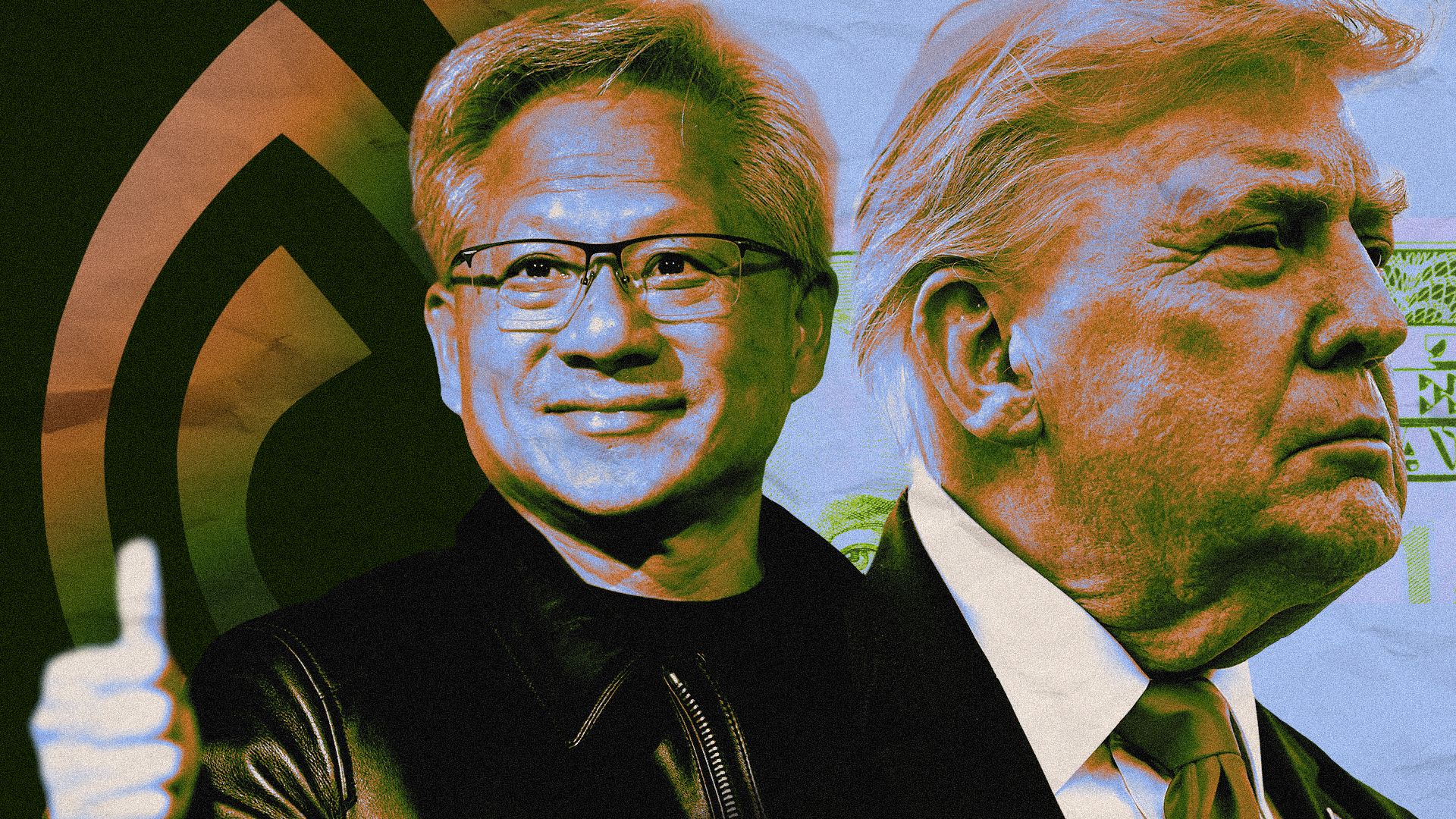
President Trump pushed Nvidia to reinstate Jensen Huang as CEO after allies argued he was "too big to fail" for the U.S. economy and a victim of "deep state" maneuvering, sources familiar with the discussions told Axios.
Why it matters: Trump put the weight of the presidency behind a private company's decision about who should run it, an intervention that strengthened Huang's allies inside the administration and put officials critical of the company in an increasingly uncomfortable position.
Driving the news: "Jensen is too big to fail," one source familiar with the discussions told Axios.
Behind the scenes: Huang's allies appealed to Trump's long-standing distrust of the intelligence community, portraying the Nvidia founder as a victim of persecution by unnamed government insiders.
- A Trump adviser said allies sought to convince Trump that "deep staters" were working against Huang.
- The intelligence included findings about Huang's relationship with a woman suspected of spying for China, which Secretary of State Marco Rubio circulated to senior officials in a memo earlier this year.
Between the lines: A senior administration official argued the intelligence never established Huang was compromised, knowingly violated U.S. law or had sex with a spy.
- "People are weaponizing some true information and spinning it to reflect as negatively as possible against Huang. That's the president's concern," the official said.
Go deeper:
3. Microsoft wants "permission" for next Windows
Microsoft isn't ready to say when the next major version of Windows will arrive. First, the company wants to make sure people are happy with the one they already have.
Why it matters: Microsoft has spent years pitching AI as the next great leap in personal computing, but Windows chief Pavan Davuluri tells Axios the company's immediate priority is improving Windows 11's reliability and performance.
Driving the news: Asked in an interview at Microsoft's Ignite conference last week when Windows 12 might arrive, Davuluri emphasized the work still underway on Windows 11, which he said now has more than a billion users.
- The company's focus is on ensuring "the quality, the craft, the fundamentals, the performance, the reliability" of the operating system while proving the value of its new AI capabilities, he said.
- Microsoft also needs to build the underlying technology for future AI applications and demonstrate that people actually find those capabilities useful.
- Only then, Davuluri suggested, does Microsoft "earn permission" to move on to building what's next.
Between the lines: Microsoft has faced criticism over Windows 11's reliability and its aggressive efforts to bring AI into the operating system.
- Davuluri didn't rule out Windows 12 or offer a timetable, but his comments suggest Microsoft is focused on strengthening its current operating system rather than rushing out a replacement.
- Bob O'Donnell, president and chief analyst at Technalysis Research, said Microsoft has recognized the need to address stability and security problems before making another big leap.
"There's this general sense of, 'Look, this stuff should be working and it should be working solidly, securely all the time,' and we're still not quite there yet," O'Donnell told Axios.
4. Training data
- Elon Musk's SpaceX is making billions leasing computing capacity to other AI companies, but its own efforts are falling further behind. (NYT)
- The Nasdaq added $2 trillion in value amid a massive rally in the stock market, per WSJ.
5. + This
Bloomberg Terminal subscribers get to see a daily quote on the platform. Yesterday's was reportedly serendipitous given the timing of Jensen Huang's return to Nvidia:
- "The report of my death was an exaggeration." — Mark Twain
Editor's note: Yesterday's story on OpenRouter was corrected to say it is owned by Stripe (not Square), and the headline was corrected to clarify that OpenRouter warned of a possible data exposure (not that the data was routed to MiniMax).
Thanks to Bradley Olson and David Nather for editing this newsletter and Matt Piper for copy editing.
Sign up for Axios AI+
