Axios AI+

December 13, 2023

Ina here, back after being excused from jury duty, where I ran into my old CNET boss, Michael Kanellos. Today's AI+ is 1,274 words, a 5-minute read.
1 big thing: Exclusive — Biden team wades into open source AI controversy

Illustration: Aïda Amer/Axios
The Biden administration has big plans to tackle one of the AI boom's sharpest controversies — whether open source AI models make society safer or put the world at greater risk.
Why it matters: AI's ownership structure and intellectual property rules will shape how it evolves — and governments' choices today to promote or restrict open source versions of AI will set a course for decades to come.
The big picture: The White House's wide-ranging AI executive order this year tasked the National Telecommunications and Information Administration (NTIA) with studying the open source question and recommending actions.
NTIA administrator Alan Davidson tells Axios he wants to hear a wide range of viewpoints before making recommendations in a report due to the White House by next July.
- "We've been given a pretty clear homework assignment," Davison said. "We're not trying to prejudge it one way or the other."
The big picture: Most of the AI models that power popular services like ChatGPT today — including projects at OpenAI, Google and Microsoft — are closely owned and held.
- There are other AI projects available under full open source license, which means anyone can access their code and build on it.
- Meta has released a number of its AI products under partial open-source terms.
- Open source software, which often has roots in university labs rather than corporate offices, still underlies most of today's internet.
Davidson said he was glad that President Biden's executive order sought further exploration into what role open source AI should play rather than endorsing or rejecting the approach.
- "I'm glad no one jumped to one conclusion or the other," Davison said. "That would be easy to do."
- While reserving judgment, Davidson expressed optimism there are middle paths. "This isn't an either/or [situation]," he said. "We need policies that are going to promote both safety and allow for broad access to AI tools."
- Some middle-ground options could include approaches that vary based on risk as well as exploring ways to ensure that safety mechanisms can't easily be removed from open source models.
- "We've been talking to a lot of thoughtful people who see nuance in the approach as a real possibility," Davidson said.
Of note: In terms of risk, Davidson said he is largely focused on present harms, such as bias, security and trust, rather than the existential risk that AI could destroy humanity — though he also said addressing the former could help prevent the latter.
Details: The NTIA, which is part of the Commerce Department, is holding an event online and at the Center for Democracy & Technology in Washington, D.C. today to kick off its work.
- A public comment period is slated to begin early next year and additional in-person gatherings are also possible before the agency begins drafting its report.
Separately, The NTIA is continuing work on a report expected early next year on ways that the government can use procurement guidelines and other means to encourage AI systems that are auditable and accountable.
2. Axel Springer, OpenAI in news deal for ChatGPT
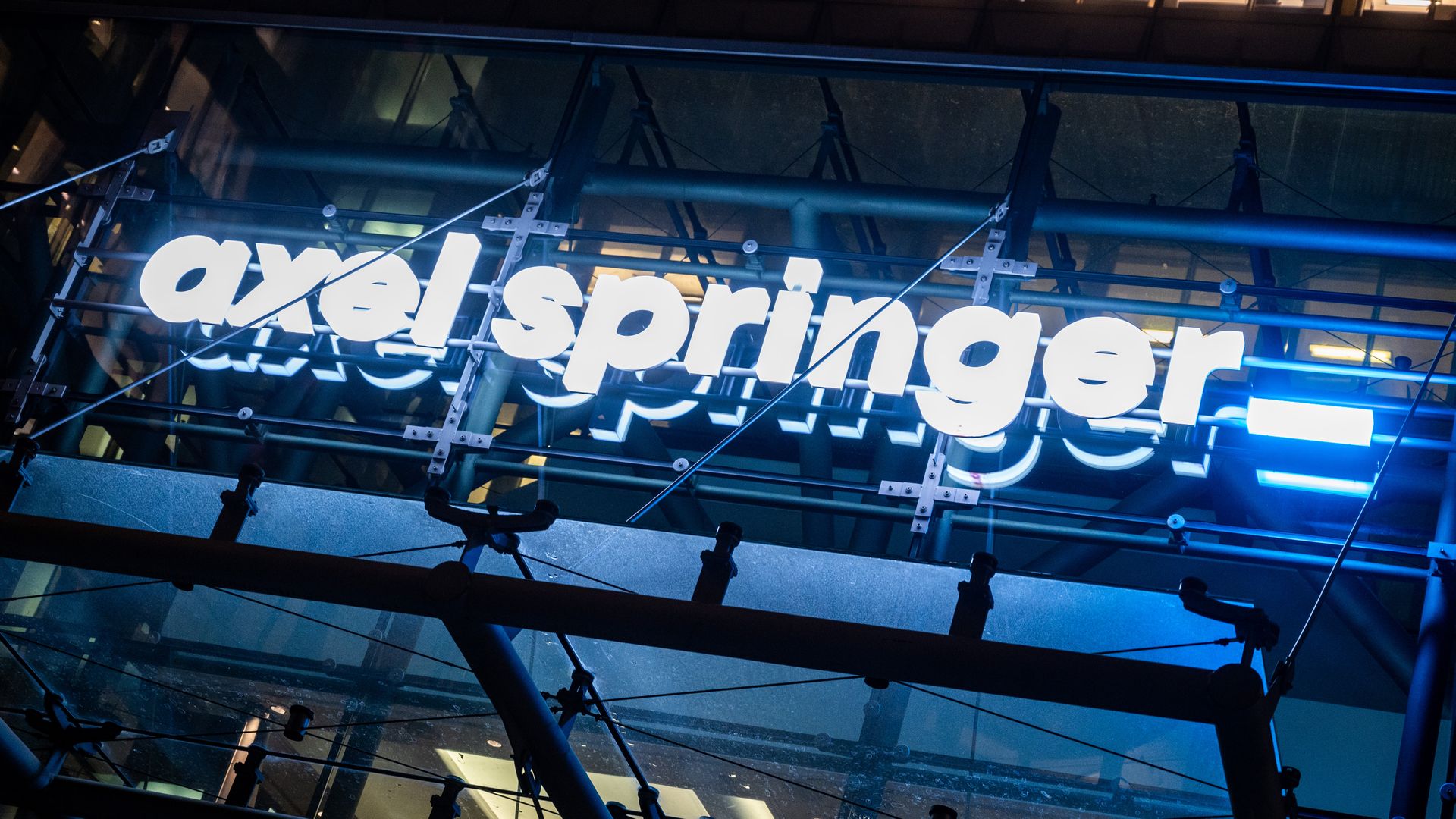
Photo: Christophe Gateau/picture alliance via Getty Images
ChatGPT parent OpenAI has struck a deal with Axel Springer, parent to a slew of German and U.S. media outlets, to "help provide people with new ways to access quality, real-time news content through our AI tools," OpenAI COO Brad Lightcap announced Wednesday, Axios' Sara Fischer reports.
Why it matters: The deal marks a new milestone in the relationship between journalism companies and artificial intelligence firms — one that involves not just providing data to train ChatGPT's models, but also using vetted journalism to bolster the accuracy of ChatGPT's responses.
Be smart: The deal also marks the first time OpenAI has detailed plans for ChatGPT to provide attribution to news publishers in its responses.
- In a statement, the two firms said the new arrangement "explicitly values the publisher's role in contributing to OpenAI's products" and marks a "significant step" in both firms' commitment to "creating new financial opportunities that support a sustainable future for journalism."
Details: As part of the deal, ChatGPT will gain access to to content from Axel Springer publishers, including German outlets such as Bild and Welt and American outlets such as Politico and Business Insider, that it can use for real-time news summaries and to help train its large language models.
- ChatGPT users will receive summaries of select global news content from Axel Springer's media brands in response to certain user prompts, including content that is paywalled.
- ChatGPT's answers will include attribution and links to the full articles that the content is pulled from.
- Financial terms of the deal were not disclosed.
Between the lines: The deal marks the first global publishing group agreement for OpenAI, which to date has announced partnerships only with the Associated Press and the American Journalism Project. a group that supports local publishers.
- Most major journalism companies are currently engaged in talks with AI firms, including OpenAI, about finding ways to partner or get compensated for the use of their content in training large language models.
- For months, Axel Springer CEO Mathias Döpfner has been urging his newsrooms to leverage AI, telling CNN in October that his firm will use AI for "fact-checking," without specifying how.
Yes, but: Not all publishers have been as quick to embrace such deals, concerned that handing their content to Big Tech firms could create a long-term power imbalance.
3. Many federal agencies don't meet AI rules

Illustration: Tiffany Herring/Axios
Many federal agencies are behind on complying with AI requirements in executive orders and federal law, but hundreds of plans exist for the government to use the tech in help desk chatbots, monitoring volcanoes and other areas, report Axios Pro's Ashley Gold and Maria Curi.
Driving the news: The U.S. Government Accountability Office (GAO) today released a study on how agencies are using AI, finding that 20 of the 23 federal agencies reviewed reported more than 1,200 current and planned uses of AI.
- These include "analyzing data from cameras and radar to identify border activities, analyzing photographs from drones and targeting of scientific specimens for planetary rovers."
- About 1,000 applications of AI are in the planning stage, with some 200 already underway at agencies.
- NASA and the Department of Commerce reported the highest number of uses of AI.
State of play: Agencies reported using AI in areas including agriculture and law enforcement.
- Science and internal management were the most common uses, accounting for 69% of the total.
- Telecoms and financial services were the least common, with just six and eight respective instances.
- Agencies made 888 of their AI plans and activities public, but the remaining 353 "were considered sensitive or not disclosed to the public."
Of note: Three agencies — the Department of Housing and Urban Development, Nuclear Regulatory Commission and Small Business Administration — reported no AI use cases.
- Two agencies, DHS and State, both provided some examples that they later determined weren't actually AI.
Catch up quick: GAO, formerly known as the Government Accounting Office, is Congress' nonpartisan assessor of data, particularly as it relates to government spending.
A version of this story was published first on Axios Pro. Unlock more news like this by talking to our sales team.
4. Training data
- Essential AI, founded by two former Google employees who co-authored a groundbreaking paper in the field, has landed $57 million in funding. (Bloomberg)
- The Senate voted 59-40 on Tuesday to confirm Harry Coker, Jr. as the U.S.'s next national cyber director. (Axios)
- X (formerly Twitter) will reportedly take in $2.5 billion in ad revenue this year, compared to nearly $5 billion in the year before Musk acquired the company. (Bloomberg)
- The New York Times has hired Quartz co-founder Zach Seward as its editorial director of AI initiatives. (Axios)
5. + This
Dictionary.com named the AI-related meaning of "hallucinate" as its word of the year.
Thanks to Scott Rosenberg and Meg Morrone for editing this newsletter.
Sign up for Axios AI+

Scoops on the AI revolution and transformative tech, from Ina Fried, Madison Mills, Ashley Gold and Maria Curi.