Axios AI+
October 16, 2026



Maria here, bringing AI policy and politics reporting throughout the week now as an AI+ co-author!
- I'm at the helm for the first time today, still processing the fact that tech reporting is apparently cinematic enough for Aaron Sorkin. (If any sources need to meet in Rock Creek Park, just lmk.)
Today's AI+ is 1,233 words, a 4.5-minute read.
1 big thing: Apple and Meta's AI peace deal

Apple and Meta, whose leaders have spent years trading barbs over privacy and the future of computing, are joining forces to bring one of America's most powerful open-weight AI models to Apple's high-end Macs.
Why it matters: The collaboration marks a striking detente between two longtime Silicon Valley rivals, underscoring how the AI race is reshaping relationships across the technology industry.
- The companies still compete over devices and the next generation of computing, but both see an opportunity in bringing powerful AI capabilities to personal computers.
- "We're excited for mommy and daddy to be playing nice again," Meta AI chief Alexandr Wang told Axios.
Driving the news: Meta is releasing Muse Spark Open, a model similar to Muse Spark 1.3 that it says is the most powerful U.S.-developed open-weight AI model available.
- Meta joins a host of Western AI companies that have released powerful open-weight systems that promise to slash AI costs, provide companies with more control and offer an alternative to the Chinese AI ecosystem.
- As proof of Muse Spark Open's capabilities, Meta worked with Apple to make the model run locally across two or four connected Mac Studios powered by Apple's M5 Ultra chips, using Apple's MLX framework.
Zoom in: The prospect of a powerful model — it has 816 billion parameters — running on Apple hardware offers a proof of concept for how companies could build their own AI systems.
- That could give companies more alternatives to Nvidia GPUs and proprietary models from leading AI companies, potentially shifting some of the economics of AI.
- Meta's model will be free to download, with a license allowing commercial use, and will also be available through cloud providers and developer tools.
What they're saying: Wang said the companies have been working together for several months, with Daniel Gross, a former Apple executive now at Meta, helping bring the two sides together.
- "I think he played a really big role in kind of getting the two companies to work nicely together," Wang said in a telephone interview.
Flashback: Apple executive chairman Tim Cook and Meta CEO Mark Zuckerberg have repeatedly clashed over privacy and their competing business models.
The big picture: The AI race is making for some strange bedfellows — think Elon Musk and Anthropic, or Bernie Sanders and MAGA combatant Steve Bannon — scrambling long-standing Silicon Valley rivalries and even bringing together political adversaries.
Between the lines: The Apple-Meta collaboration doesn't mean the companies have resolved their differences, but it suggests those disagreements no longer prevent them from working together when their interests align.
- Meta benefits from making its AI models widely available, while Apple can showcase the capabilities of its most powerful computers.
- And because the model runs locally, Meta doesn't receive users' prompts or other information — sidestepping the privacy concerns that have long divided the companies.
"Meta has no control or visibility to any of that," Wang said of how developers use the model.
Yes, but: Making powerful AI models openly available raises concerns that bad actors could remove safeguards and use the technology for cyberattacks or biological threats.
The bottom line: Wang acknowledged that Apple and Meta will continue to compete in some areas, but said that doesn't have to prevent them from working together.
2. The debt-fueled AI boom is cracking
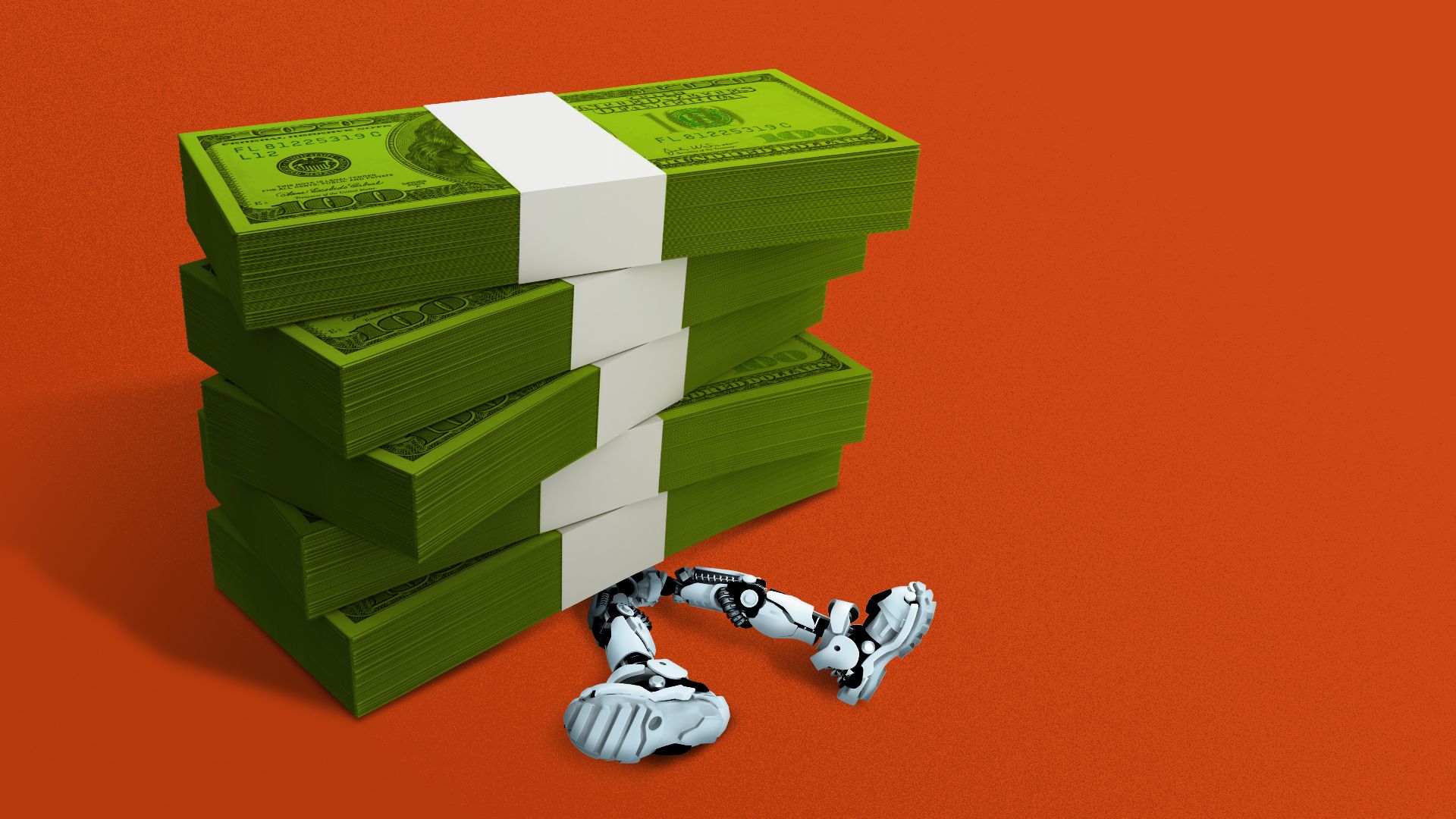
Wall Street appears to be hitting its limit on AI, and financiers are starting to say the quiet part out loud: All of this AI spending doesn't look like it can pay off, at least not for everyone.
Why it matters: The gap between what it costs to build AI infrastructure and what companies are actually paying to use it is widening. Wall Street's anxiety is surging as the debt piling up to fund data centers and chips looks increasingly disconnected from economic reality.
Driving the news: A massive gap is opening up between AI infrastructure spending and expected returns.
- While AI providers are projected to spend $7 trillion on infrastructure through 2030, research from Gartner forecasts they will generate no more than $3.6 trillion in related revenue over that same period.
- Gartner also predicts that more than 80% of specialized AI cloud providers, known as neoclouds, will cease operating independently by 2030.
Case in point: CoreWeave, one of the largest neoclouds with among the closest ties to Nvidia — the AI boom's financial and spiritual foundation — has faced a multiday sell-off of its stock and debt.
Follow the money: Sources on Wall Street used to tell Axios that as long as the AI buildout was paid for in cash, there was nothing to worry about. But today, a third of the capex being spent on AI is coming from debt, and capital markets are showing signs of severe fatigue.
- It's getting harder to secure financing. Global AI-related debt issuance plunged to $23 billion in September 2026, down sharply from $113 billion in June, per the Financial Times.
- Banks are actively pulling back to avoid concentration risk, with JPMorgan CEO Jamie Dimon confirming his bank is tightening up on credit.
- Infrastructure projects and providers are struggling: Approximately $18 billion in bank loans for an Oracle data center campus recently slid into stressed territory, while Nvidia-backed AI cloud provider Firmus shelved an IPO that sought a valuation north of $30 billion.
Zoom in: The constant spending relies on the belief that compute demand will never falter — a belief that has structural cracks.
- Reflection AI co-founder Ioannis Antonoglou told Semafor that businesses may need "a decade or two decades" to fundamentally redesign their operations around AI.
Between the lines: This creates a mismatch: Data centers and chips require enormous investment today, but the returns that could justify that spend will take years to materialize.
The bottom line: The stock market and economy have become increasingly tied up with the AI boom. If the AI bet doesn't work, markets and the economy could falter as well.
3. AI could drive a Tesla-SpaceX tie-up

Tesla unveiled its Roadster last night, featuring SpaceX-designed thrusters that literally lifted the car off the ground.
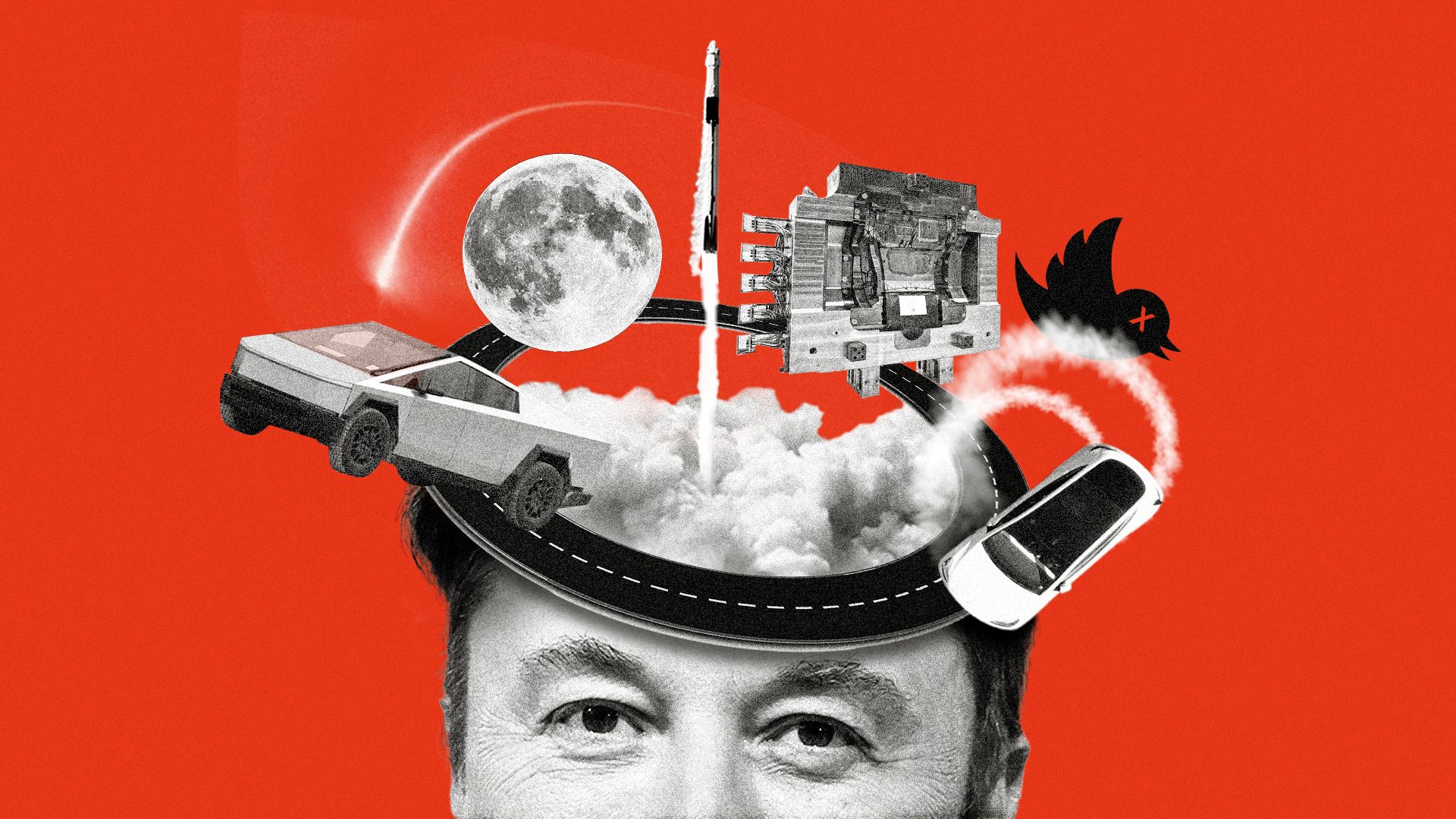
- A much bigger Tesla-SpaceX tie-up — the long-speculated merger of Elon Musk's two companies — could come as soon as this fall, say analysts at the Barclays investment bank.
The big picture: Musk's business empire is becoming increasingly interconnected, raising the prospect of a combination that would consolidate his control over two of the world's most valuable companies, while allowing both to move faster on big AI projects.
Zoom in: The Barclays analysts, led by Dan Levy, view AI as a central driver of a potential deal.
4. Training data
- DOJ officials halted a criminal probe into Meta over alleged illegal drug sales on its platforms. (Bloomberg Law)
- Amazon launched two new "Bee"-branded AI gadgets that can listen to conversations, compose notes and issue reminders. (CBS News)
- Anthropic granted independent AI evaluator METR employee-level access to its models to assess safety risks. (Reuters)
- AI, crypto and DEI helped drive venture capitalist Marc Andreessen's political shift toward President Trump. (Bloomberg)
5. + This
Hey, it's Maria again. For those watching AI developments wondering what it's all for, I leave you with this masterpiece.
Thanks to Bradley Olson for editing this newsletter and Matt Piper for copy editing.
Sign up for Axios AI+
