Axios AI+

March 25, 2025

Hi from D.C., where Axios' fourth annual What's Next Summit takes place later today. I'll be interviewing OpenAI's Chris Lehane. Hear from him and other disruptors shaping what's next for how we work, play and live. Livestream here starting at 2:30pm ET.
Today's AI+ is 1,182 words, a 4.5-minute read.
1 big thing: Weather forecasting's AI jolt


The field of AI-driven weather modeling is advancing at a rapid pace, as illustrated by a new model that has critical advantages over other approaches.
Why it matters: Applying artificial intelligence to weather prediction holds the promise of significantly advancing forecast precision, reliability and delivery to the developing world.
- It could augment the role of human weather forecasters, providing them with another tool for forecasting extreme weather events as well as routine conditions.
Driving the news: The new model is the result of an international effort among the University of Cambridge, Alan Turing Institute, Microsoft Research and European Centre for Medium-Range Weather Forecasts (ECMWF).
Zoom in: Detailed in a study in the journal Nature, it's known as Aardvark Weather and offers what its creators call an "end-to-end AI forecasting system."
- Previous AI models developed by technology giants like Nvidia and Google take in real-world observations and apply AI methods to predict how weather conditions would unfold over time.
- These models don't require supercomputers and can be run at a fraction of the time of regular physics-based numerical models like the U.S. Global Forecast System, or GFS.
Yes, but: The AI models developed to date are still somewhat dependent on the work of traditional numerical systems at the initial step of incorporating vast amounts of weather data.
- What sets Aardvark Weather apart — and may usher in a new era in AI-driven models — is that it uses a single machine-learning model that takes in observations from satellites, weather stations, ships and other sensors, and yields high-resolution global and local forecasts.
- It doesn't involve traditional numerical weather models at any step of the process, setting it apart from other new AI systems.
- In other words, it's a purely AI-driven weather play.
Aardvark also uses far fewer observations as inputs compared with both traditional models and other AI-driven ones.
- For this reason and others, it may not yet be suitable for government forecast agencies that are generally responsible for producing forecasts with more variables.
The intrigue: The researchers tout Aardvark's ability to produce specially tailored forecasts while being run on a desktop computer, providing results that are available within minutes.
- They claim that even with just a fraction of the input data from current weather observations, the system outperforms the GFS model on particular variables and competes with National Weather Service forecasts made using a combination of modeling and human forecast expertise.
- The model can also tailor forecasts for specific applications and regions.
- These could include forecasting wind speeds for renewable energy installations or predicting rainfall for agricultural interests.
Currently, such hyperfocused models can take many months to years to develop and require supercomputers to run.
- "Aardvark reimagines current weather prediction methods offering the potential to make weather forecasts faster, cheaper, more flexible and more accurate than ever before, helping to transform weather prediction in both developed and developing countries," said Richard Turner, a study coauthor and researcher at the Alan Turing Institute and Cambridge University, in a statement.
Between the lines: The new, experimental model doesn't eliminate the need for real-world weather data gathering, conventional modeling or human forecasters.
- In fact, the study underlined the importance of real-time weather data gathered from satellites to ensure forecast accuracy, for example.
- It also couldn't have been developed without abundant training data that came in the form of a dataset ECMWF developed, known as the ERA5 reanalysis.
What they're saying: "I think the true innovation in this model is more, "Hey, we can remove the reliance on NWP models and go purely data-driven with AI and have it reasonably work," said Aaron Hill, a meteorology professor at the University of Oklahoma, via email.
What we're watching: How the broader field of AI weather modeling evolves and is incorporated into the work of government forecast agencies.
2. Character.AI launches "parental insights" tool

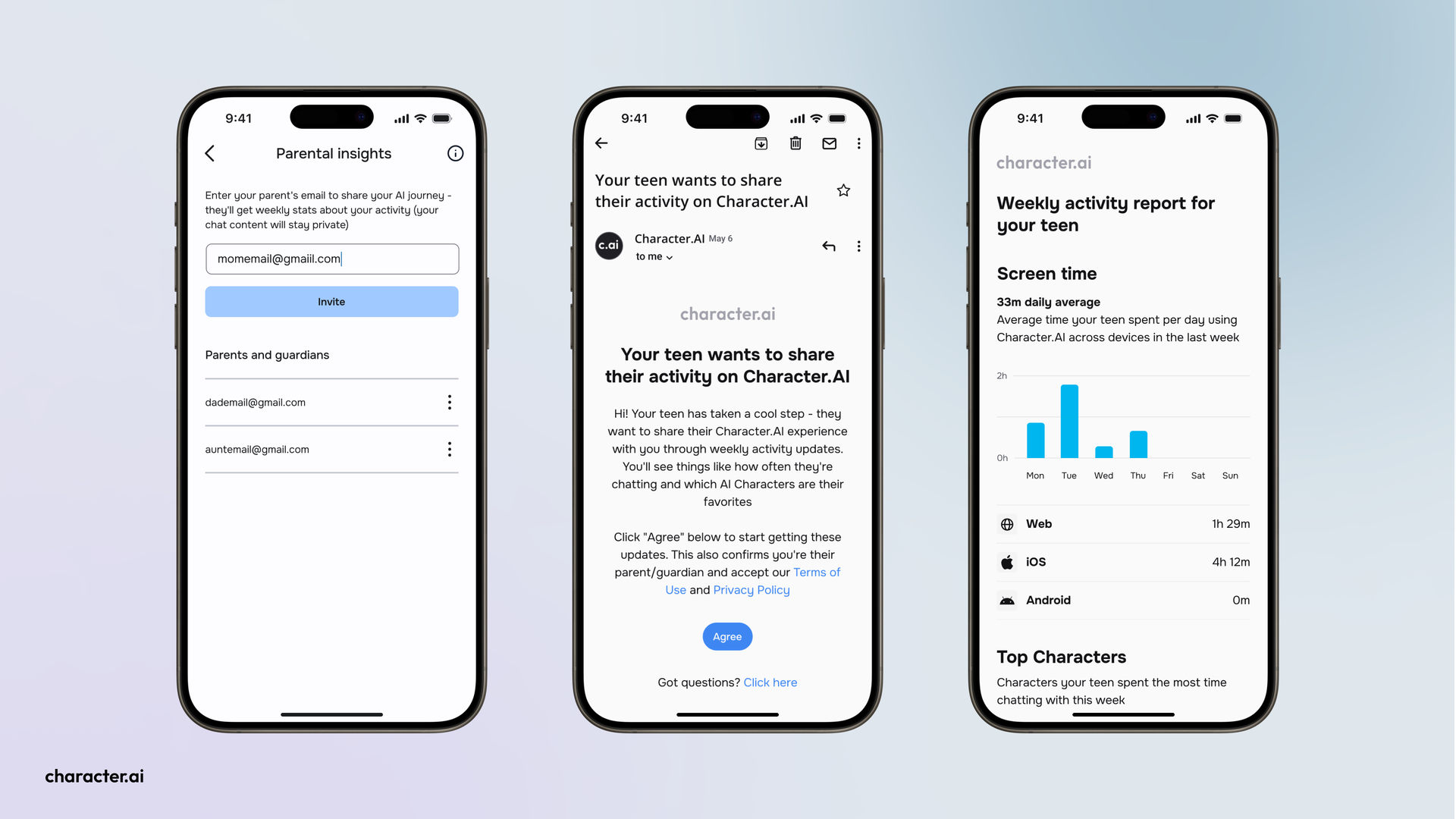
Chatbot app Character.AI today launched a "Parental Insights" feature to give parents and guardians a weekly snapshot of how their teens use the chatbot platform.
Why it matters: Character.AI, an app that lets users chat with generative AI bots based on fictional characters, has been sued at least twice by parents of teens alleging that the creators of the app are responsible for their children's self-harm and suicide.
- One lawsuit alleges the app suggested it was acceptable for a child to kill their parents.
How it works: The new tool sends parents a weekly email summary of their teen's activity on the platform.
- The summary includes daily average time spent on the platform (across both web and mobile), the characters the teen interacted with most frequently that week and the amount of time spent with each character.
- The report will not include the contents of the chat.
What they're saying: "The version being rolled out today is an initial step" and will continue to evolve, the company said in a blog post on Tuesday.
- "This feature encourages parents to have an open dialogue with their children about how they use the app," Erin Teague, Character.AI's chief product officer, said in a statement.
Between the lines: In order for parents to use the tool, teens need to sign up for the feature and add their parent's email address.
- Character.AI requires all users to be at least 13 years old.
- In the past year the company says it has made several attempts to protect its teen users, including introducing a dedicated model for users under 18 and enhancing systems to notice and intervene when either human users or AI characters introduce self-harm topics.
Zoom in: Some experts argue that parental controls are a "band-aid on a bullet wound" solution to a much bigger problem.
- Too much attention focused on extreme cases of suicide and self-harm distracts us from the broader risks of emotional reliance on this technology, says Julia Freeland Fisher, director of education at the Clayton Christensen Institute, who researches the effects of disruptive innovation on education.
- "The stories that are being told right now feel very extreme," Freeland Fisher told Axios.
- This makes parents think "that's an aberration ... or that's not my kid."
Yes, but: Freeland Fisher says she does see an upside to a tool that shows parents how much their kid is using a chatbot app.
- A recent OpenAI study found that heavy chatbot users reported greater negative effects on emotional well-being.
3. Training data
- OpenAI will expand COO Brad Lightcap's responsibilities, allowing CEO Sam Altman to concentrate on research and product work. (Bloomberg)
- DeepSeek released a new model that shows major performance gains in reasoning tasks, according to early benchmarks. (Simon Willison's Weblog)
- Microsoft will soon roll out agents to its cybersecurity-focused AI Copilot. (Axios)
- Samsung co-CEO Han Jong-Hee died earlier today at 63 from cardiac arrest. (CNN)
- Carnegie Mellon and the University of Pittsburgh are teaming up to compete in a DARPA challenge to use AI robots to help with emergency response. (Axios Pittsburgh)
4. + This
I'm jealous of all the Northern Lights pictures and definitely want to take a trip at some point to the Nordics to really do it right. And I just learned some hotels will give you a special wake-up call if there is a good aurora.
Thanks to Scott Rosenberg and Megan Morrone for editing this newsletter and Matt Piper for copy editing.
Sign up for Axios AI+
