Axios AI+
February 18, 2026


👋 Mady here, currently obsessing over Morgan Stanley projecting over $2 trillion in tech debt issuance for this year.
Today's AI+ is 1,163 words, a 4.5-minute read.
1 big thing: AI brings order to the Olympics

This year's Winter Olympics are doubling as a proving ground for how artificial intelligence can help athletes train, organizers shuffle events, and fans experience a centuries-old celebration of what humans can physically do.
Why it matters: The same technology reshaping the world is also transforming an event that brings the world together.
AI's most important role is also its least glamorous: logistics.
- Pulling off two weeks of precisely timed, globally broadcast competition requires orchestrating tens of thousands of athletes, staff and spectators — all at the mercy of winter weather.
- That's the kind of rapid contingency planning that AI excels at: running simulations, weighing options and helping officials adjust without derailing the broader program.
Where else AI is showing up:
- Broadcasting: The tech is bringing more data to the coverage and automating the process of producing highlights so fans can see just the clip they want. What used to be an entirely manual process has been greatly accelerated by AI, giving viewers on-demand access to nearly any individual performance.
- Judging: In sports decided by fractions of a point, AI-assisted video analysis can help officials review rotations, landings and form with greater precision. In figure skating, for example, computer vision could soon tell judges whether the blades of a figure skater actually completed the required rotations.
- Live translation: AI is easing language barriers among athletes and fans converging from around the world. Samsung is lending volunteers phones with on-device AI translation that works even in mountain areas with spotty cell service, helping bridge language gaps so volunteers can answer questions regardless of whether they speak the language.
- Data crunching: The Olympics generate massive amounts of performance and operational data — an area where LLMs shine. Omega, the official timekeeper, is using an internally developed LLM that lets its staff ask questions of the data (and then receive answers to queries), something that could be rolled out to broadcasters in the future. Another partner, Alibaba Cloud, is using its homegrown Qwen model to help National Olympic Committees search and sort documents across languages.
Flashback: AI's footprint has expanded even from the Paris Summer Games in 2024, where it played a supporting role, including early chatbot experiments for athletes.
Between the lines: The most visible shift is in how events are explained, not just shown. While drones are providing new angles to live coverage, AI is allowing for people to better understand the action.
- Networks are leaning into AI‑driven replays and contextual data to demystify unfamiliar sports. That's important because more than half of Olympic TV viewers aren't hardcore sports fans, says Yiannis Exarchos, CEO of Olympic Broadcasting Services.
The result is even casual viewers can "understand the sport and, most importantly, fall in love with it," Exarchos says
- "We should push the boundaries — but it should be used when it is meaningful," Exarchos told reporters during the Games' first full week. "It's not about showing off technology — it's about the athletes."
What's next: By the time the games arrive in Los Angeles in 2028, AI's role is expected to be far more ambitious.
- Organizers are already eyeing one massive task: using AI to help design a transit-first Olympics in a sprawling, car-centric metropolis.
- Getting from one place to another could prove to be as tough as sticking the landing on a gymnastics routine.
2. Meta to buy millions more chips from Nvidia
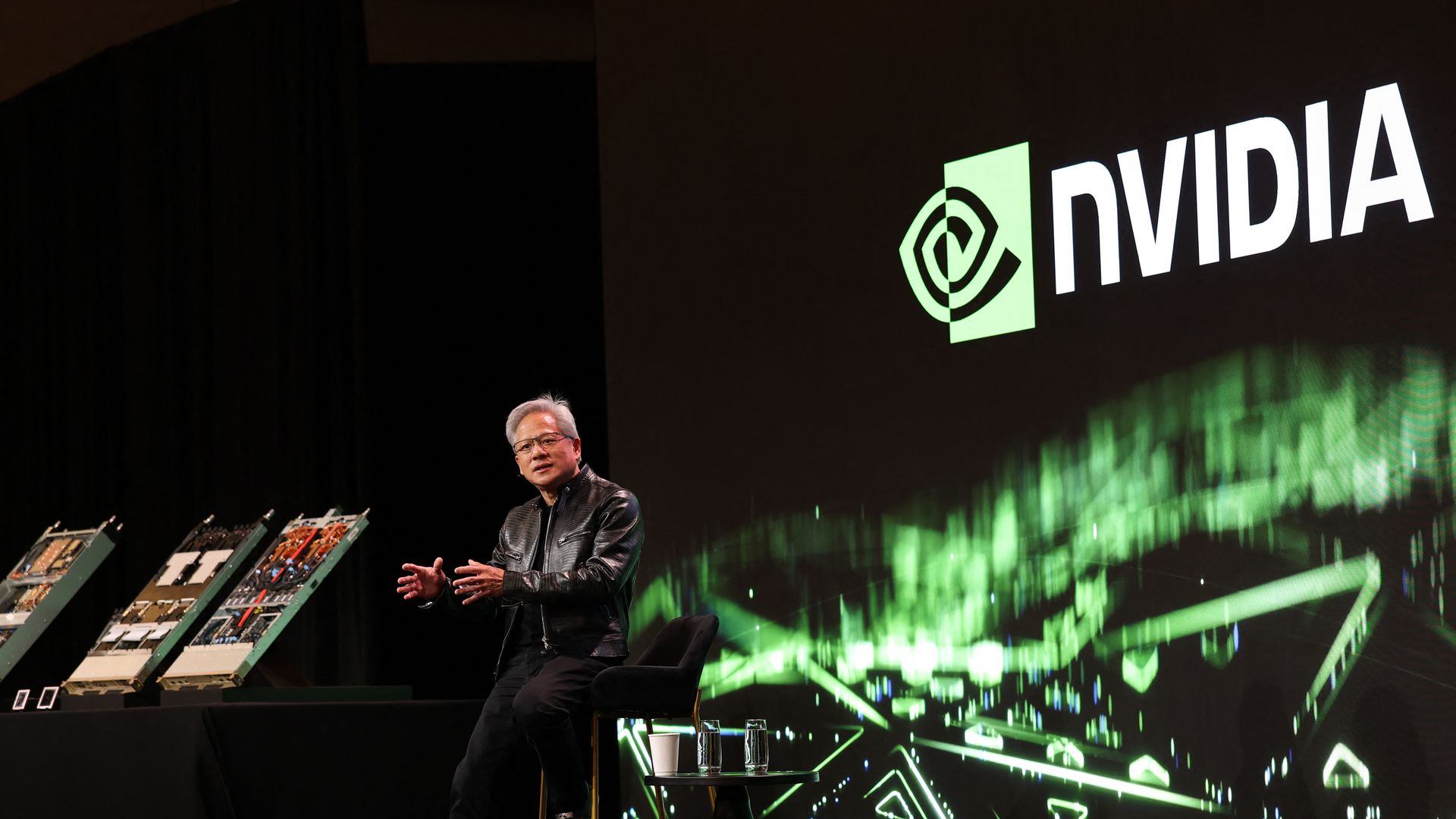
Meta is doubling down on Nvidia AI chips, committing to spend tens of billions of dollars on the chipmaker's newest offerings and sending shares of both companies higher.
Why it matters: Even though Meta is already one of Nvidia's biggest buyers, the deal is so big that it stands to boost both companies.
Driving the news: Meta will buy millions of chips from Nvidia, ranging from standalone Grace CPUs to next-gen Blackwell GPUs and upcoming Vera Rubin systems, to use across its U.S. data center buildout.
- This makes Meta the first Big Tech firm to commit to buying standalone central processing units from Nvidia, which are used to run AI rather than train AI.
- This signals a shift toward inference over training, with the latter requiring more intense and expensive general processing units, or GPUs
- Financial details of the deal were not disclosed.
Between the lines: Meta is locking in scarce next-generation compute at a time when Nvidia's Blackwell GPUs are back-ordered and rivals are scrambling for supply.
Zoom out: It's a signal that there's still strong demand for compute power amid the AI buildout.
- Hyperscalers — the companies behind the largest data center buildouts — are on track to spend $650 billion this year.
- Chip companies like Nvidia stand to benefit from that, as their chips are seen as the best — and most expensive — on the market.
- Any sign of a slowdown in spending tends to hurt Nvidia shares, but a deal like this is a balm for investors who've been increasingly skittish about how long the AI spending spree can last.
3. Anthropic's newest AI model is cheaper and faster
Anthropic is releasing Claude Sonnet 4.6, its new default model, which the company says has better coding and computer use skills than prior versions.
Why it matters: Anthropic continues to shrink the gap between its premium and mainstream AI offerings, making advanced capabilities the default, even for free users.
Zoom in: Sonnet 4.6 offers:
- Stronger "computer use" skills. Anthropic says the model can use software the way a person would: clicking, typing and navigating interfaces.
- Smarter real work. Sonnet 4.6 reportedly outperforms the just-released Opus 4.6 on some real-world office tasks, meaning users won't need to pay for a premium model for certain jobs.
- Better coding at lower cost. Sonnet 4.6 improves on its predecessor by reasoning over long chunks of code, reading context before editing it, tightening logic instead of doubling it, and delivering smarter answers faster.
4. Lawmakers want data centers to pay their own way


A new Senate bill that would ensure the cost of data centers' energy use isn't passed on to consumers is stirring up plenty of debate — pro and con — among AI and energy interests.
The big picture: The measure — which Axios reported on exclusively before its introduction last week — would guarantee that consumers won't face any rate hikes driven by data centers.
- It also would ensure that new data centers use energy from generation sources that are separate from the grid.
Keep reading ... and sign up here for Axios' Future of Energy newsletter.
5. Training data
- Apple is accelerating its push into AI wearables, including smart glasses, a pendant and AirPods. (Bloomberg)
- AI model research can't keep up with the AI models. (Axios)
6. + This

I had so much fun taking pictures at yesterday's women's figure skating short program that it was hard to pick one to share. I chose this one of Amber Glenn because her routine was stunning. However, she missed a required element and is in 13th place heading into Thursday's free skate.
Thanks to Megan Morrone for editing this newsletter and Matt Piper for copy editing.
Sign up for Axios AI+
