Axios AI+

January 14, 2026

I'm en route to Munich for a European trip that includes Davos and Milan to cover the Winter Olympics for Axios.
Today's AI+ is 1,229 words, a 4.5-minute read.
1 big thing: AI's productivity paradox


AI might one day replace us all — for now though, humans still spend a lot of time cleaning up its mess, according to a Workday survey, released today.
Why it matters: The promise of AI is productivity. The reality is often more work, not less.
Zoom in: For employees, AI is both speeding up work and creating more of it, per a report by HR software company Workday.
- 85% of respondents said that AI saved them 1-7 hours a week, but about 37% of that time savings is lost to what they call "rework" — correcting errors, rewriting content and verifying output.
- Only 14% of respondents said they get consistently positive outcomes from AI.
- Workday surveyed 3,200 employees who said they are using AI — half in leadership positions — at companies in North America, Europe and Asia with at least $100 million in revenue and 150 employees.
Reality check: The report did not specify which AI products respondents were using or which companies built them.
Zoom out: "There is a big productivity paradox," Gerrit Kazmaier, president of product at Workday, tells Axios.
- The most frequent users of AI, he says, are the ones investing the most time in reviewing and correcting what it produces.
- The findings line up with other studies that call AI productivity gains into question — from MIT and Harvard Business Review.
- The term "workslop" has caught on for a reason.
The big picture: CEOs and employers are super eager to reap the productivity benefits of AI — particularly so they can bring down labor costs.
- But for now, AI is mainly being used as an excuse to conduct layoffs that are due to other factors, says Rob Hornby, co-CEO of consultancy AlixPartners.
- In a survey from his firm, also out today, 95% of CEOs said they expected to conduct layoffs in the next five years because of AI. That's likely more hope than reality. CEOs aren't yet seeing productivity gains from AI, he says.
Yes, but: There are some productivity benefits to AI in some specific niche areas, like some types of low-level commoditized writing, he says. But overall, "we're having a tough time proving out real productivity benefits," Hornby says.
- Plus: AI tools are rapidly getting better at doing real-world work, so the problem could soon resolve itself. Anthropic's new tool designed to automate rote office tasks was created in less than 1.5 weeks and the code was written entirely by AI (see below.)
Between the lines: Incorporating and using a new technology effectively takes a lot of time — ask anyone who lived through the advent of the Internet.
- It takes time for employees to learn new tools, for employers to integrate them and for businesses to build products that actually make them useful.
- Workday and other enterprise tech firms are trying to sell AI-based software products to solve that latter piece.
2. Anthropic's viral new work tool wrote itself

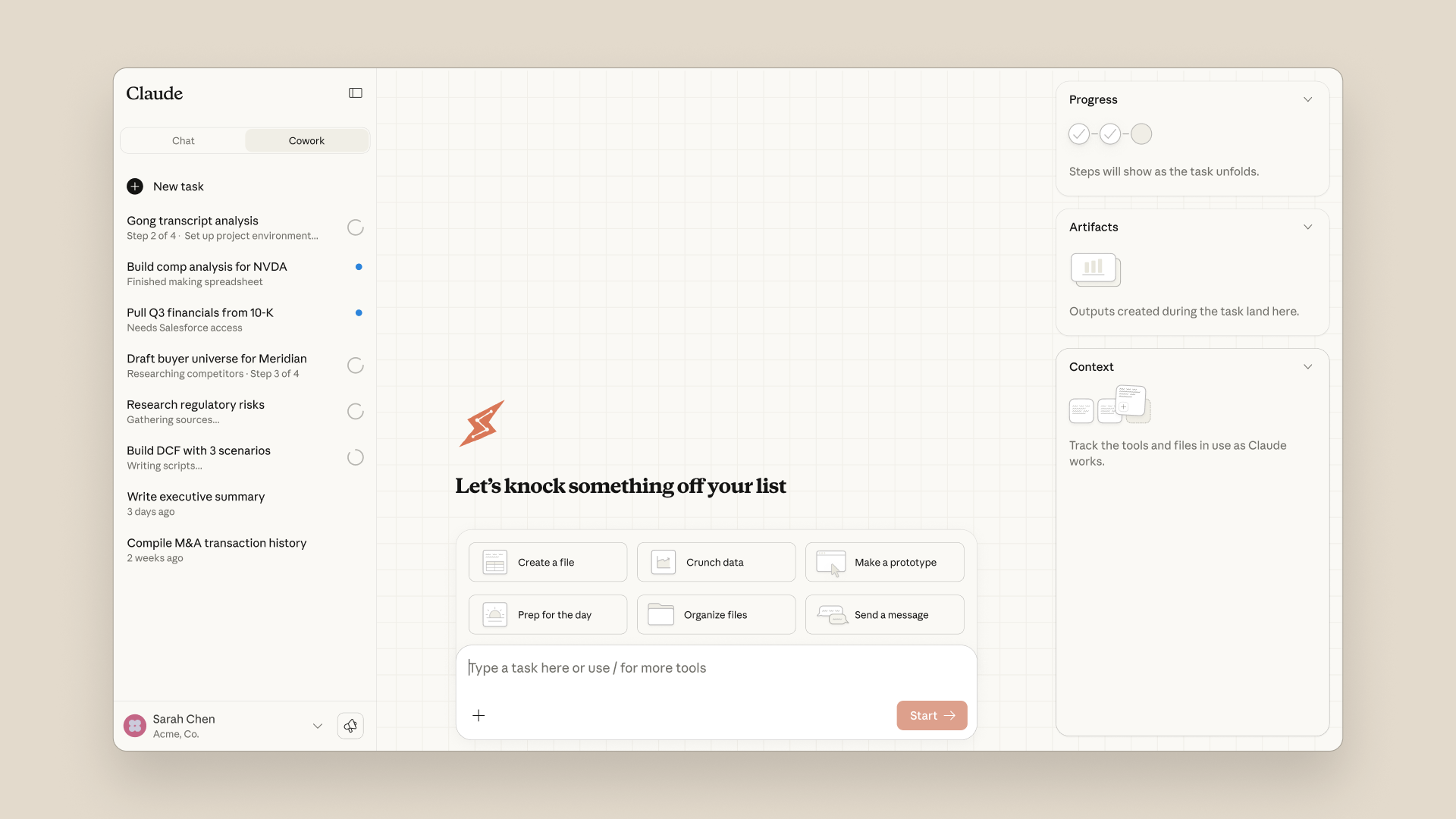
Anthropic is previewing a new tool for non-coders that mostly built itself, engineers at the AI firm say.
Why it matters: The viral popularity of the tool — called Cowork, and designed to help non-coders with everyday work tasks — signals a shift toward software built by AI, with humans guiding the way.
Driving the news: Anthropic's head of Claude Code, Boris Cherny, said on X that "all" of Cowork was built with Claude Code, the company's AI-powered coding tool.
- It's an example of "vibe coding" — an AI-driven approach where people mostly use prompts to create software, rather than write code themselves.
- Users can ask Cowork to create new spreadsheets from a pile of screenshots, organize messy downloads, or create draft reports from scattered notes.
What they're saying: Felix Rieseberg, of Anthropic's technical staff: "We built Cowork the same way we want people to use Claude: describing what we needed, letting Claude handle implementation, and steering as we went."
- "We spent more time making product and architecture decisions than writing individual lines of code"
- It only took a week and a half to build Cowork, Rieseberg adds.
Zoom out: The early buzz around Cowork is bringing more attention to "vibe coding" tools from other AI companies, too.
- "You don't want to be one of the ones left behind, clinging to your keyboard," technologist Chris Maconi posted on X. "Download Claude Code, Cursor, OpenCode, or whatever AI coding tools you can get your hands on."
Reality check: Cowork is still just a preview, limited to Claude Max subscribers using macOS.
- Dan Shipper, co-founder and CEO of AI subscription service Every, tells Axios that he has a handful of small complaints — which are really just feature requests.
- It only works on Claude's desktop app, not mobile or the web. He can only work in one folder at a time, and the UI can be a little confusing.
- "It's a work in progress," Shipper says.
What's next: Anthropic's Rieseberg is asking for feedback on the new tool.
3. Lawmaker looks to ban AI chatbots in toys


California state Sen. Steve Padilla is proposing a pause on AI chatbot toys for kids.
Why it matters: AI-enabled toys are raising major concerns about security risks, privacy and kids' exposure to harmful or inappropriate content.
Driving the news: Earlier this month, Padilla introduced SB 867, a first-of-its-kind bill that would place a four-year moratorium on toys with AI and chatbot features for kids under 12.
What they're saying: "We want to make sure that before we more broadly deploy this technology in toys that are designed, manufactured and marketed for young children, that harms are understood and we're being careful before we proliferate this stuff in a way that can be harmful," Padilla said in an interview with Axios.
- Padilla said he anticipates adding sponsors to the bill "very shortly" and that he hadn't spoken specifically with Gov. Gavin Newsom about it yet.
- "I'm a parent and a grandparent ... this is something that's concerning, but eminently addressable, right?"
How it works: During the four-year moratorium, AI toys would not be permitted to be sold or manufactured in California.
- "That's a pretty big market," Padilla said.
- The bill has similar language to Padilla's SB 243, a chatbot safeguards bill that passed in California last year, around design features aimed at young consumers, he said.
"This is not an anti-technology bill," Padilla told Axios.
- "This is a bill about protecting innocent young children from harm, and I think that's absolutely appropriate," he said.
What's next: The bill will need to advance through California's legislative process this year before possibly becoming law.
- Padilla's legislation also comes shortly after President Trump signed an executive order targeting state AI laws.
4. Training data
- Google's recent deals with Apple and Walmart are raising investors' hopes in the promise of AI. (Axios)
- Anthropic product chief (and Instagram co-founder) Mike Krieger is shifting roles at the company, becoming co-head of its labs. (The Verge)
- Roblox's AI-powered age verification system is coming under fire. (Wired)
- Chinese authorities told customs agents this week that Nvidia's H200 chips aren't permitted to enter China, giving no indication whether it was a long-term or temporary directive, sources told Reuters.
5. + This
10-year-old Drew Fleschut of Dallas, Pennsylvania, won a recent mullet contest that drew 150 contestants showing off their "business in front, party in the back" hairstyles.
Thanks to Megan Morrone for editing this newsletter and Matt Piper for copy editing.
Sign up for Axios AI+
