Axios AI+
May 11, 2026


Ina here, gearing up to follow the final week of the jury phase of the Elon Musk vs. OpenAI trial.
"The Axios Show": Bumble CEO and founder Whitney Wolfe Herd talks with Axios' Sara Fischer about her plans to overhaul the dating app to lure back love-seekers and help solve the loneliness crisis. Watch the episode on YouTube.
Today's AI+ is 1,186 words, a 4.5-minute read.
1 big thing: AI chats are the new diary
The juicy personal texts, emails and digital diary entries of the biggest AI execs revealed in Elon Musk's lawsuit against OpenAI highlight how the chats from these companies' own tools could become a new trove of courtroom evidence.
Why it matters: Courts are increasingly treating chatbot conversations as discoverable evidence, raising new legal and privacy concerns for AI users.
The big picture: Conversations with a lawyer or therapist can receive special legal protections. Conversations with a chatbot often do not, as OpenAI CEO Sam Altman himself has flagged.
Zoom in: Recent cases are already testing how AI conversations can be used in court.
- In February, a federal court judge ruled that a man's conversations with Claude — even though their purpose was to prepare for discussions with his lawyer — were admissible in a criminal case against him.
- Chatbot conversations have surfaced in other criminal proceedings, including efforts to prosecute a murder case in Florida and a wildfire arson case in Los Angeles.
Zoom out: A diary — like the one OpenAI president Greg Brockman was forced to discuss in Musk's lawsuit — records what someone chooses to write down.
- "Brockman's diary is striking precisely because it is rare," New York-based lawyer James Rubinowitz told Axios. "Within the next decade, the diary equivalent will be standard discovery in every major executive litigation in the country."
- "AI exchanges can create a timestamped record of what a party believed, when they believed it, what facts they shared, and how they framed their injuries, damages, or intent — often in ways that differ from later pleadings, discovery responses, or deposition testimony," Tyson & Mendes partner Robert Olson wrote in an article on the firm's website.
Between the lines: Rubinowitz said chatbot logs are arguably even more problematic than a diary because a diary won't encourage you to keep sharing more information, while a chatbot can — and does.
- "These tools are engineered to extend every conversation, to ask the follow-up question, to keep the user engaged for one more exchange," Rubinowitz said. "They are designed to keep you talking."
- Without legal protection, he said, the implications for civil and criminal litigation "are going to be earth-shattering."
What we're watching: Whether courts or lawmakers carve out protections for AI conversations when people use chatbots as stand-ins for lawyers, doctors or therapists.
2. Exclusive: Coursera, Udemy complete merger


Coursera and Udemy have completed their merger, creating a massive online learning platform built for workers and employers, just as AI changes the skills needed for nearly every job.
Why it matters: Coursera says someone has enrolled in a generative AI course every three seconds, on average, so far in 2026 — up from every four seconds in 2025.
The big picture: AI is pushing workers, employers and schools to rethink which skills matter, and which ones will still matter years from now.
- Together, Coursera and Udemy are aiming to help workers acquire those skills and help companies hire the employees who can prove that they have them.
Zoom out: There's no shortage of ways to learn about AI: watch a YouTube video, pay for an online course from someone you follow on Instagram, read Axios or just ask ChatGPT or Claude to teach you.
- Coursera CEO Greg Hart, however, says Coursera and Udemy can offer more rigorous training and credentials employers can use as proof of skill.
- "I think there's a very distinct difference between sort of surface-level knowledge and information ... versus a rigorous course that delivers the right level of material in the right way," Hart tells Axios.
- AI, meanwhile, is forcing education providers to rethink both how people learn and how instructors assess whether students have mastered the material.
Threat level: The race to push AI into the workplace is moving faster than reskilling programs, and some companies are already using AI to justify layoffs.
- By 2030, more than 120 million workers could be at medium-term risk of redundancy because they are unlikely to get needed reskilling, according to the World Economic Forum.
- This shift will require "societal-level programs that literally touch every single citizen," Hart told Axios.
What they're saying: "Mostly what keeps me up at night is how quickly can we help everyone learn to use this technology, both effectively and responsibly," Google VP Lisa Gevelber tells Axios.
- Gevelber founded Grow with Google, the company's initiative to help workers get certified for tech jobs.
- She says workers need to understand not just how to use AI, but when not to use it.
Catch up quick: Coursera and Udemy announced their combination in December — an all-stock deal valued at $2.5 billion — bringing together two of the biggest names in online learning.
- The combined company reaches more than 290 million learners, 18,000 enterprise customers and 95,000 instructors, alongside hundreds of university and industry partners.
The bottom line: The companies are betting that the next big education platform will tell workers what they need to learn and help them prove that they learned it.
3. Jensen Huang: "Run. Don't walk" toward AI

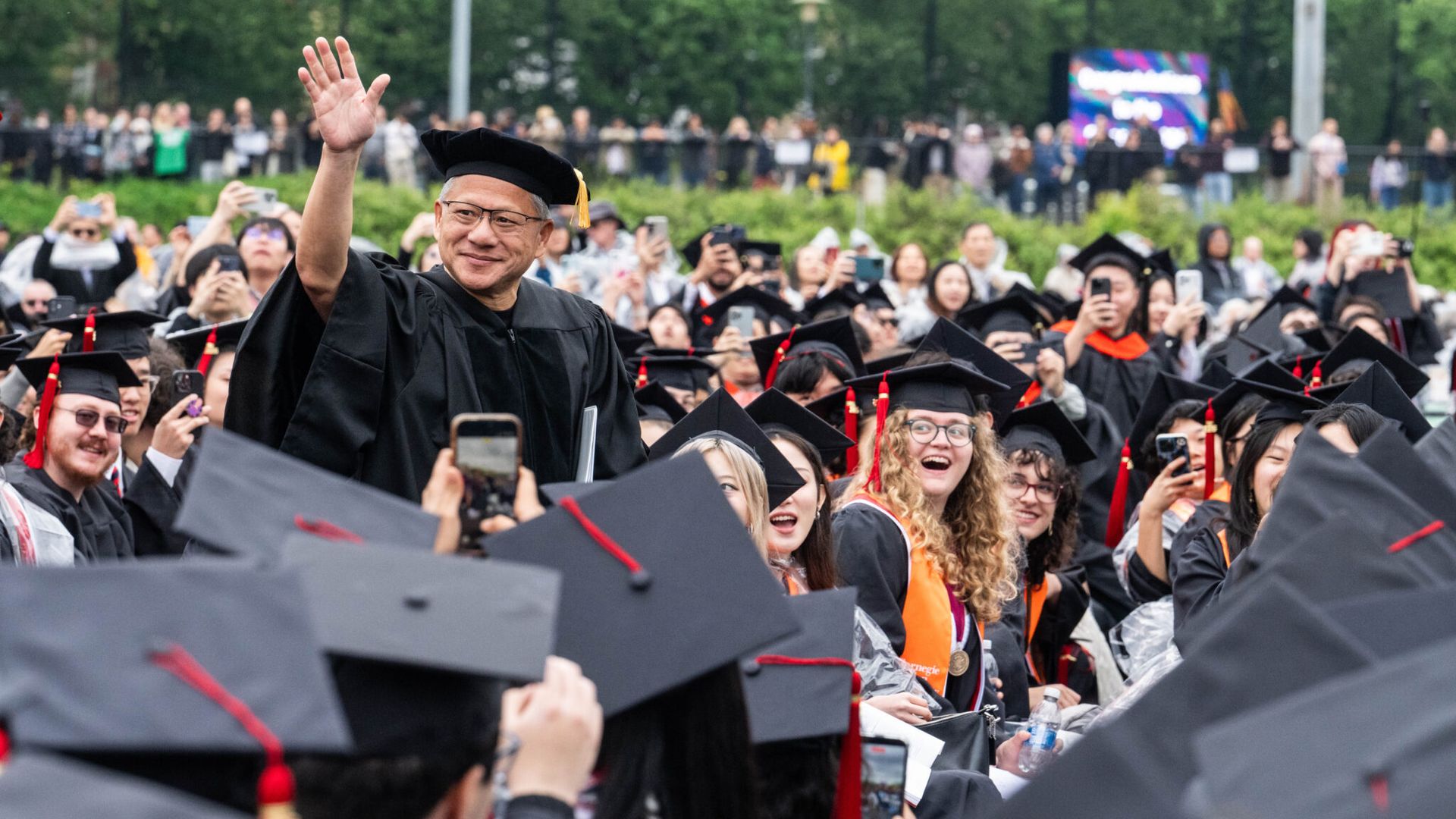
Nvidia founder and CEO Jensen Huang told graduates at Carnegie Mellon University in Pittsburgh yesterday that demand for AI infrastructure is creating a "once-in-a-generation opportunity to reindustrialize America and restore the nation's capacity to build."
Why it matters: With many college grads fearing AI could obliterate their career dreams, Huang pointed to boundless opportunity as a "new industry is being born. A new era of science and discovery is beginning ... I cannot imagine a more exciting time to begin your life's work."
Nvidia, which makes AI chips, is the world's most valuable company. Huang told 5,800 recipients of undergraduate and graduate degrees that the AI buildout will require plumbers, electricians, ironworkers, and builders for chip factories, data centers and advanced manufacturing facilities.
- "No generation has entered the world with more powerful tools — or greater opportunities — than you," he said. "We are all standing at the same starting line. This is your moment to help shape what comes next. So run. Don't walk."
"Every major technological revolution in history created fear alongside opportunity," Huang added. "When society engages technology openly, responsibly, and optimistically, we expand human potential far more than we diminish it."
4. Training data
- Scoop: A pro-AI super PAC backed by OpenAI's Greg Brockman, Palantir co-founder Joe Lonsdale and longtime tech VC Ron Conway endorsed three more Democrats in upcoming primaries. (Axios)
- More than 600 OpenAI employees made $6.6 billion total after the company let them sell their shares last October. (Wall Street Journal)
5. + This
Mady here after "making" an AI-generated gospel rendition of Sam Altman's texts to Mira Murati while he was being ousted as CEO. TikTokers have been obsessed with turning texts into gospel songs using platforms like Suno, which is what I used for this.
Thanks to Megan Morrone for editing this newsletter and Matt Piper for copy editing.
Sign up for Axios AI+
