Axios AI+
November 14, 2024

Good morning! Chicago Magazine convinced Blackhawks star Connor Bedard and the Art Institute to help them recreate a classic scene from "Ferris Bueller's Day Off."
Today's AI+ is 1,170 words, a 4.5-minute read.
1 big thing: Anthropic's Claude gets a nuclear test


Anthropic is working with the Department of Energy's nuclear specialists to ensure its models don't help people make weapons, the company first shared with Axios.
Why it matters: Anthropic believes this is the first time a frontier model has been used in a top secret environment, paving the way for similar partnerships with other government agencies.
Zoom in: Anthropic said today that it's been working with DOE's National Nuclear Security Administration since April to "red team" Claude 3 Sonnet to make sure its model wasn't sharing potentially dangerous information about nuclear energy.
- In red-teaming exercises, experts test systems by trying to break them.
- NNSA has been testing Anthropic's models to see whether people could abuse them to find nefarious use cases for nuclear energy, like developing weapons.
The latest: The pilot program was just extended through February so NNSA can red team Claude 3.5 Sonnet, which Anthropic unveiled in June, for the same concerns.
- Anthropic tapped its existing partnership with Amazon Web Services to prepare Claude for government use.
Yes, but: Given the sensitive nature of this testing, Anthropic did not disclose the findings of the pilot program.
- The company told Axios it plans to share its findings with scientific labs and other organizations so they can conduct their own testing.
What they're saying: "While U.S. industry leads in frontier model development, the federal government has unique expertise needed to evaluate AI systems for certain national security risks," Anthropic national security policy lead Marina Favaro said in a statement.
- "This work will help developers build stronger safeguards for frontier AI systems that advance responsible innovation and American leadership," she added.
Catch up quick: President Biden issued a national security memorandum last month that called on the Energy Department and other agencies to conduct AI safety tests in classified settings.
- Both Anthropic and OpenAI signed agreements with the AI Safety Institute in August to test their models for national security risks ahead of public release.
The intrigue: AI model operators are racing to get government contracts.
- Anthropic launched a partnership with Palantir and Amazon Web Services last week to make Claude available to U.S. intelligence agencies.
- OpenAI has inked deals with the Treasury Department, NASA and several other agencies.
- Scale AI has developed its own model based on Meta's open-source Llama for the defense sector.
What we're watching: As with most projects in Washington right now, it's unclear whether these safety testing partnerships will survive the Trump transition.
- Elon Musk, now part of the president-elect's inner circle, has been a wild card on the question of AI safety.
- A longstanding concern that AI could endanger humanity's future led Musk to become a cofounder of OpenAI in 2015, and more recently he supported a failed state measure in California to impose tighter safety controls on large models.
- At the same time, Musk is developing and promoting his own AI brand and model, xAI — which favors an "anything goes" approach in the name of free speech.
Go deeper: AI safety becomes a partisan battlefield
2. Exclusive: NHL updates massive video trove, readying for AI

For the past five years, the National Hockey League has been moving its massive collection of video footage from hard drives and slow tape backups to flash storage.
Why it matters: Having a fast and unified storage system provides greater efficiency today. It's also preparing the league for a new world of AI-enabled features for fans and players alike.
Driving the news: The NHL has been working with VAST Data, a storage technology company that has also done work for xAI and Pixar, among others.
- The first phase of the project involved moving decades of video archives, some 20 petabytes of data, onto the modern storage platform.
- The NHL also has VAST's systems installed at each of the league's arenas, enabling faster turnaround of high-resolution game footage for use by broadcasters and content creators.
Between the lines: The effort has resulted in a more efficient use of scarce IT resources, avoiding the need for folks with specialized storage knowledge such as how to build Fibre Channel networks.
- "Any time you can remove complexity in IT you are doing something right," Grant Nodine, the NHL's senior VP of technology, told Axios.
The data move also makes it easier to do machine learning and computer vision work on all that video, Nodine said. The effort complements an existing push to get more data from sensors in pucks and player jerseys.
- While sensors can show where the puck and skaters are, video analysis can help show which way a player is facing and who has control of the puck.
- The result will be more statistics for data-hungry fans as well as insights that players and teams can use to improve their performance.
The bottom line: As hockey legend Wayne Gretzky famously said, you want to skate to where the puck is going, not to where it is.
3. Palantir's defense head on the AI race with China

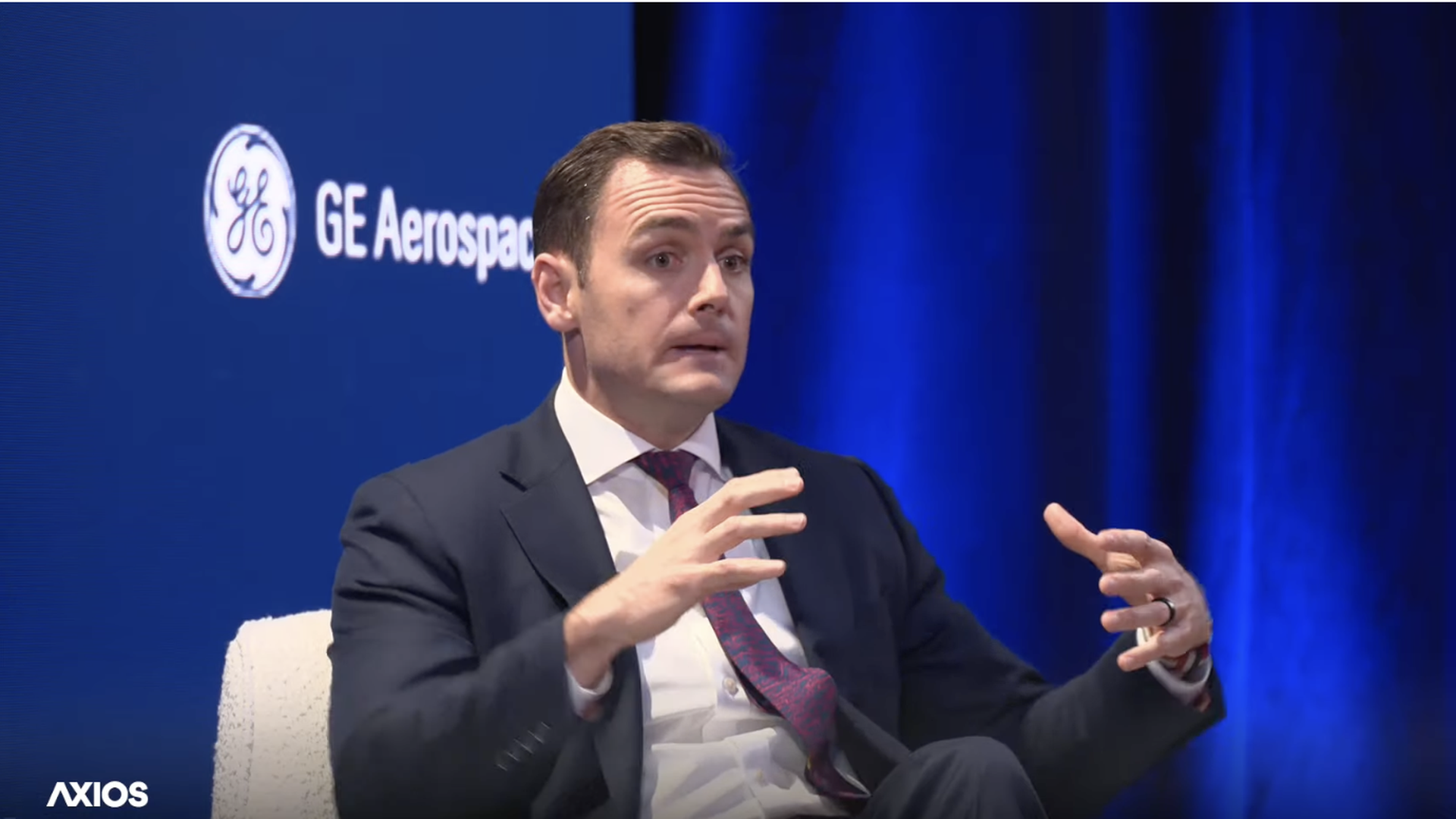
This is no time for complacency in the U.S.'s race against China to lead artificial intelligence, Mike Gallagher, Palantir head of defense, told Axios' Mike Allen at the Axios Future of Defense event in Washington yesterday.
Why it matters: Gallagher suggested that leveraging software and AI to automate processes could help the Department of Defense reinvest resources into more critical military capabilities.
- Gallagher had previously served in the U.S. House as a Republican representative from Wisconsin and chaired the House select committee on competition with China.
Zoom out: In the shadow of President-elect Trump nominating a slate of controversial figures to various White House or Cabinet posts, Gallagher warned political infighting could hinder innovation.
- "My concern is that we find ourselves mired in cultural or political issues, and we don't get the actual meaningful modernization that we need done," Gallagher said.
Catch up quick: Palantir recently teamed up with Amazon and OpenAI competitor Anthropic to make Anthropic's Claude models available to U.S. intelligence and defense agencies.
When Palantir CEO Alex Karp publicly said that America was a force for good in the world, it was a "recruiting bonanza," Gallagher told Axios.
- "There are so many young patriots that want to work for a company like Palantir that is unapologetic in its desire to support the U.S. military and also do cool stuff in the commercial space," Gallagher said.
Go deeper: Palantir hires China hawk Mike Gallagher
4. Training data
- OpenAI will offer a research preview of a new AI agent in January, per sources. Codenamed "Operator," the tool will take actions on a user's behalf. (Bloomberg)
- CoreWeave raised a further $650 million in a secondary offering, with Cisco and Pure Storage among the investors. (CNBC)
- AMD said it would lay off about 1,000 employees, or 4% of its staff. (The Verge)
- A VC-backed startup that makes artificial diamond substrates for GPUs and other semiconductors has just secured $50 million in combined federal and California state tax credits. (Axios)
5. + This
While we are on the subject of hockey, I'm excited that EA's upcoming NHL 25 will feature teams and players from the Professional Women's Hockey League — continuing a positive trend of including female athletes in sports video games.
Thanks to Megan Morrone and Scott Rosenberg for editing this newsletter and to Anjelica Tan for copy editing it.
Sign up for Axios AI+
