Axios AI+

May 28, 2025

Investors will be keeping a close eye on Nvidia's earnings report later today to get a sense of what President Trump's trade policies are doing to the bellwether chip giant — and the whole AI industry. Today's AI+ is 1,233 words, a 4.5-minute read.
1 big thing: Google tries smart glasses again

More than a decade after its Google Glass flopped, Google is developing a new generation of augmented reality glasses designed to merge the physical and digital worlds.
Why it matters: Augmented reality glasses are shaping up to be a key interface for AI-powered computing.
- Meta has invested steadily in the category and Apple and others are ramping up development.
Driving the news: At Google I/O, the company offered more details on its prototype Android XR glasses and announced partnerships with Samsung and Warby Parker.
- Unlike Meta's existing Ray-Ban smart glasses, Google's prototype adds an optional small display to the standard cameras, speakers and microphones.
- Google also showed off its Gemini AI assistant running on its Project Moohan headset, the Apple Vision Pro rival that Samsung and Google plan to start selling later this year.
- Google teased a third device, Project Aura, by Chinese hardware maker Xreal, known for glasses that allow users to both see the real world and watch movies and other content on a large virtual display.
How it works: Google's XR glasses connect via a nearby smartphone, while Aura glasses tether to a small custom computer powered by a Qualcomm processor.
Flashback: Introduced in 2013, the "explorer edition" of Google Glass cost a whopping $1,500 despite its limited function and awkward design, including a small display that was housed in a prominent acrylic block. Those who bought the device were often mocked, with some dubbing wearers as "glassholes."
- Google has had an on-again, off-again relationship with virtual and augmented reality ever since. It has had a range of products, many short-lived, including its low-end Cardboard and its Daydream family of devices.
Between the lines: Reflecting on Google Glass, Sergey Brin said the product was too expensive and too distracting, among other flaws.
- "I definitely feel like I made a lot of mistakes with Google Glass," Brin said during an on-stage interview at Google I/O, appearing alongside Demis Hassabis. "I just didn't know anything about consumer electronic supply chains."
- "I am still a big believer in the format, so I'm glad that we have it now."
Hassabis said modern AI gives the glasses a purpose.
- "I feel like the universal assistant is the killer app for smart glasses and I think that's what's going to make it work," he said, adding that the underlying hardware technology "has also moved on and improved a lot."
Zoom in: I tried both the prototype Android AR glasses and Project Moohan and both felt like a glimpse of the future and solid competitors to the products on the market.
- The display on the AR glasses is small but has enough detail to show images, such as a small map with directions. Google's Gemini AI assistant is available at the touch of a button and was able to answer a wide array of questions about paintings and other objects in the demo environment.
- Project Moohan felt lighter than the Vision Pro and offered a wide field of view.
- The controls were just as intuitive as the Vision Pro, but with an easier setup.
Yes, but: Google's augmented reality glasses aren't coming this year, while Meta is expected to offer a version of its Ray-Bans with a small screen included.
- Project Aura is also seen as largely a 2026 proposition, though some developers might get their hands on the device a bit sooner.
2. Exclusive: Meta shuffles AI team to move faster

Meta is restructuring its AI teams to speed up the rollout of new products and features, as Axios first reported yesterday.
Why it matters: Meta faces stiff competition in the AI race, including from OpenAI and Google as well as Chinese rivals such as TikTok parent ByteDance.
Driving the news: In an internal memo sent yesterday and seen by Axios, chief product officer Chris Cox laid out the new structure, which will see efforts divided into two teams: an AI products team, headed by Connor Hayes, and an AGI Foundations unit, co-led by Ahmad Al-Dahle and Amir Frenkel.
- The AI products team will be responsible for the Meta AI assistant, Meta's AI Studio and AI features within Facebook, Instagram and WhatsApp.
- The AGI Foundations unit will cover a range of technologies, including the company's Llama models, as well as efforts to improve capabilities in reasoning, multimedia and voice.
- The company's AI research unit, known as FAIR (Fundamental AI Research), remains separate from the new organizational structure, though one specific team working on multimedia is moving to the new AGI Foundations team.
Between the lines: No executives are leaving as part of the changes, nor are any jobs being cut, though the company has moved in some leaders from other parts of the company.
- Meta hopes that splitting a single large organization into smaller teams will speed product development and give the company more flexibility as it adds additional technical leaders.
- The company is also seeing key talent depart, including to French rival Mistral, as reported by Business Insider.
What they're saying: "Our new structure aims to give each org more ownership while minimizing (but making explicit) team dependencies," Cox said in the memo.
Flashback: Meta reshuffled its AI teams in 2023 with a similar goal of speeding its efforts.
3. AI makes phishing scams harder to detect

AI chatbots have made scam emails harder to spot and the tells we've all been trained to look for — clunky grammar, weird phrasing — utterly useless.
Why it matters: Scammers are raking in more than ever from basic email and impersonation schemes. Last year, the FBI estimates, they made off with a whopping $16.6 billion.
- Thwarting AI-written scams will require a new playbook that leans more on users verifying messages and companies detecting scams before they hit inboxes, experts say.
The big picture: ChatGPT and other chatbots are helping non-English-speaking scammers write typo-free messages that closely mimic trusted senders.
- Before, scammers relied on clunky tools like Google Translate, which often were too literal in their translations and couldn't capture grammar and tone.
- Now, AI can write fluently in most languages, making malicious messages far harder to flag.
What they're saying: "The idea that you're going to train people to not open [emails] that look fishy isn't going to work for anything anymore," Chester Wisniewski, global field CISO at Sophos, told Axios.
- "Real messages have some grammatical errors because people are bad at writing," he added. "ChatGPT never gets it wrong."
The big picture: Scammers are now training AI tools on real marketing emails from banks, retailers and service providers, Rachel Tobac, an ethical hacker and CEO of SocialProof Security, told Axios.
- "They even sound like they are in the voice of who you're used to working with," Tobac said.
- Tobac said one Icelandic client who had never before worried about employees falling for phishing emails was now concerned.
- "Previously, they've been so safe because only 350,000 people comfortably speak Icelandic," she said. "Now, it's a totally new paradigm for everybody."
4. Training data
- Salesforce is paying $8 billion to buy cloud data management giant Informatica, the latest in a string of acquisitions. (CNBC)
- Anthropic is testing a voice mode for the mobile version of Claude with plans to expand the feature in the coming weeks. (TechCrunch)
- Following in the footsteps of Google, Facebook and Apple, OpenAI is exploring allowing people to use ChatGPT credentials to log in to other apps. (TechCrunch)
5. + This
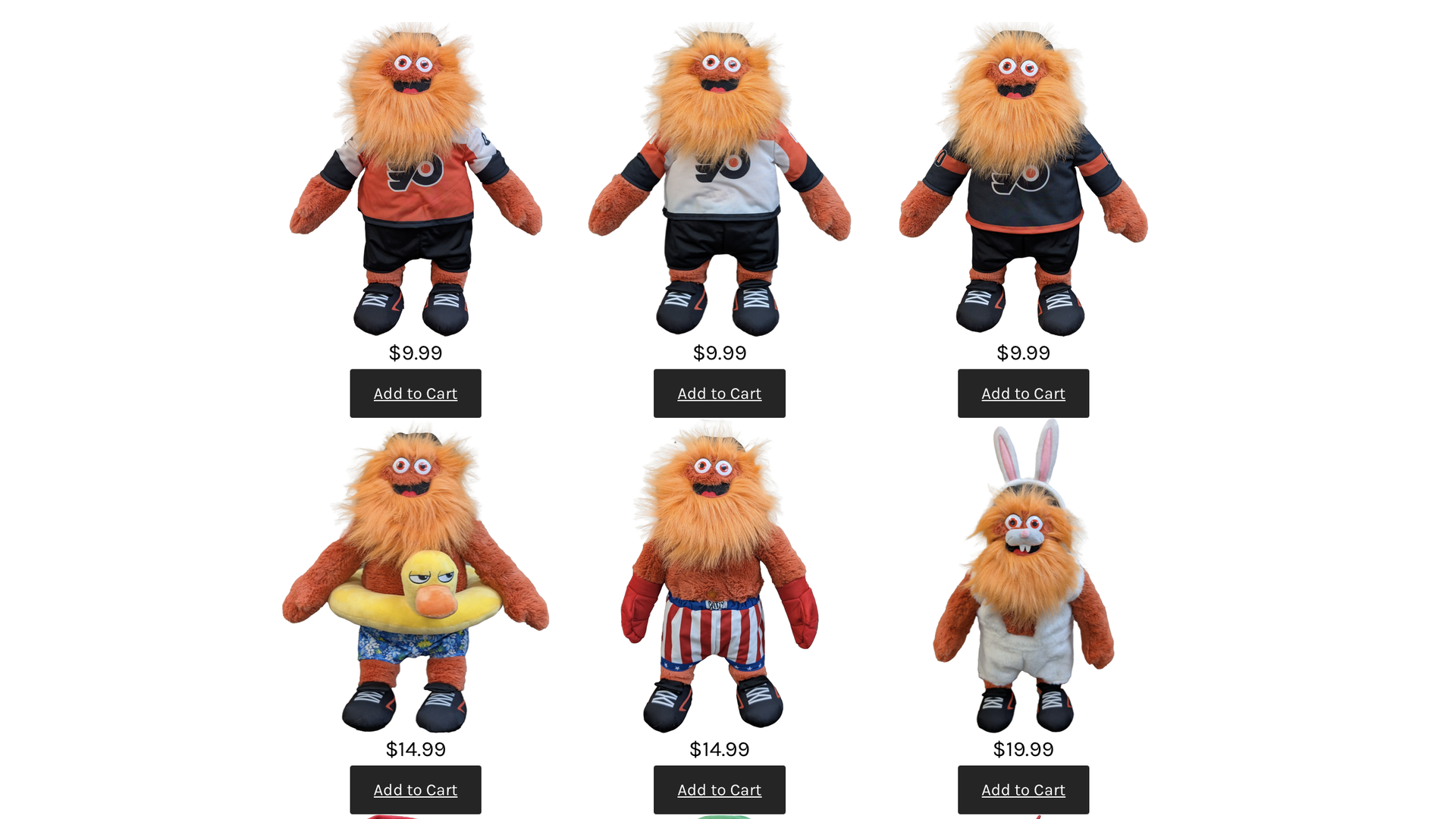
You can now build your own "Itty bitty Gritty," a custom version of the popular Philadelphia Flyers mascot. I haven't ordered one. Yet.
Thanks to Scott Rosenberg and Megan Morrone for editing this newsletter and Matt Piper for copy editing.
Sign up for Axios AI+
