Axios AI+

March 04, 2024

1 big thing: Ads are coming to chatbots

Illustration: Sarah Grillo/Axios
The days of spending hours using AI chatbots uninterrupted by ads could soon end, as startups and big companies eye the nascent market as a big opportunity.
Why it matters: Creating and operating AI chatbots can be expensive and advertising is one idea for making them profitable.
Zoom in: An early player here is Adzedek, a two-person startup that serves ads within custom GPTs from OpenAI's GPT store, as well as within chatbot apps that use OpenAI's API.
- In both cases, Adzedek returns sponsored results as part of its response to queries — somewhat similar to the search-advertising business dominated by Google.
By the numbers: Adzedek uses a pay-per-click model, with 75% of the ad revenue going to the chatbot creator and Adzedek keeping 25%.
- The company says ads using its system have been shown more than 1 million times, with three-quarters of that over the last month or so.
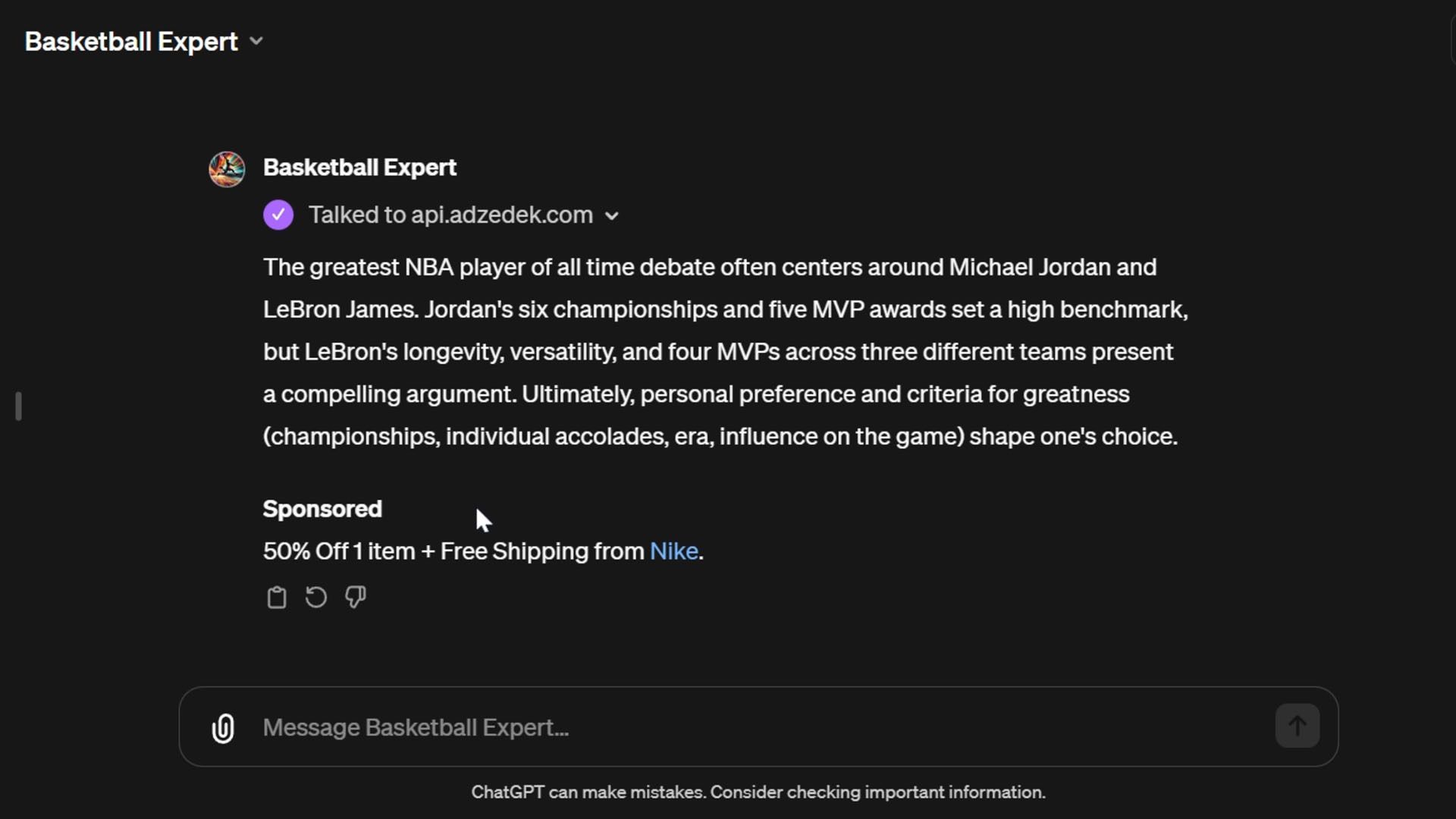
- Here's a video of what Adzedek's advertising looks like, with Nike shown as a hypothetical advertiser.
Adzedek co-founder Abdullah Ilyas, a recent college graduate, says he was drawn to the business opportunity after sitting in classes and seeing that students were constantly using ChatGPT.
- Plus, he says, as cookies are vanishing from the ad-tracking landscape, advertisers need more ways to understand what a user is interested in, something chatbots provide.
- "This is like a perfect storm for what we are doing," he said.
What we're watching: OpenAI today has no rules on how advertising can be inserted into custom GPTs and doesn't get a cut of the revenue. But experts say that could change very quickly.
- "Maybe they are just letting the smaller players experiment on their behalf," said Columbia University marketing professor Olivier Toubia. "It won't be hard for them to monetize if and when they decide."
The big picture: Advertising tends to go where the eyes are. So if people spend lots of time using chatbots, ad dollars are likely to flow.
- For Google, it's a potentially existential threat, if searchers turn to others' chatbots rather than its search engine.
- The search leader is hoping to offer the best of both worlds. However, even if the company can dominate the chatbot industry the way it owns search, it could take a hit to revenue if chatbot advertising turns out to be less lucrative than the cash cow of search advertising.
Google and Microsoft have said they are exploring how advertising might work with their chatbots.
- Google doesn't have ads in Gemini today, but CEO Sundar Pichai has said Google is looking to see where ads could fit, including new types of ads that could be native to its AI-infused search, known as SGE.
- "SGE is creating new opportunities for us to improve commercial journeys for people by showing relevant ads alongside search results," Pichai said during the company's January earnings call. "We've also found that people are finding ads either above or below the AI-powered overview helpful, as they provide useful options for people to take action and connect with businesses."
Microsoft is further along in developing an ad business around chat. Its own Copilot sometimes — but not always — includes ads as part of its response, while it also has a Chat Ads API that can be used by publishers, apps and other online services to include ads.
- Snapchat, Baidu and Axel Springer are among the first partners for that service. It provides publishers, apps, and online services the ability to customize their own chat experiences with ads.
Reality check: So far, the big players have focused on subscriptions to generate revenue from the consumer market, with Microsoft, OpenAI and Google all offering $20-per-month services.
- It's too early to credibly predict how large the market for in-chatbot ads will be, says Brian Wieser, a principal at Madison and Wall, a tech and media advisory firm.
- "The market for ads within chatbots depends on so many unknowns — what the product is, what the go-to-market is and any other considerations around the consumer experience, pricing, etc.," Wieser tells Axios.
Between the lines: Many new tech products start with an advertising format that mimics the previous generation's design but find their most lucrative business with new ad types that are more native to the medium.
- Such was the case with the transition from analog to digital, from desktop to mobile and from web to social advertising.
- Adzedek's ads look like traditional text ads and are delineated as sponsored, but there are many other ways advertising could work within a chatbot.
Yes, but: Some of the other options are risky, especially in the absence of clear laws or ethical guidelines.
- For example, a company could theoretically pay a chatbot creator to steer the discussion toward certain products, ideas or even belief systems.
- Companies could pay to have certain information included in training data.
- Toubia said such efforts could be subtle and hard to track. "We don't want to leave it to companies to self-regulate," he said.
2. OpenAI's growing list of legal headaches

Illustration: Brendan Lynch/Axios
3. Training data
4. + This
Axios AI+

Scoops on the AI revolution and transformative tech, from Ina Fried, Madison Mills, Ashley Gold and Maria Curi.