Axios AI+

October 14, 2025

The bad news is I did something to my back and it's aching. The good news is I learned a fun new word for a pinched nerve: radiculopathy. Also, RIP Miss Major. Today's AI+ is 1,283 words, a 5-minute read.
Situational awareness: OpenAI and Walmart are teaming up to let shoppers plan meals, restock essentials and use instant checkout directly through ChatGPT, Axios' Kelly Tyko reports.
1 big thing: Global AI race will redefine geopolitics

A new report from JPMorgan Chase warns that AI will shake up global alliances, stoke fresh populism and change the rules of war in the century ahead.
Why it matters: The report, first seen by Axios, says the U.S. is dominating the worldwide AI race. Efforts to maintain that dominance are ushering in new, uncomfortable norms.
Zoom in: "The Geopolitics of AI: Decoding the New Global Operating System" calls the 2024 presidential election "the most consequential event" that has shifted the geopolitics of AI over the past year.
- This year, the U.S. "government's orientation to the tech sector and to the wider international community has shifted," the JPMorgan Chase Center for Geopolitics wrote.
Private-sector AI or AI-adjacent companies now see the government as a dealmaker or a direct investor.
- The Trump administration took a stake in Intel, and officials agreed to let Nvidia sell some chips in China in exchange for a portion of sales — developments that some have likened to a command economy.
- The U.S. is "reshuffling the global conditions in which nations are approaching their AI priorities," the report says.
What they're saying: "I wouldn't want to trade places with any other country in the world when it comes to where we are on AI," Derek Chollet, an author of the report who leads JPMorgan Chase's Center for Geopolitics, tells Axios.
- Chollet was counselor to Secretary of State Tony Blinken in the Biden administration and then chief of staff to Secretary of Defense Lloyd Austin.
- The report says the U.S. dominates in terms of private-sector AI investment, with the first half of 2025 on track to surpass the previous year's sum.
Yes, but: Some Trump-era policies might ultimately set America back in AI innovation, the report says.
- "[R]ecent trends related to tariffs, immigration and the reduction in U.S. science and technology funding may be in tension with the nation's stated AI goals globally," the authors write.
Driving the news: That tension is on display in the latest dial-up of trade tensions between the U.S. and China — the two nations that JPMorgan Chase says are most AI dominant, though the nations are on divergent paths.
- China threatened to cut off global access to its rare earth supplies, a critical input for a range of U.S. products, including semiconductors.
- Trump threatened to retaliate with 100% tariffs on Chinese goods and harsher export controls on critical software, though later insisted "it will all be fine!" with China.
What to watch: "AI is as geopolitically significant as anything since the dawn of the nuclear age 80 years ago," Chollet tells Axios.
- "Governments drove technological development in the nuclear age, but AI has principally been driven by the private sector. Now governments all around the world are having to play catch-up," says Chollet.
The bottom line: JPMorgan Chase says there are seven "strategic axes" that are "already motivating governments, businesses, and alliances to reposition in ways that will shape the century ahead."
- "Assertive China" is investing huge sums to try to position itself at the "forefront of AI development."
- America is repositioning itself "to counterbalance China's rise."
- The European Union is "striving to reduce their dependence on foreign technology and bolster their own AI capabilities."
- The Middle East's "sovereign wealth funds are leveraging energy abundance to become key players in AI infrastructure."
- Labor disruption & populism: AI "impacts are likely to include significant transitions for markets, for work, and for workers."
- Defense leadership: "Militaries that integrate AI fastest will hold decisive battlefield advantages."
- Energy & hardware as the new chokepoints: "Semiconductors, critical minerals, and electricity capacity define who can scale AI, and who risks falling behind."
2. AI writing hasn't won the web yet

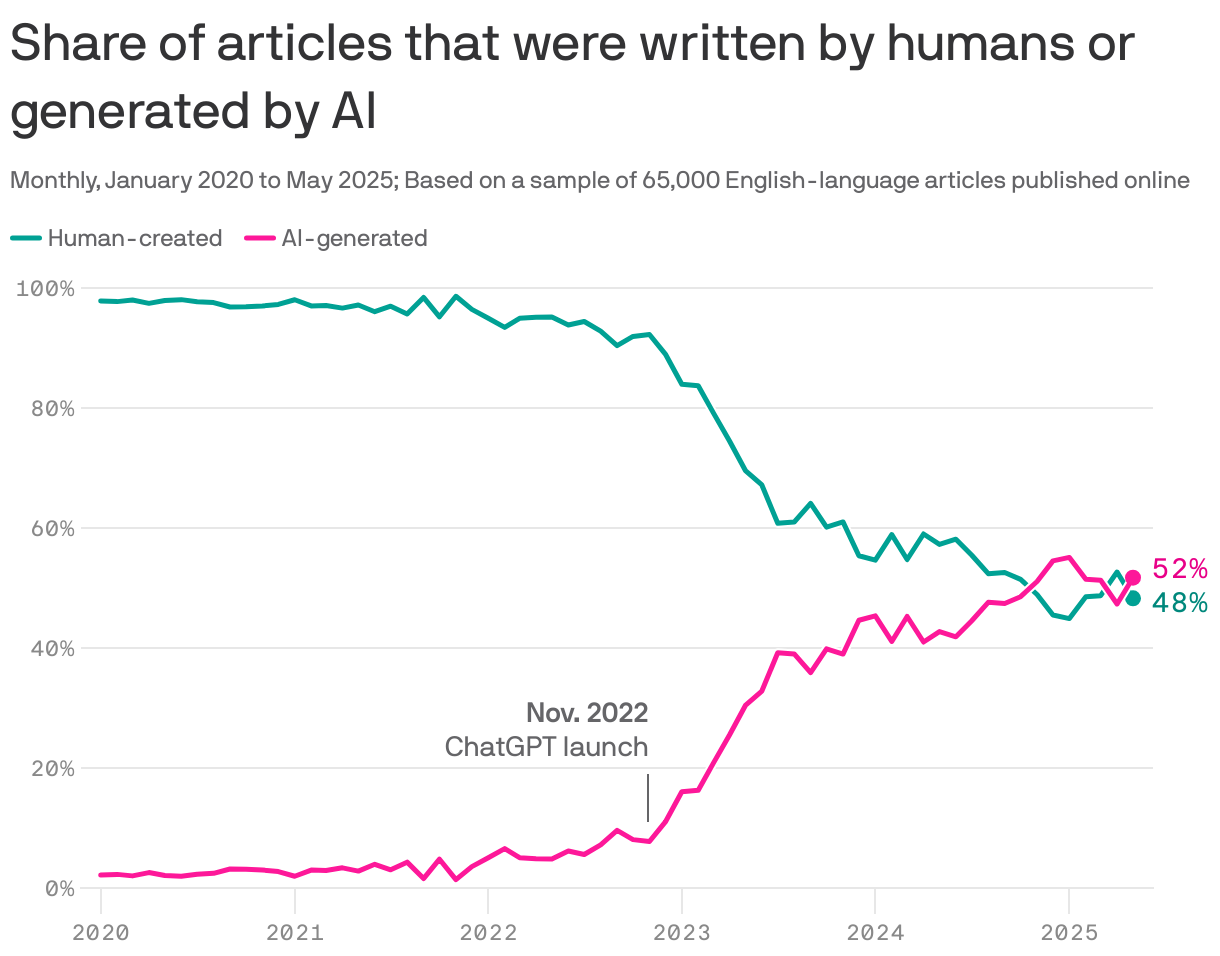
New articles generated by AI briefly outnumbered those written by humans online, but the two are now roughly equal, per a new report from SEO firm Graphite.
Why it matters: Researchers have long feared that if AI-made content online overwhelms human-created material, large language models could choke on their own exhaust and collapse.
The big picture: A 2022 report from Europol estimated that 90% of online content would be generated by AI by 2026.
- According to Graphite's analysis of 65,000 URLs that were posted online between 2020 and 2025, the percentage of AI-generated articles rose sharply after ChatGPT's launch in November 2022.
- The percentage of AI-generated articles in this data set briefly surpassed human-written articles in November 2024, but the two have stayed roughly equal since.
What they did: Graphite used an AI detector called Surfer to analyze a random sample of URLs from Common Crawl, an open source database of over 300 billion web pages. The database spans 18 years and adds 3–5 billion new pages monthly.
- The pages had publish dates between January 2020 and May 2025 and were classified as either articles or listicles using Graphite's article page type classifier.
- Articles were deemed AI-generated if 50% or less of the content was found by Surfer to have been written by a human.
Zoom in: Distinguishing between machine and human-written content is tricky.
- To evaluate Surfer's accuracy, Graphite tested it with its own sample of AI-generated articles and with a set published before ChatGPT's launch, which were likely written by humans.
- Surfer had a 4.2% false positive rate (labeling human-written articles as AI-generated) and a 0.6% false negative rate (labeling AI-written articles as human) for articles it generated with GPT-4o.
By the numbers: Content farms may also be learning that AI-generated content isn't prioritized by search engines and chatbot responses, according to a second report from Graphite.
- Graphite found that 86% of articles ranking in Google Search were written by humans, and 14% were generated by AI.
- The pattern held across chatbots, too. 82% of articles cited by ChatGPT and Perplexity were written by humans, and only 18% were AI-generated, according to Graphite's research.
- When AI-generated articles do appear in Google Search, they tend to rank lower than human-written articles.
Yes, but: Researchers told Axios that a definitive count of AI-made content isn't possible with today's tools and definitions.
- It's hard to determine what content is AI-generated and what is human-generated because humans are increasingly working together with AI.
- "At this point, it's a symbiosis more than a dichotomy," Stefano Soatto, professor of computer science at UCLA and VP at Amazon Web Services, told Axios.
3. Meta still on prowl for AI talent

Meta's hiring of Thinking Machines co-founder Andrew Tulloch is a sign that Mark Zuckerberg isn't done with nabbing big-name AI talent, according to a source familiar with the company's plans.
Yes, but: The source said Tulloch's pay package is less than an earlier offer he turned down. A previous report denied by Meta said Tulloch rejected an offer that could have approached $1.5 billion, factoring in various incentives and a rise in Meta's stock.
4. Training data
- OpenAI closed a multiyear deal with Broadcom to work together on chips with an eye toward delivering 10 gigawatts of compute power. (N.Y. Times)
- California Gov. Gavin Newsom signed SB 243 to mandate AI chatbot companion safety protocols. (Axios)
- Exclusive: Visa announced a new tool to help merchants distinguish legitimate AI shopping agents from malicious bots. (Axios)
5. + This
I'm allergic to avocado, so this does little for me, but researchers at Oregon State University have a new AI app to detect when avocados are ripe.
Thanks to Megan Morrone for editing this newsletter and Matt Piper for copy editing.
Sign up for Axios AI+