Axios AI+

July 25, 2025

Yes, it's been a long week — but not only is today Friday, it's also National Tequila Day. Today's AI+ is 1,146 words, a 4.5-minute read.
1 big thing: Courts' looming deepfake evidence nightmare


Photos, videos and audio — once courtroom gold — are becoming less reliable as deepfakes spread, digital forensics experts warn.
Why it matters: Courts can't keep up, and there aren't enough forensic analysts to verify AI-faked evidence.
The big picture: AI-generated evidence can take many forms. Consider the following hypotheticals:
- A divorce case where one parent edits a photo's background to imply the child was in an unsafe environment.
- A murder investigation where deepfake video falsely puts an innocent person at the scene the crime.
- A wrongful termination lawsuit over the creation of a deepfake audio recording that contains fireable comments from a co-worker (something similar has already happened in Baltimore County).
Between the lines: As AI tools improve, proving that a photo, video or audio snippet was manipulated will get more challenging, if not impossible.
- As with financial fraud cases that rely on expert testimony to unpack accounting records, courts will now depend on digital forensics experts to spot the telltale signs of tampered media.
- Even expert analysis may not be enough to persuade a jury beyond a reasonable doubt.
Threat level: Photos, videos and audio have long been the gold standard for evidence in any legal case.
- "Everybody has images, everybody has voice recordings, CCTV cameras, police body cameras, dashcams," Hany Farid, co-founder and chief science officer at GetReal Security, told Axios. "It's just everything. It's bonkers."
The other side: Defendants will also face challenges in proving their media hasn't been altered by AI.
- For example, lawyers could argue that body camera footage from a police officer was tampered with, even if it wasn't.
- "In parts of the country where the police are not trusted, that could gain some traction," Farid said.
The intrigue: This isn't the first time courts have had to adapt to new technology, Farid added.
- When photo and video evidence first emerged, judges often required negatives or scrutinized timestamps.
- But today's legal standards haven't caught up to the speed and sophistication of deepfake tools, which are evolving far faster than past media forms.
Zoom in: Even for forensics investigators, the technology isn't there yet to help track the chain of custody for deepfakes, Joseph Pochron, managing director of digital investigations and cyber risk at Nardello & Co., said at the Deepfake Resilience Symposium in San Francisco last week.
- Each AI verification tool on the market is a black box in terms of how it determines what percentage of a piece of content was AI-generated, creating an opening for manipulation and misinterpretation of images, videos and audio, Pochron said.
- Now, investigators have to get creative with how they prove something is or is not AI-manipulated.
- Pochron's team has begun transcribing audio and analyzing sentence structure to see if it matches patterns common in AI tools. But even that method will be moot within a year as deepfakes become more humanlike.
The bottom line: Experts urge people to preserve as many original files — voicemails, text messages, photos — on their devices as possible in case they're needed in court.
- "We've had a couple [cases] where it's an email that's been emailed again, but where's the original?" Pochron said. "The metadata or any other supporting artifacts may be crucial to help us figure this out."
What's next: AI tools have already perfected the art of deepfake images and audio, and it will be less than two years until they fine-tune fake videos, too, Farid said.
Go deeper: Scammers may benefit from ChatGPT's new image tool
2. OpenAI's GPT-5 is coming next month


OpenAI's long-anticipated GPT-5 model is set to debut sometime in August, Axios has learned.
Why it matters: The race to create the biggest and best AI models is accelerating as the Trump administration has said the U.S. must do "whatever it takes" to beat China.
The big picture: GPT-5 was expected earlier, but OpenAI's plans have shifted several times. Recently, though, there have been signs its release is imminent.
- CEO Sam Altman posted on X on July 19 that GPT-5 would be released "soon."
- Then Altman appeared July 23 on Theo Von's podcast, where he praised the abilities of the new model.
- GPT-5 use is already surfacing in the wild, as testers get their hands on the code and security experts do their red teaming — additional signs that the model is getting close to release.
Between the lines: In addition to being better at coding and more powerful overall, GPT-5 is expected to combine the attributes of both traditional models and so-called reasoning models such as o3.
- Altman clarified that the model OpenAI recently used to achieve gold medal performance at the International Mathematical Olympiad would not be included in GPT-5.
- OpenAI is planning to launch GPT-5 with mini and nano versions that will also be available through its API, according to The Verge, which first reported the new timeline.
The intrigue: OpenAI's new open-weights model is also coming soon, but could arrive before or after GPT-5 depending on last-minute schedule tweaks, Axios has heard.
- That model, too, has seen delays from initial expectations.
- OpenAI hasn't released an open-weights model since GPT-2 in 2019.
3. Global investors can't quit American AI

Investors who flocked to Europe for outsized market returns earlier this year are now coming back — not because of America itself, but because of America's AI dominance.
Why it matters: Without an AI boom of its own, Europe will struggle to keep up and attract global investors.
What they're saying: "People want to be in the U.S. markets in the AI trade," Stuart Kaiser, head of U.S. equity strategy at Citi, tells Axios.
Zoom in: The numbers tell the story.
- Nvidia alone is worth an amount equal to 14% of the total U.S. GDP, notes Brave Eagle Wealth Management chief investment officer Robert Ruggirello.
- "Not owning it is ... painful," he wrote in a note.
Between the lines: U.S. firms are embracing AI at scale. Europe is behind.
- European firms lag U.S. peers by 45–75% on AI adoption, according to an October 2024 McKinsey report.
- Europe's slower AI momentum reflects regulatory pressure, higher corporate taxes, and fragmented markets — barriers the U.S. doesn't face.
- Even European AI successes often funnel into U.S. markets: DeepMind, the British AI firm behind Gemini, sold to Alphabet in 2014.
Reality check: Strategists still see growth opportunities in Europe and beyond, given fiscal stimulus and potentially better economic growth.
4. Training data
- C3.ai said CEO Tom Siebel will step down due to health issues involving an autoimmune disease and "significant visual impairment." (Silicon Valley Business Journal)
- Amid a flurry of recent layoffs, Microsoft CEO Satya Nadella penned a memo to staff warning the AI transition "might feel messy at times." (GeekWire)
- A Google executive apologized for bugs in Google Assistant's performance of home automation tasks and promised significant improvements later this year. (9to5 Google)
5. + This
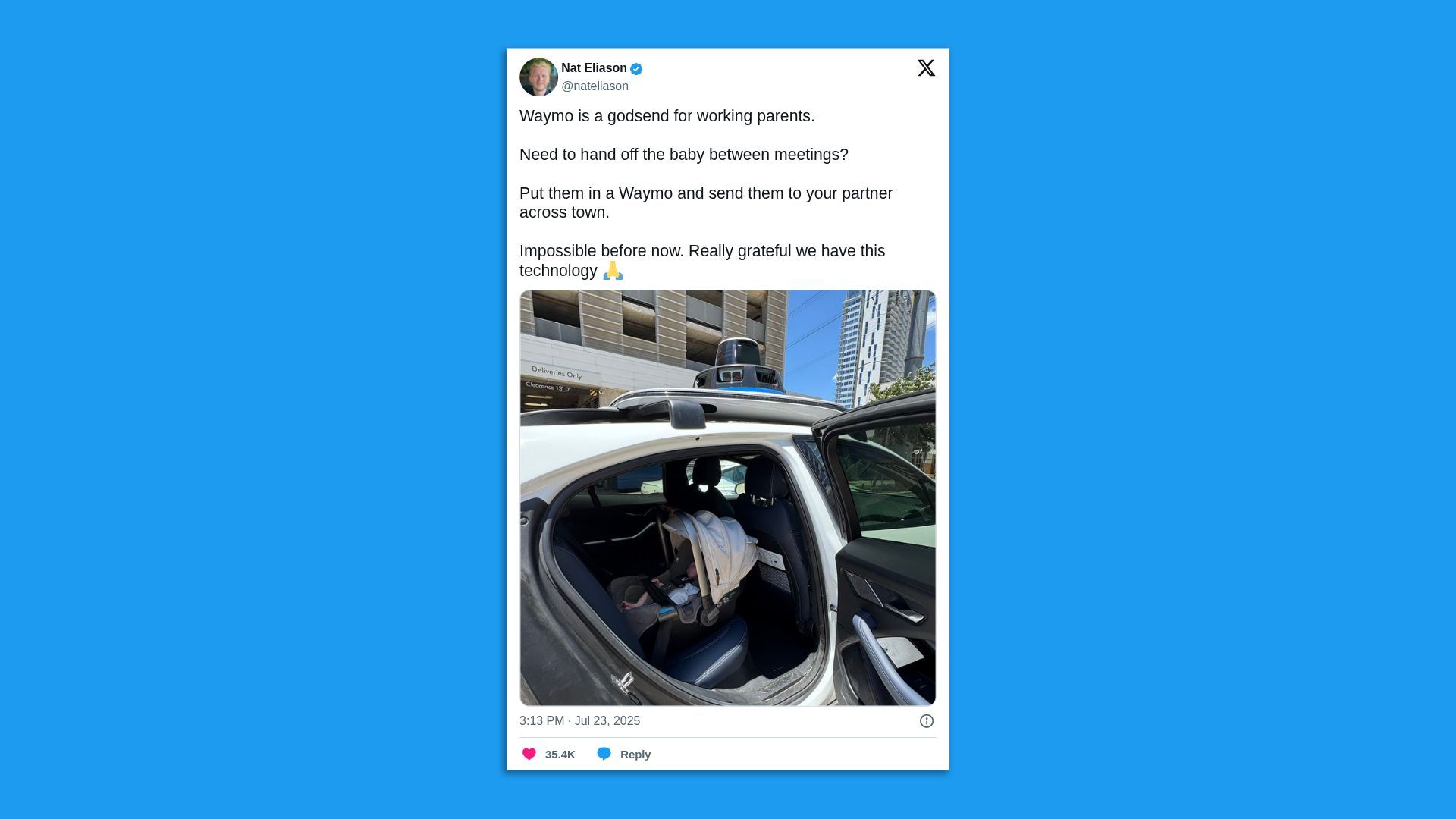
This is a joke — we don't have any evidence of harried parents today actually handing off their baby via a driverless Waymo ride. But check back in a decade and who knows?
Thanks to Scott Rosenberg and Megan Morrone for editing this newsletter and Matt Piper for copy editing.
Sign up for Axios AI+
