Axios AI+

December 07, 2023

Hi, it's Ryan. Here's a free domestic tip: Don't take a sleeping pill and then accidentally lock your partner out of your shared apartment. Today's AI+ is 1,217 words, a 4.5-minute read.
Situational awareness: Faebook is finally rolling out default end-to-end encryption for Messenger (but not yet for Instagram messages).
1 big thing: AI helps clamp down on fentanyl
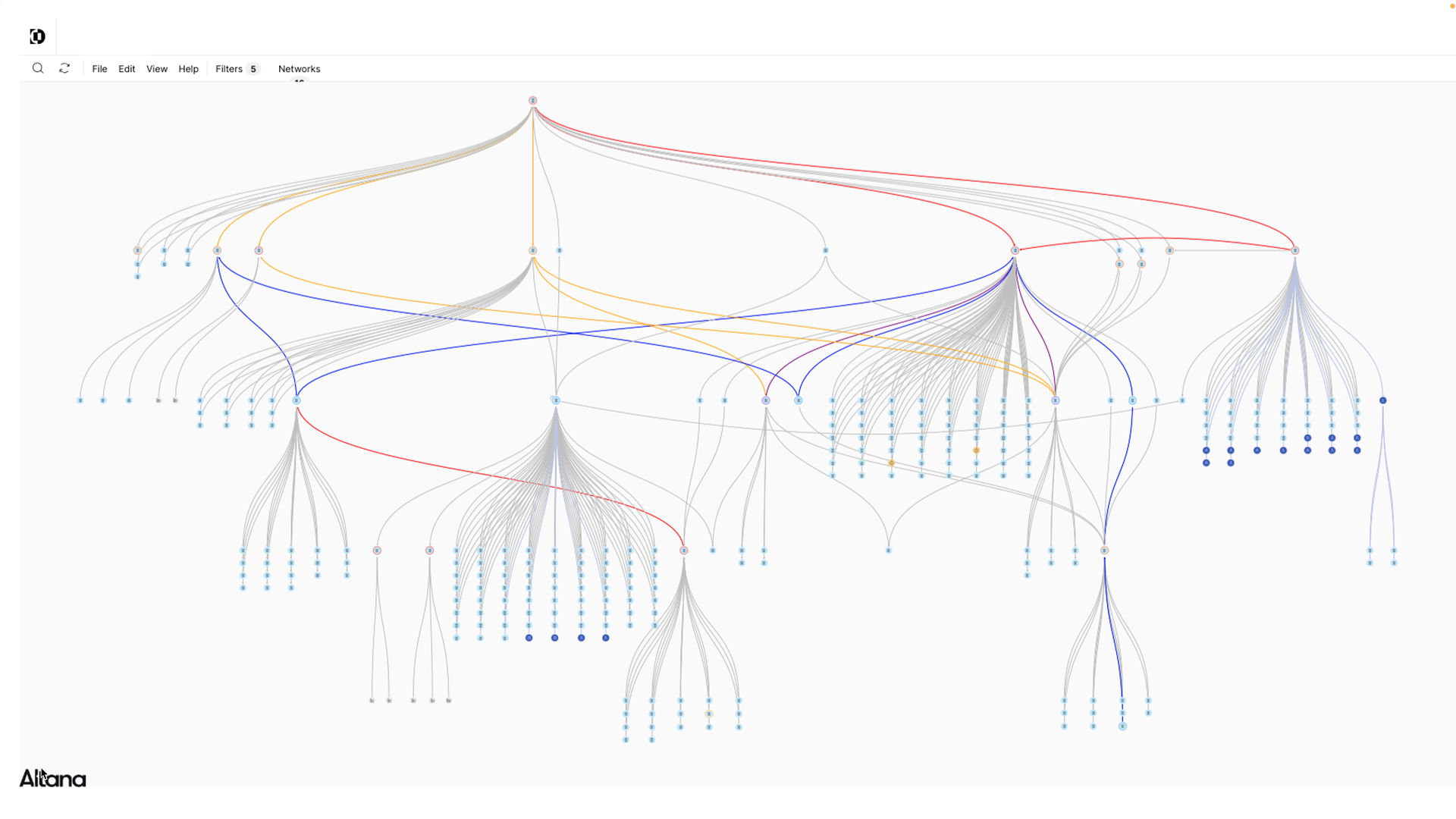
Altana Atlas images showing the supply chain of a company indicted for trafficking fentanyl precursor chemicals. Image: Altana
The days of drug-sniffing dogs aren't over — but now Customs and Border Protection (CPB) agents are using AI to track down the precursor chemicals used in fentanyl production in Mexico to help stop the drug from being created.
Why it matters: More than 70,000 Americans died of synthetic opioid overdoses in 2021, according to the National Institute on Drug Abuse.
- Finished fentanyl is so small and disguisable that enforcement is close to impossible using traditional methods.
What's happening: With the addition of AI systems, agents can see deeper into fentanyl supply chains, leading to bigger seizures of both finished fentanyl and the chemicals used to make it.
- Altana, a startup that operates a global supply chain platform, is helping Customs and Border Protection agents map how fentanyl ingredients are assembled and shipped to production sites — helping to shut down both.
- After giving every CBP agent access to the Altana Atlas as part of a $9 million contract to trace forced labor in supply chains, Altana CEO Evan Smith tells Axios he "jumped at the chance," to expand the contract into counternarcotics.
Details: The CBP graph is a private copy of the Altana Atlas with "billions of transactions, hundreds of millions of unique links, and millions of companies," per Smith, based on publicly available data from 450 million companies and proprietary data from CBP.
- Neither Altana or CBP were willing to comment on specific enforcement operations, but Altana said its Atlas is "being used across the entirety of the global supply chain to track shipments of illicit precursors."
Be smart: Tracking chemicals and the network of shell companies that ship them has become a critical part of breaking up fentanyl supply chains.
- Having access to AI with multilingual capabilities is another critical advantage as the number of countries in fentanyl supply chains grows.
By the numbers: Since expanding Altana's contract, CBP concluded two successful operations: one that seized 13,000 pounds of fentanyl precursor chemicals and another that netted 10,000 pounds of fentanyl and 284 arrests.
Context: The Department of Homeland Security uses AI-powered systems from several vendors to suppress the illegal fentanyl trade.
- Secretary Alexander Mayorkas told Axios in November that CBP is also using AI to detect unusual travel patterns of vehicles crossing the border – identifying 75 kilograms (165 pounds) of narcotics in a single instance recently.
What they're saying: "AI has changed the game. It can make faster analysis than humans could make alone — spotting changes in trade patterns and participating parties," Ana Hinojosa, a former CBP executive director who is now president of ABH Consulting, tells Axios.
- "Traditional drug trafficking strategies have not worked for fentanyl," Hinojosa says. "The players are more organized. The precursor chemicals are not in and of themselves illegal," while many transit countries have corruption problems and see the trade as a problem for "the stupid Americans who are killing themselves with it," she said.
2. Purple Llama alert!

Illustration: Lindsey Bailey/Axios
Today Meta released benchmark cybersecurity practices for large language models, which it says is an effort to "level the playing field for developers to responsibly deploy generative AI models."
Why it matters: The White House has urged AI companies to ramp up their safety efforts, and codify some safety requirements in its AI Executive Order, worried that AI chatbots and open source LLMs like Meta's Llama 2 will lead to dangerous misuse.
- LLMs can serve as attack vectors, hacked to access proprietary information, or manipulated to produce harmful content, even when they've been designed not to.
The big picture: Cybersecurity risks around LLMs are "a pervasive problem that we need to mitigate," Joseph Spisak, Meta's director of product management for generative AI, tells Axios.
- "There's no real ground truth: We're still trying to find our way into how to evaluate these models" and need to "build a community to help standardize these things," he said.
What's happening: Meta's two key releases in its "Purple Llama" initiative are CyberSec Eval, a set of cybersecurity safety evaluation benchmarks for LLMs; and Llama Guard, which "provides developers with a pre-trained model to help defend against generating potentially risky outputs."
- Spisak tells Axios that Purple Llama will partner with members of a newly-formed AI Alliance that Meta is helping lead and others such as Microsoft, AWS, Nvidia and Google Cloud.
The intrigue: Purple Llama is a reference to what you get when red teams (attacking teams) and blue teams (defense) are combined and added to Meta's open source foundational model.
Flashback: Meta previously released a Llama 2 Responsible Use Guide, an approach that critics say is insufficient for managing how an open source model can be misused in the wild.
3. Senate AI forum cheat sheet
Lawmakers leading the year's final AI insight forums said they'll be applying what they've learned to legislation soon, with committees holding hearings on potential bills, Ashley Gold and Maria Curi report.
Driving the news: Senators heard from groups of experts on both "doomsday scenarios" for AI and national security issues Wednesday.
- Sen. Mike Rounds (R - S.D.) told reporters that forum organizers are eyeing "five or six" bills in a bipartisan effort, but declined to name specifics.
Yes, but: The lack of specifics is also a reminder that Congress is full of other priorities and partisan disagreements which are holding up major spending packages.
What they're saying: Senate Majority Leader Chuck Schumer said he expected some Senators were less alarmed about AI's risks than he expected.
The intrigue: Per sources in the room, Schumer kicked off today's first forum asking all participating how they rated the probability of artificial general intelligence being disastrous for humanity.
- "It was kind of surreal," one participant who asked not to be named tells Axios, adding that answers were all over the place or people declined to say.
Schumer walked out after the afternoon national security forum wrapped saying there's agreement more investment in defense-related AI is necessary.
- Palantir CEO Alex Karp tells Axios he thinks funding for defense AI needs to be boosted "dramatically" and account for one percent of the Pentagon's budget.
What we're watching: The extent of AI provisions in the National Defense Authorization Act.
- Per Rounds: "It's not going to be enough. But what we'll have to do every single year is begin with AI as part of the focus."
Meanwhile, the EU is expected to finalize its AI Act this week.
4. Training data
- Governments and law enforcement can spy on you through push notifications. (Axios)
- Meta faces another lawsuit, this time from the state of New Mexico, alleging Facebook and Instagram failed to protect children from psychological and and physical harm. (Axios)
- Nvidia's rivalry with AMD is set to heat up: Meta and Microsoft have said they will buy AMD's new MI300X chip when it starts shipping early next year. (CNBC)
- Twitter's last global head of information security is suing X, claiming he was fired for standing up to Elon Musk's 2022 job slashing effort at the platform. (Axios)
- The crown prince of AI, Sam Altman, will be today's featured guest on the new video podcast What Now? with Trevor Noah. (Spotify)
- Trading places: Steve Hotelling, a top Apple hardware exec who developed the company's Touch ID interface, is leaving the company. (Bloomberg)
5. + This
Now you can order an AI-generated letter from Santa, because of course you can.
Thanks to Meg Morrone for editing this newsletter.
Sign up for Axios AI+

Scoops on the AI revolution and transformative tech, from Ina Fried, Madison Mills, Ashley Gold and Maria Curi.