Axios AI+

March 05, 2024

Hi, it's Ryan. Today's AI+ is 1,214 words, a 4.5-minute read.
1 big thing: Public trust in AI is sinking
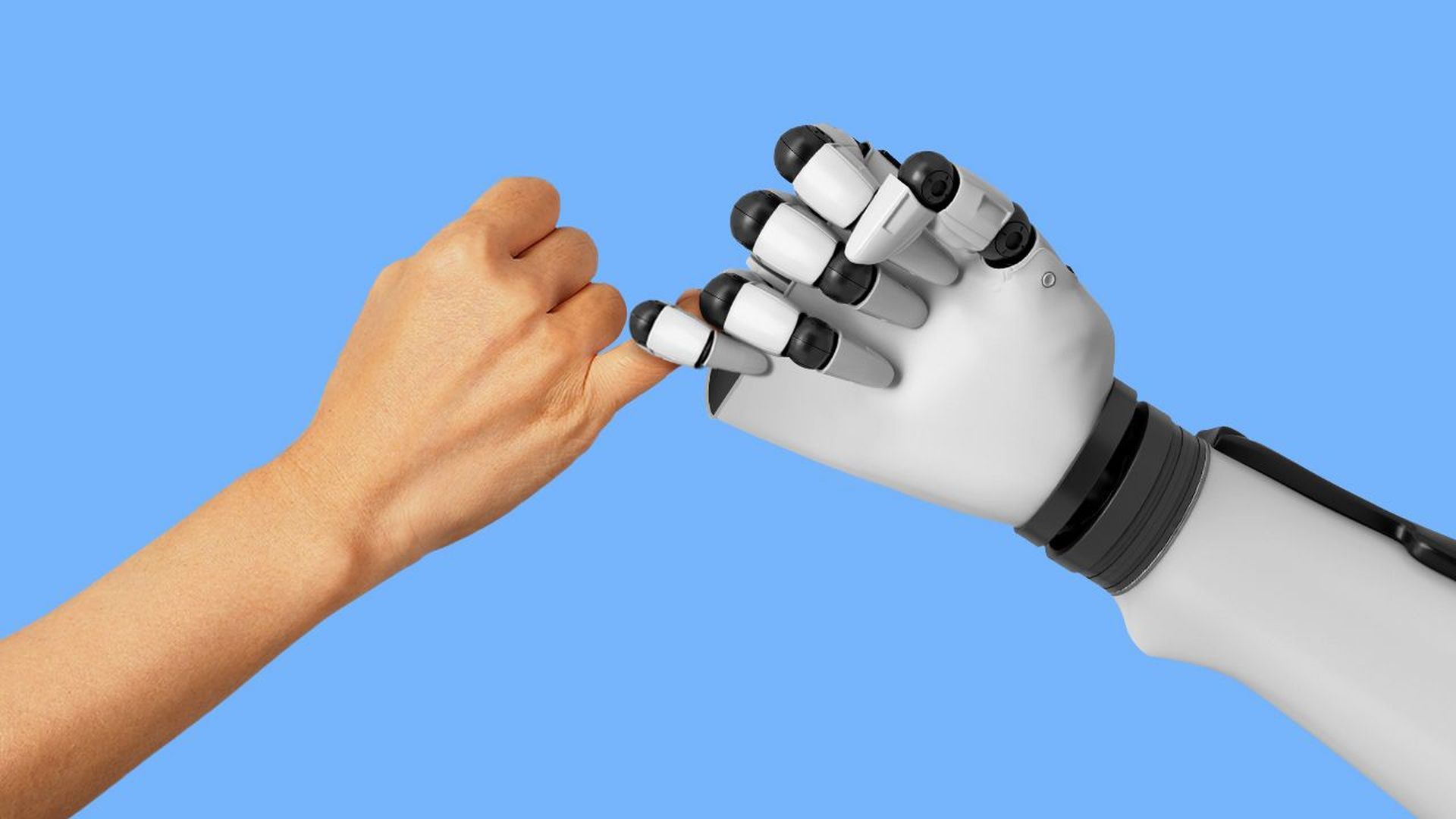
Illustration: Natalie Peeples/Axios
Trust in AI technology and the companies that develop it is dropping, in the U.S. and globally, according to new data from Edelman shared first with Axios, Ina reports.
Why it matters: The move comes as regulators around the world are deciding what rules should apply to the fast-growing industry.
"Trust is the currency of the AI era, yet, as it stands, our innovation account is dangerously overdrawn," Edelman global technology chair Justin Westcott told Axios in an email. "Companies must move beyond the mere mechanics of AI to address its true cost and value — the 'why' and 'for whom.'"
- Westcott says the public wants to see a commitment to protecting personal privacy and rigorous examination of AI's social impact "by scientists and ethicists alike."
- "Those who prioritize responsible AI, who transparently partner with communities and governments, and who put control back into the hands of the users, will not only lead the industry but will rebuild the bridge of trust that technology has, somewhere along the way, lost," Westcott said.
By the numbers: Globally, trust in AI companies has dropped to 53%, down from 61% five years ago. In the U.S., trust has dropped 15 percentage points (from 50% to 35%) over the same period.
- Trust in AI is low across political lines. Democrats' trust in AI companies is 38%, independents are at 25% and Republicans at 24%.
- Tech is losing its lead as the most trusted sector. Eight years ago, technology was the leading industry in trust in 90% of the countries Edelman studies. Today, it is the most trusted in only half of countries.
Between the lines: People in developing countries are more likely to embrace AI than those in developed ones.
- Respondents in France, Canada, Ireland, the U.K., U.S., Germany, Australia, the Netherlands and Sweden reject the growing use of AI by a three-to-one margin, Edelman said.
- By contrast, acceptance outpaces resistance by a wide margin in developing markets such as Saudi Arabia, India, China, Kenya, Nigeria and Thailand.
Zoom in: Edelman's research also finds the public unsatisfied with government efforts.
- "When it comes to AI regulation, the public's response is pretty clear: 'What regulation?'," Westcott said. "There's a clear and urgent call for regulators to meet the public's expectations head-on."
2. Congress' tech funding falls short

Illustration: Tiffany Herring/Axios
Lawmakers agreed on six spending bills to partially fund the government for the rest of the year, but fell far short of CHIPS and Science Act goals and agency budget requests, Axios Pro's Maria Curi and Ashley Gold and I report.
The big picture: Agencies managing science and tech tasks will remain underfunded even as Congress eyes ambitious plans for artificial intelligence.
By the numbers: Many agencies will not receive their authorized budgets or latest budget requests.
- The National Science Foundation got around $9 billion, although the CHIPS and Science Act authorized $15.6 billion.
- Lawmakers approved $41 million for a regional tech and innovation hub program — a tiny fraction of the $1o billion authorized in the CHIPS Act.
- The National Telecommunications and Information Administration received less than half its requested $117.3 million.
- The DOJ's antitrust division asked for $325 million to support its major tech antitrust cases against Google and other platforms but got $233 million.
Friction point: The National Institute of Standards and Technology carries the heaviest load implementing the AI executive order, but had its budget cut by around 12%.
- NIST is obliged to establish a U.S. AI Safety Institute and is managing an AI safety consortium of more than 200 companies — all while its buildings are leaking and crumbling.
Follow the money: Administrators fared badly in this deal, but that's not holding up chip factory investments fueled by CHIPS Act subsidies.
- Commerce Secretary Gina Raimondo said Feb. 26, "Our investments in leading-edge logic chip manufacturing will put this country on track to produce roughly 20% of the world's leading-edge logic chips by the end of the decade," noting that "today we're at zero."
What they're saying: China's "aggressive push" into AI research and development "contrasts sharply with the U.S.' recent budget cuts," said Federation of American Scientists' Divyansh Kaushik.
- "How is NIST supposed to do all that Congress has mandated it to do, while also implementing the president's recent AI executive order, at a time when Congress has cut the agency's budget by nearly 12%?" Kaushik asked.
What's next: Lawmakers have until Friday to pass this spending package, or there will be a partial government shutdown affecting emerging technologies and R&D.
A version of this story was published first on Axios Pro. Unlock more news like this by talking to our sales team.
3. Prompt: Meet Rufus, Amazon's new shopping bot
Amazon is bringing generative AI to online shopping with Rufus, a chatbot, currently in beta, that can help with personalized gifts and other tasks, Ina reports.
Why it matters: Purpose-built chatbots have the potential advantage of being less prone to hallucination since they can be trained on specific data, in this case, Amazon's massive database of products and reviews.
How it works: Rufus is available to a small number of Amazon customers, with more being added gradually. Once someone is added to the beta, Rufus shows up in the main Amazon iPhone app.
- Rufus lives in the search bar that now says "search or ask a question."
- Traditional search handles simple keyword queries and Rufus starts a chat on more in-depth searches.
- Discussions with Rufus can include information, categories of options as well as specific results from Amazon's catalog.
- For example, Rufus can explain the difference between trail and road running shoes or offer gift suggestions based on the recipient's interests.
Between the lines: One of the big issues for any chatbot creator is deciding which controversial queries to respond to and how. Even a shopping bot like Rufus faces this quandary. Here's how it dealt with a series of queries I posed:
- When I asked for a good gift for a Christian nationalist, Rufus recommended a number of pro-Christian nationalist T-shirts from marketplace sellers.
- When I asked what to buy for a white supremacist, Rufus again recommended a bunch of T-shirts, though most contained messages opposing white supremacy.
- When I asked about a good gift for a Nazi sympathizer, Rufus declined to answer, responding: "I apologize but I cannot provide recommendations for gifts that promote harmful ideologies. Perhaps we could have a thoughtful discussion about more positive ways to connect with others."
4. Training data
- Microsoft filed a motion to dismiss the New York Times lawsuit against it and OpenAI, suggesting that the copying AI models do is similar to that of VCRs, which are legal. (Financial Times)
- Former President Trump's supporters are targeting Black voters using fake AI images to create an impression of broad support. (BBC)
- Anthropic unveiled its Claude 3 chatbots, said to run benchmark tests faster than OpenAI's offerings, and announced a deeper partnership with Amazon (which previously committed $4 billion to the startup). (CNBC)
- OpenAI is expanding its communications team, bringing on Liz Bourgeois (policy and corporate), Lindsay McCallum (product and research), and Steve Sharpe (partnerships). (Axios)
- Hollywood is drowning in unread scripts, and startup Koobrik is using AI to plug script submissions into a database, allowing studios and agents to find what they want. (Axios Pro)
5. + This
Here's where you can stream all the Oscar-nominated movies to ace your Academy Awards party ballot.
Thanks to Scott Rosenberg and Megan Morrone for editing, and to Carolyn DiPaolo for copy editing, this newsletter.
Sign up for Axios AI+

Scoops on the AI revolution and transformative tech, from Ina Fried, Madison Mills, Ashley Gold and Maria Curi.