
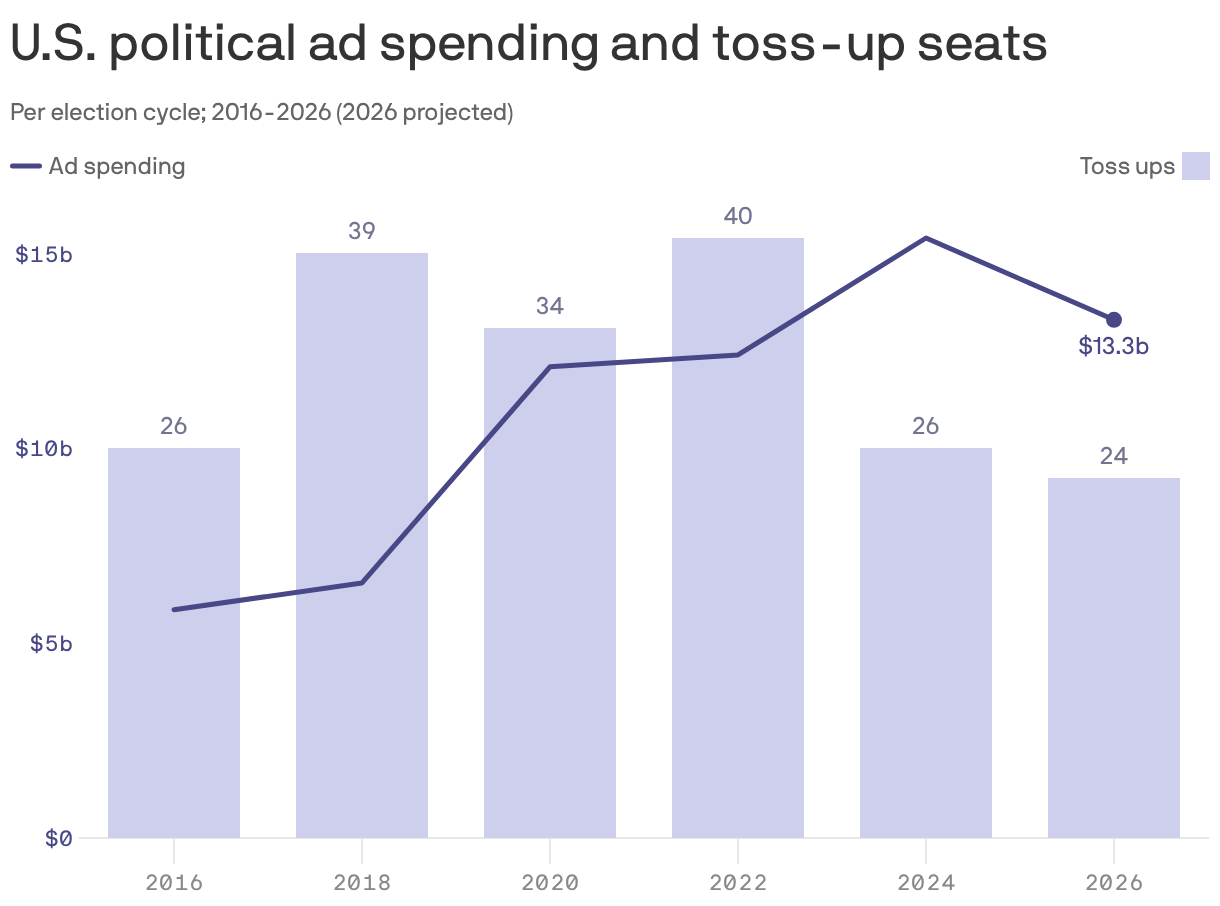
Over the past decade, U.S. political ad spend has grown at a compound annual rate of 8.55%, despite the average number of toss-up elections declining, per data from Cook Political Report.
Why it matters: Spending is not growing because races are becoming more competitive, but because of policies that allow unlimited spending by outside groups, more issue advocacy moving to the states and the rise of digital advertising channels, like streaming.
The big picture: In other Western democracies, such as Canada, New Zealand, France, the U.K. and Australia, caps have dramatically reduced how much outside groups can spend on elections.
- Less deadlocked legislative branches also means issue advocacy marketing often remains more concentrated at the federal level.
- Stronger transparency measures in other countries make it harder for campaigns and outside groups to funnel ad dollars into more obscure digital channels.
The result: Even in the world's largest ad market, the onslaught of political marketing in the U.S. can feel overwhelming to consumers.
- Without adequate transparency measures, dark money groups can more easily influence elections.
By the numbers: U.S. political advertising, which includes cause and appeal messaging, is expected to reach more than $13 billion this cycle, a new midterm record, according to data from WPP Media.
- That figure is slightly larger than estimates from other third parties, such as those from AdImpact, which do not include certain types of ad spend, such as direct mail or print. (AdImpact projects this year's cycle will reach $11.6 billion in political ad spend.)
Stunning stat: The U.S. political ad market this year is bigger than the entire ad markets in countries like Spain and Italy.
Context: The 2010 Citizens United Supreme Court decision that allowed unlimited spending by outside groups on elections certainly paved the way for unprecedented growth, but other political dynamics have also had an impact.
- With Congress becoming more gridlocked and less productive, more issue advocacy battles are moving to the states, driving a surge in local issue and down-ballot spending.
- AdImpact projects nearly $700 million will be spent this cycle on ads targeting state legislatures, up around 17% from 2024.
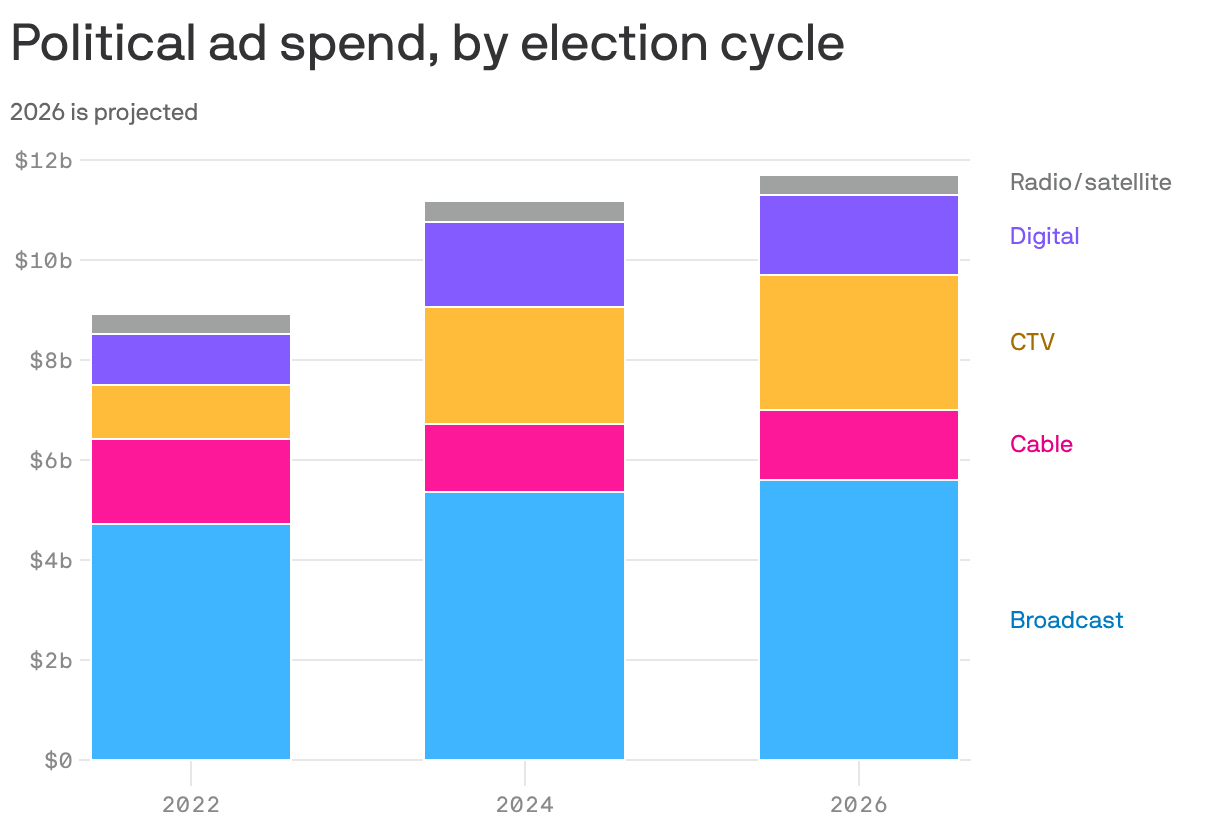
Between the lines: The rise of digital channels, especially streaming, has also given campaigns and outside groups more places to spend.
- Because political messaging relies heavily on geographic targeting, and because get-out-the-vote messaging tends to perform best on video, broadcast has long been considered the most effective and efficient advertising medium for campaigns.
- While broadcast still makes up the majority of political ad spend today, more investment has moved to new channels, such as connected TV (streaming) and other digital video platforms, where inventory isn't limited to a 24-hour linear TV schedule.
- Digital and CTV now account for roughly 37% of political ad spend measured by AdImpact. AdImpact's data includes cable, radio, satellite and broadcast, as well as most trackable digital spend on platforms such as Facebook, Google, Snapchat and X and trackable CTV spend on platforms like YouTube TV, Paramount+ and others.
What to watch: More campaigns are eyeing streaming because of the ability to target audiences more precisely and limited regulatory oversight of those platforms.
- Outside groups often pay multiple times what a campaign pays for ads on broadcast TV and radio because of laws ensuring candidates get the lowest rates. Online, super PACs can negotiate directly.
- Congressional efforts to expand transparency requirements for broadcast ads to digital ads have mostly failed in Congress.
