Exclusive — Bowser's sports legacy: big wins, big public tab

Add Axios as your preferred source to
see more of our stories on Google.
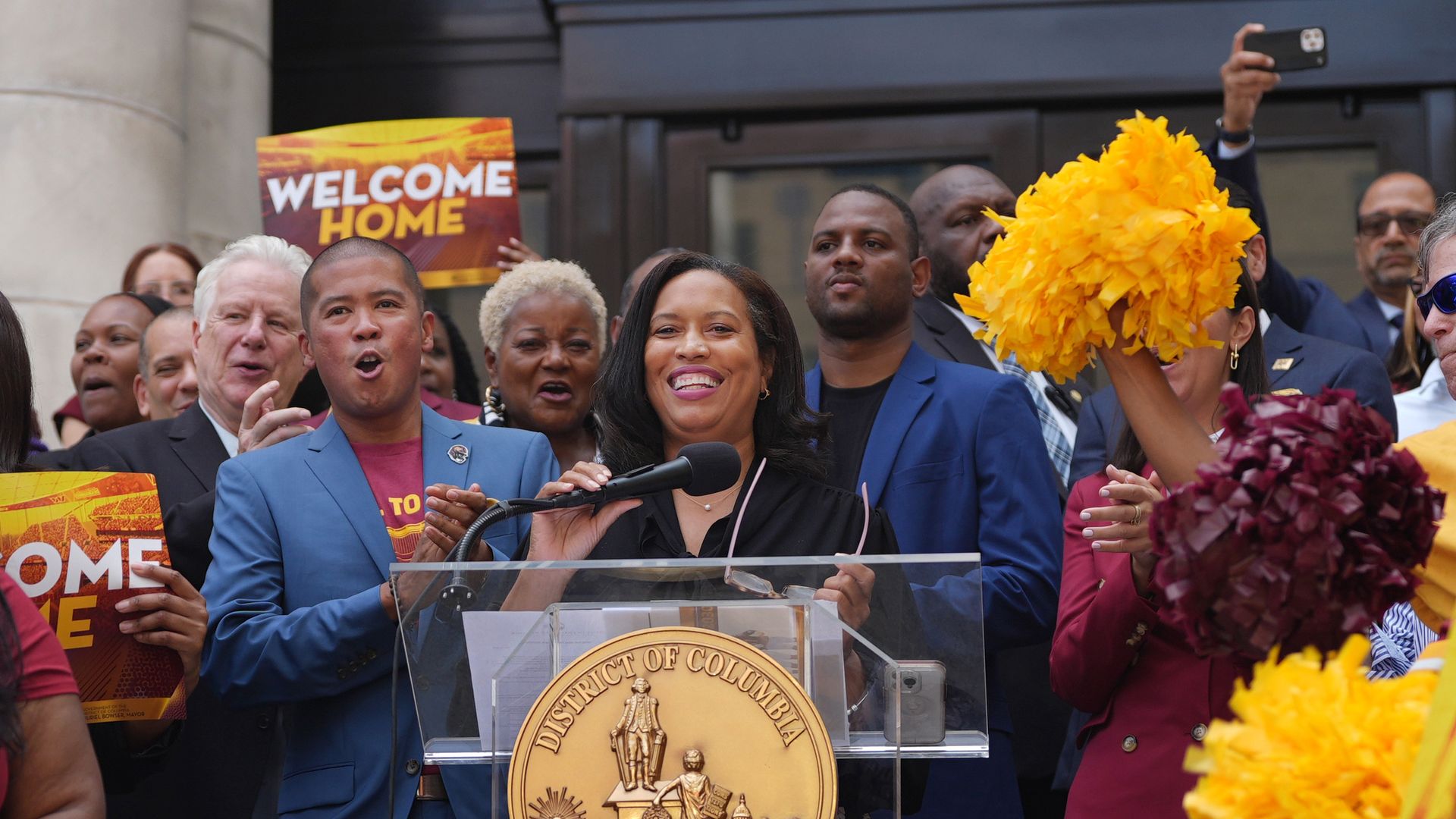
Mayor Bowser held a rally last year ahead of the first D.C. Council vote on the RFK Stadium deal legislation. Photo: Leah Millis for The Washington Post via Getty Images
On the third floor of the John Wilson Building, outside the D.C. mayor's office, Muriel Bowser has trophy cases on display.
- Inside, there's a street sign for Black Lives Matter Plaza, a Pat Collins Snow Stick, and a photo of the mayor meeting Big Bird from "Sesame Street." But the prevailing theme is sports.
- Team photos and championship rings are the centerpiece. There's a Commanders helmet from the team's 2025 game in Madrid, as well as Freedom 250 Grand Prix memorabilia, a more recent addition.
Why it matters: Nearing the end of her third and final term, the mayor is taking a victory lap after establishing D.C. as a "Sports Capital."
- In an exclusive interview with Axios, Bowser discussed her legacy and her priorities before leaving office in January.
Her legacy, as she sees it: "All professional sports teams will be in the District of Columbia by 2030."
- "When I say now that the Super Bowl can come to Washington, people don't laugh at me," she says.
To get there, she had to woo the Commanders back from Maryland, secure control of the RFK Stadium land from the federal government, and negotiate a deal that could win D.C. Council approval.
- Two years ago, she helped keep the Wizards and Capitals in D.C. after the teams announced plans to decamp to Virginia.
The big picture: Sports have been part of Bowser's economic development strategy since her first year as mayor in 2015, when she pitched them as a way to develop neighborhoods and counteract D.C.'s dependence on federal jobs.
- That was before the pandemic fueled remote work, emptying downtown, and DOGE took a buzzsaw to the federal workforce.
What she's saying: "It seems clairvoyant, right?"
- "What DOGE did took us off a cliff," she says, "but we always had the mindset of attracting more private-sector jobs, and now we have to be very serious about it."
She also points to creating incentives to convert federal buildings, attracting new employers in tech, and investing in hospitals and universities.
- "It's not, 'Do you invest in sports, or do you invest in this other thing?'" she says. "You have to invest in both."
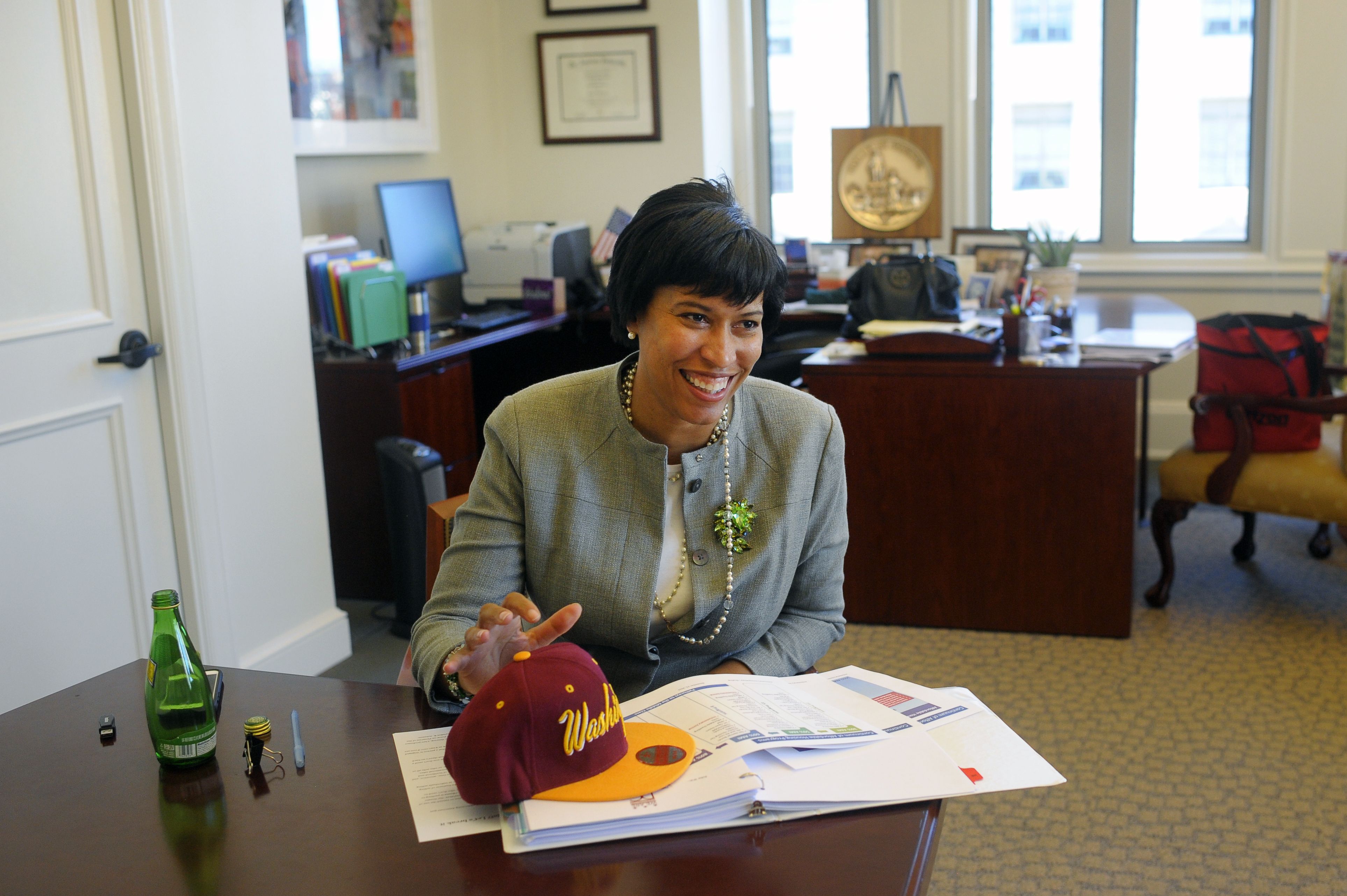
Fast forward: A decade after becoming mayor, her "Sports Capital" pitch is starting to look less like a slogan.
Case in point: D.C. is building a calendar of major sports events.
- The National Women's Soccer League championship is Nov. 21 at Audi Field. In April, the Men's Frozen Four — college hockey's grand finale — comes to Capital One Arena.
- And Washington hosts the 2027 NFL Draft later that spring.
The biggest project still to come: The new Commanders stadium at RFK.
💰The mayor's office describes the Commanders' $2.7 billion commitment toward stadium construction as the "single largest private investment in the District's history."
- And while D.C. hasn't yet landed its first Super Bowl, the incoming $3.7 billion domed stadium will make it a contender. Just look at Vegas and Nashville.
Yes, but: Bowser's sports legacy comes with a sizable public tab.
- During her tenure, D.C. has committed more than $1.6 billion to build or renovate major sports venues, per reports from Bowser's administration earlier this year.
- More than half of that is for the new Commanders stadium. The broader RFK development package tops $1 billion when you include parking, infrastructure and public spaces like a sports complex.
- The rest includes about $515 million for Capital One Arena, $150 million for Audi Field, and $64 million for CareFirst Arena.
The other side: Critics of the RFK deal, including urbanist advocates at Greater Greater Washington, say taxpayers shouldn't subsidize billionaire team owners.
- GGW estimates the actual public cost is closer to $6 billion when accounting for the value of riverfront real estate, interest on municipal bonds, and tax revenue forgone by using the land for the stadium and parking facilities.
- As master developer, the NFL team controls the space, and critics worry housing and retail could lag far behind the stadium and parking.
Bowser's argument: The Commanders were the only anchor tenant suited for redeveloping the 190-acre stadium campus:
- "We need an anchor, and an anchor that was going to bring a couple of billion dollars to the table. … The Commanders are a great organization. They had the money, and our interests in building something great there were completely aligned."
The mayor says she had certain values she wouldn't compromise on for the campus.
- It had to be a mixed-use development surrounded by "a new community."
- It had to be a domed stadium that could be used for events year-round.
- It had to be "a great deal. It couldn't be a giveaway."
Reality check: Before approving the mayor's deal, the D.C. Council pushed the Commanders to make additional concessions estimated at $779 million, with $50 million going toward a community benefit package.
- Nearly a third of the total campus will be parks and green space, improving access to Kingman Island and the Anacostia River.
- But while the stadium is projected to open in 2030, the surrounding neighborhood will take much longer to materialize. Work on the Riverfront District, including housing, retail and restaurants, is expected to go past 2040.
⏰ No time to waste: Bowser says her team is working on a "warm handoff" for the next administration to build infrastructure around the RFK site and push through zoning for mixed-use parcels in the master plan.
Zoom out: Academics and economists have found little evidence that stadiums boost economic development, but Nationals Park is often held up as an exception.
- D.C. is on track to pay off construction bonds for Nats Park this fiscal year — 10 years ahead of schedule — and will use the same revenue stream, fueled by business and ballpark taxes, to pay for its $500 million bill at the RFK stadium site.
For Bowser, the value in pro sports isn't captured only on a balance sheet.
- "We had an [MLB] All-Star Game and a World Series here, which I think is really special to D.C. for the amount of time that we didn't have professional baseball," she says.
☹️ She says she's "never seen people so depressed" as when the Capitals and Wizards were entertaining a move to Virginia.
- "I couldn't have my constituents be depressed," she says about negotiating the deal to keep the teams downtown.
- She says the commitment that Monumental Sports made to redevelop the arena and join downtown's comeback "may even be bigger than the RFK decisions."
What's ahead: Bowser isn't done shaping D.C.'s stadium portfolio.
- When Axios interviewed her earlier this month, she opposed a D.C. Council proposal to put $300 million toward adding seats and a roof to the eight-year-old Audi Field.
- "My advice to the next mayor would be: You don't want to take $300 million out of your first budget," she says.
- Since that interview, news broke that Bowser plans to introduce legislation to renovate Nationals Park, which opened in 2008. Details haven't been shared, though the Nationals pitched a $350 million overhaul last year.