Wonder is taking over the DMV. Can it win over diners, robots included?

Add Axios as your preferred source to
see more of our stories on Google.
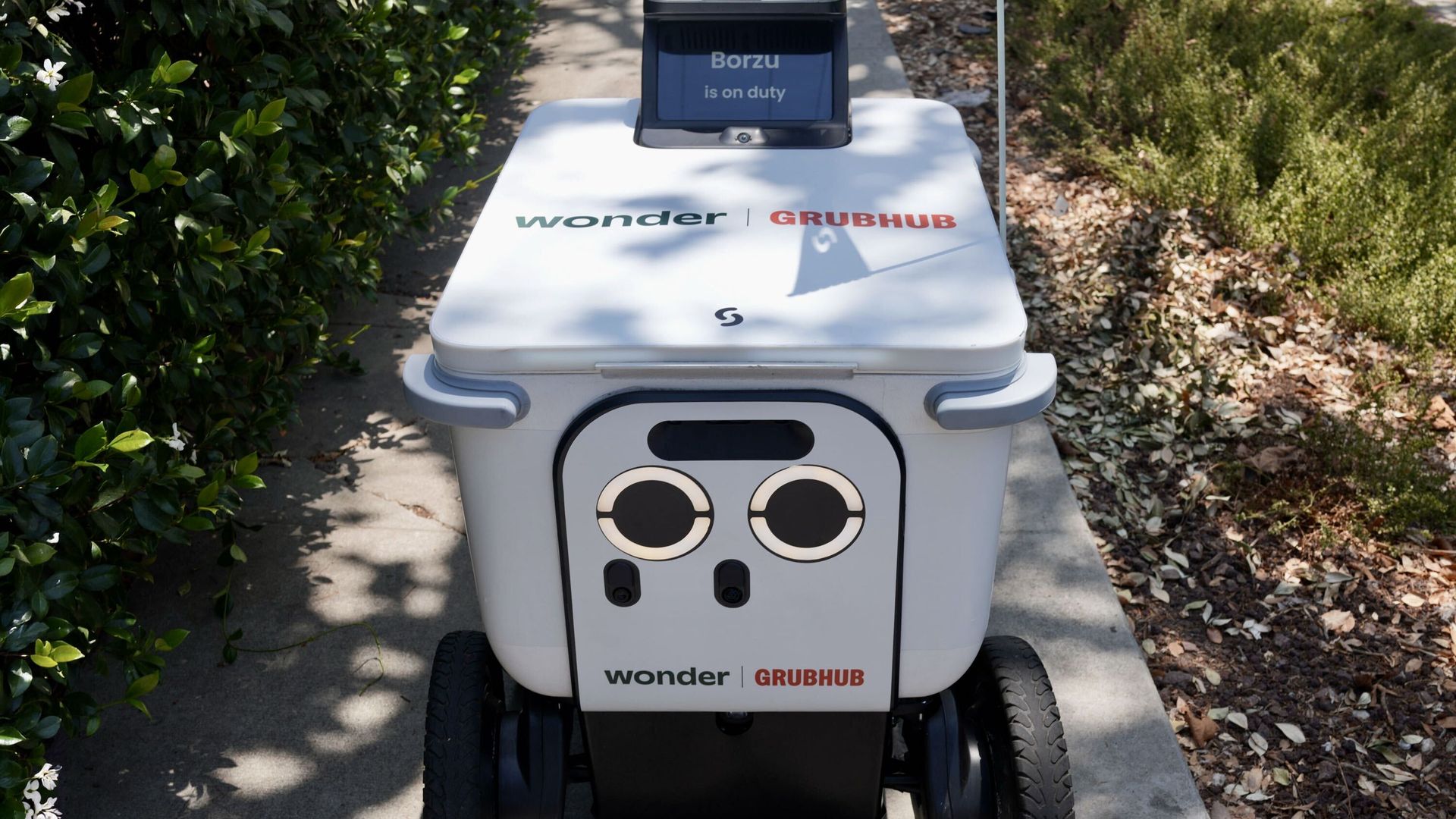
Borzu can bring you burgers in Alexandria with the rollout of Wonder's first DMV delivery robot — a small part of a massive D.C. expansion. Photo: Courtesy of Wonder
Wonder opened its first D.C. virtual food hall on 14th Street just over a year ago. Now, they're seemingly everywhere.
Why it matters: The food tech company says the DMV is one of its fastest growing markets, with more than 30 locations planned by year's end.
- So, we're wondering: Is the billionaire-backed brand accomplishing its goal of "solving dinner" — or spending its way into the restaurant business? Or both?
The big picture: Wonder-fication is the new Tatte-fication, with Wonders soon to outpace some 20 Tattes across the region — and edging in on Sweetgreen's 30-odd local salad shops.
- And Wonder's ambitions stretch far beyond restaurants: Founder Marc Lore talks about building the "Amazon of food" — combining restaurants, delivery and meal subscriptions with a heavy dose of tech and automation.
Catch up quick: Wonder's minimalist "food halls" pack upwards of 20 restaurant concepts into a single kitchen — from celeb brands like Jota by José Andrés and local spinoffs like Maydan to its own pizza, poke and kids' meals.
- The pitch: Everyone gets what they want in one order, delivered quickly from a nearby kitchen.
- Wonder also acquired Grubhub and meal kit company Blue Apron, giving it a stake in everything from cooking dinner to delivering it.
Follow the money: Wonder recently raised another $650 million at a $9 billion pre-money valuation, with plans to pour money into expansion, AI and robotics.
- Lore, a tech billionaire who helped triple Wonder's footprint from 40-plus locations to more than 140 since last May, has said the company is preparing for a possible IPO next year.
State of play: Wonder's DMV footprint is ballooning. As for saturation? "We haven't really found it yet," market operations director Ken McClain tells Axios.
- Its biggest local outpost just opened in Gaithersburg, with 11 more coming this fall in Columbia, Falls Church, Ashburn and beyond.
- Wonder typically keeps its delivery radius around five miles, meaning expansion requires clusters of kitchens and a Starbucks-ian vision to blanket a market.
Yes, but: Wonder's rapid rise has plenty of skeptics — especially in a region built on independent restaurants.
- Local operators have spent years navigating rising costs and uneven traffic. Wonder has billions of dollars to expand, experiment and acquire competitors.
- Food critics have found highs and lows, while the 14th Street location currently averages less than 2.5 Yelp stars.
One unanswered question: Whether the growth is profitable. McClain declined to say whether individual DMV locations make money, and Wonder hasn't disclosed whether it's profitable overall.
- "We do much better in suburban and less densely populated areas," Lore told the Financial Times, citing less competition, particularly late-night.
What's next: Wonder's tech ambitions are hitting DMV sidewalks.
- Last week, the company launched autonomous delivery from its Potomac Yard location in Alexandria through Serve Robotics — its first robot-delivery location outside New Jersey.
- There's one robot to start, with more expected as the service expands.
Friction point: The rollout comes amid broader anxiety about AI and automation replacing restaurant workers.
- "Nothing that we're doing right now displaces any of our actual workforce," McClain says.
- Wonder locations employ roughly 20 to 40-plus people, he says, and automation is meant to improve speed, consistency and capacity.
- "At the end of the day, we're restaurants," McClain says.
The bottom line: Wonder has proven it can expand at breakneck speed. Now it has to prove the model can make money.