Why D.C. public stations may weather federal funding cuts better than others



Add Axios as your preferred source to
see more of our stories on Google.
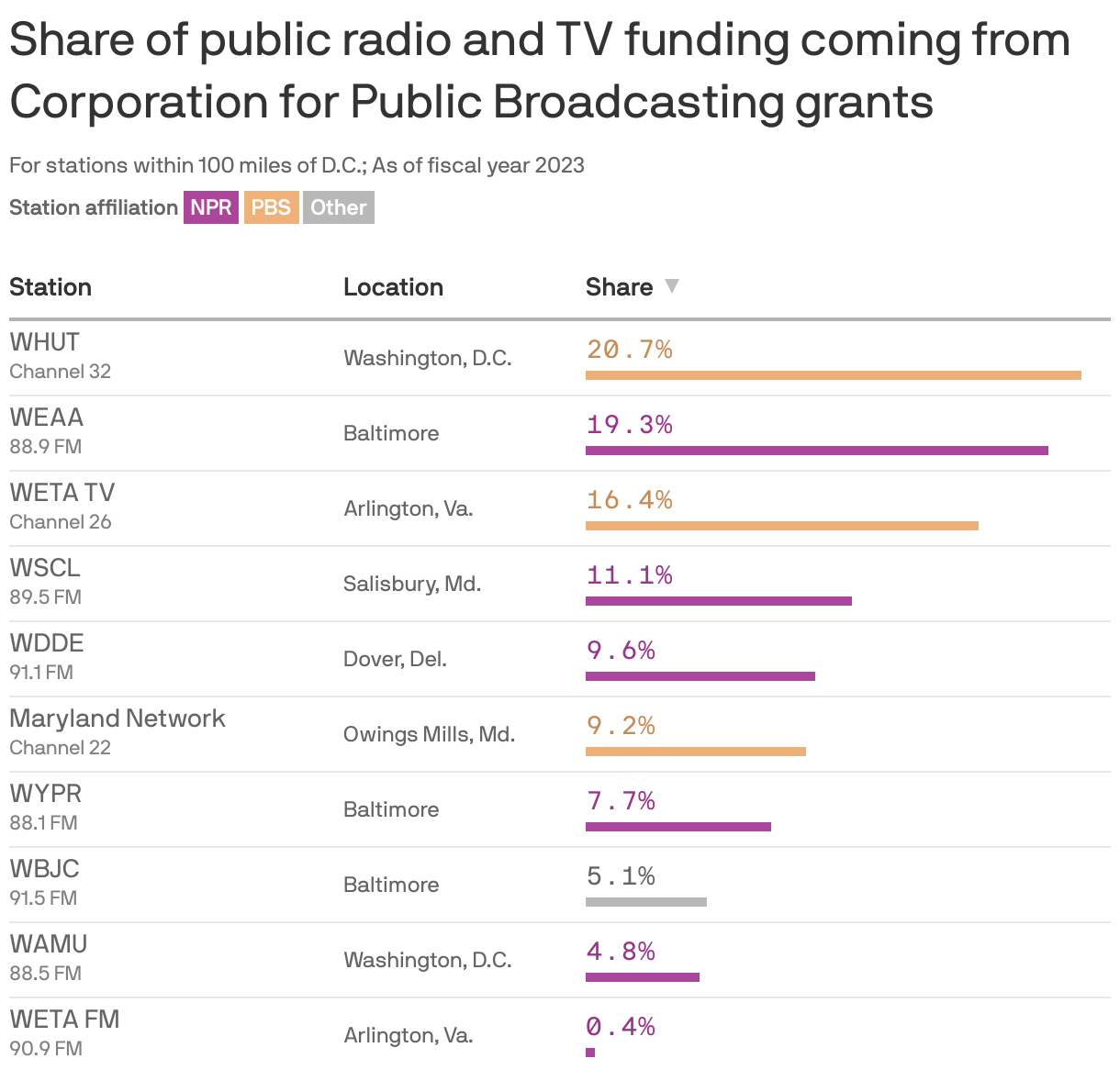
While D.C.-area public TV and radio stations are facing holes in their budgets after Congress gutted their federal funding, they're likely in a better position to weather the hits compared to others across the country.
Why it matters: The $1.1 billion in cuts to Corporation for Public Broadcasting (CPB) funding will hit PBS and NPR local member stations the hardest.
- These outlets are essential for gathering community news and issuing emergency alerts.
By the numbers: Some of the DMV's public stations see higher shares of funding from CPB grants than the national average — about 10.3% for U.S. public TV stations as of fiscal 2023, and 4.1% for radio stations.
- This is based on data manually collected from station websites and shared with Axios by Alex Curley, a former NPR staffer who has been tracking public media financing on his blog, Semipublic.
Zoom in: 20.7% of funding for WHUT (aka Howard University Television) comes from CPB grants.
- It's 16.4% for WETA's TV station and 0.4% for its radio station.
- It's 9.2% for Maryland Public Television and 4.8% for WAMU.
Yes, but: Some area stations like WETA and WAMU have said they are prepared to withstand the loss, due in part to the help of listener donations.
Caveat: Curley's dataset is extensive, but incomplete.
Between the lines: Public media stations in relatively populous, high-income cities like D.C. tend to have better access to donors.
- Rural stations tend to be more reliant on federal dollars, and are therefore more at risk.
Zoom out: D.C. also has a higher share of local journalists compared to the nation at large.
- There are 22.5 area journos for every 100,000 people, according to the Local Journalist Index 2025 from Muck Rack and Rebuild Local News, a local journalism nonprofit.
- That's compared to the national average of 8.2 journalists for every 100,000 people.