Exclusive: What the new RFK Stadium neighborhood will look like

Add Axios as your preferred source to
see more of our stories on Google.
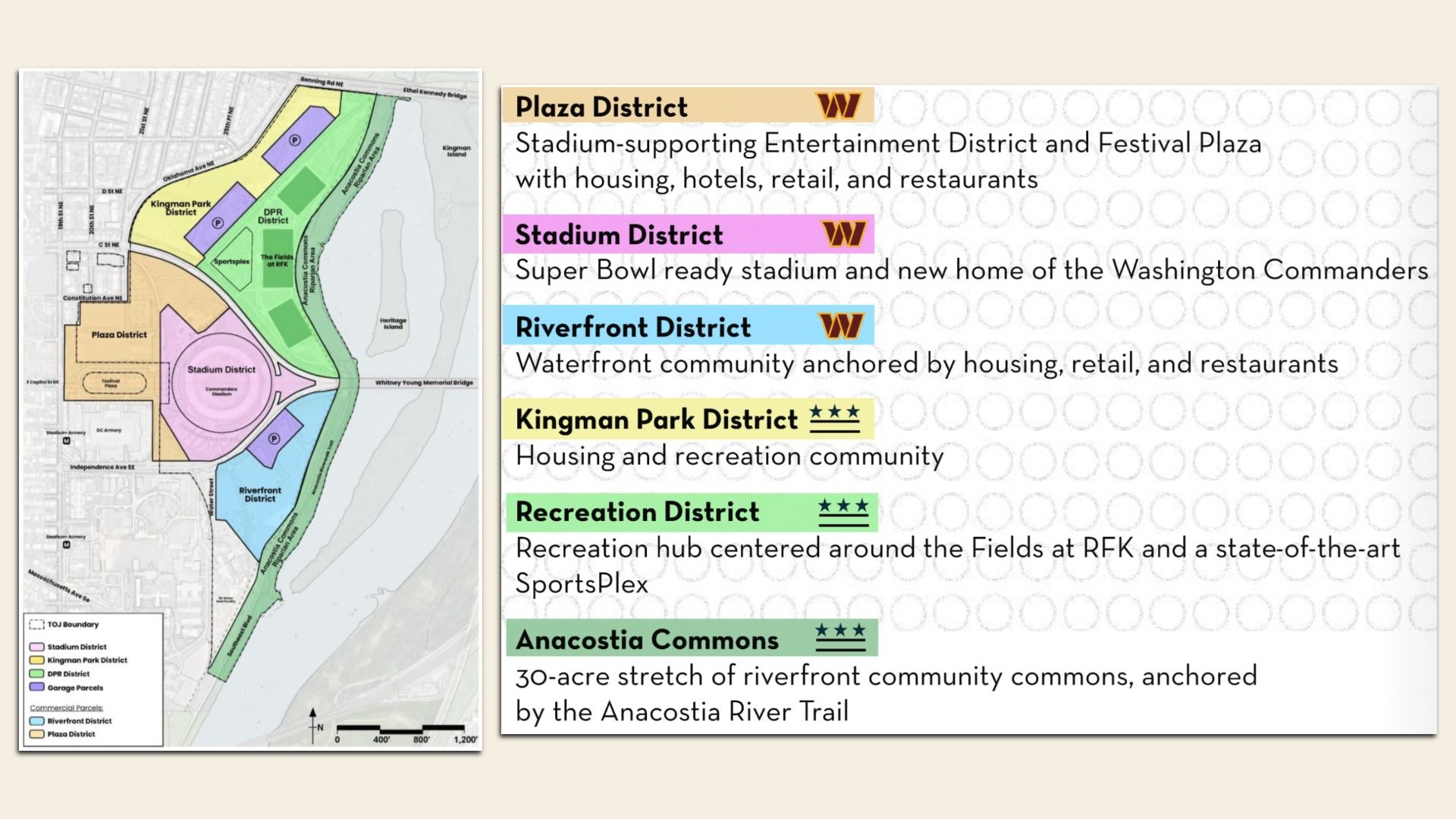
The six districts of the RFK Stadium redevelopment proposal. Image and map: Courtesy of D.C. government
The RFK Stadium redevelopment will slice 190 acres of land into six districts, about six times the scale of The Wharf.
Why it matters: The multibillion-dollar megaproject is going to transform a swath of eastern D.C., and Axios exclusively spoke to the head of real estate for the Washington Commanders, Andy VanHorn, about how it will look.
Driving the news: At the core is the Stadium District, featuring a 65,000-seat domed Commanders arena, targeted for a fall 2030 opening.
- The Commanders have rights to build half of the six districts, and the Stadium District (about 10% of the land) is priority No. 1.
- In time for kickoff, the Commanders plan to have completed two main parking structures for fans, underground parking for staff, a hotel for visitors and conferences, and an office building.
Next up for construction is the Plaza District. It's the gateway into the stadium — where housing, retail and fan zones meet just outside the Stadium-Armory station.
- It borders Lincoln Park to the west and Kingman Park to the north.
- The Commanders want to have a "Festival Plaza" here with bars, restaurants and gathering places. Big digital signs will look like the exterior of Capital One Arena or Nats Park.
- Plus: Neighborhood vibes, like a planned grocery store, pharmacy, daycare, with housing built on top.
- "These are the tallest buildings" at the RFK site, VanHorn tells Axios. They range from roughly six to 11 stories, with a variety of designs, and step down in height as they approach the rowhouses in Kingman Park.
A lot more housing will come in the Riverfront District, the final parcel that the Commanders have development rights over.
- "We think of this as a quieter community," VanHorn says, describing residential development, shops and cafes, and a potential hotel.
Between the lines: Tailgater die-hards, don't worry — there'll be thousands of surface parking spaces for classic tailgating while the whole site takes a decade to fill out, VanHorn says.
- There'll also be areas to rent for game day tailgating.
By the numbers: In its entirety, the RFK site will have at least 6,000 housing units for an anticipated 10,000 residents.
- 30% of it is meant to be affordable, or about 1,800 units.
- VanHorn anticipates housing units will primarily be rentals, given that the land RFK sits on is a 99-year lease from the federal government.
Zoom in: The D.C. government and a yet-to-be-named developer will take the lead on the Kingman Park District, expected to be a low-density neighborhood.
- Given its adjacency to an existing townhouse community, "this will be a really important one to think through," VanHorn says, to ensure it serves as a transition from the entertainment district.
D.C. is also building out the Recreation District, where it envisions an $89 million youth-focused indoor sportsplex. Its 45 acres of open space will continue to have The Fields at RFK Campus, a collection of turf fields and event space.
- The final district, Anacostia Commons, is a 30-acre-long, 200-feet-wide ribbon of land on the river banks, preserving its wildlife and nature as an undeveloped space.
- "That's going to remain a kind of more wild, less kind of manicured open space, but with trail networks in it, and access to the river," VanHorn says.
The big picture: The multiphase buildout will probably look like what the Navy Yard neighborhood did as it slowly filled up around Nats Park. Full completion will likely go into the early 2040s.
- An above-ground Oklahoma Avenue Metro station is being studied on the Orange and Blue lines.
What's next: The D.C. Council has its first public hearing on the project Tuesday, where residents can sound off about the $1.1 billion in public investments for the site infrastructure.
- A first vote on the plan is scheduled for Friday, with potential for final approval in September.