D.C. sees increase in Black medical students


Add Axios as your preferred source to
see more of our stories on Google.
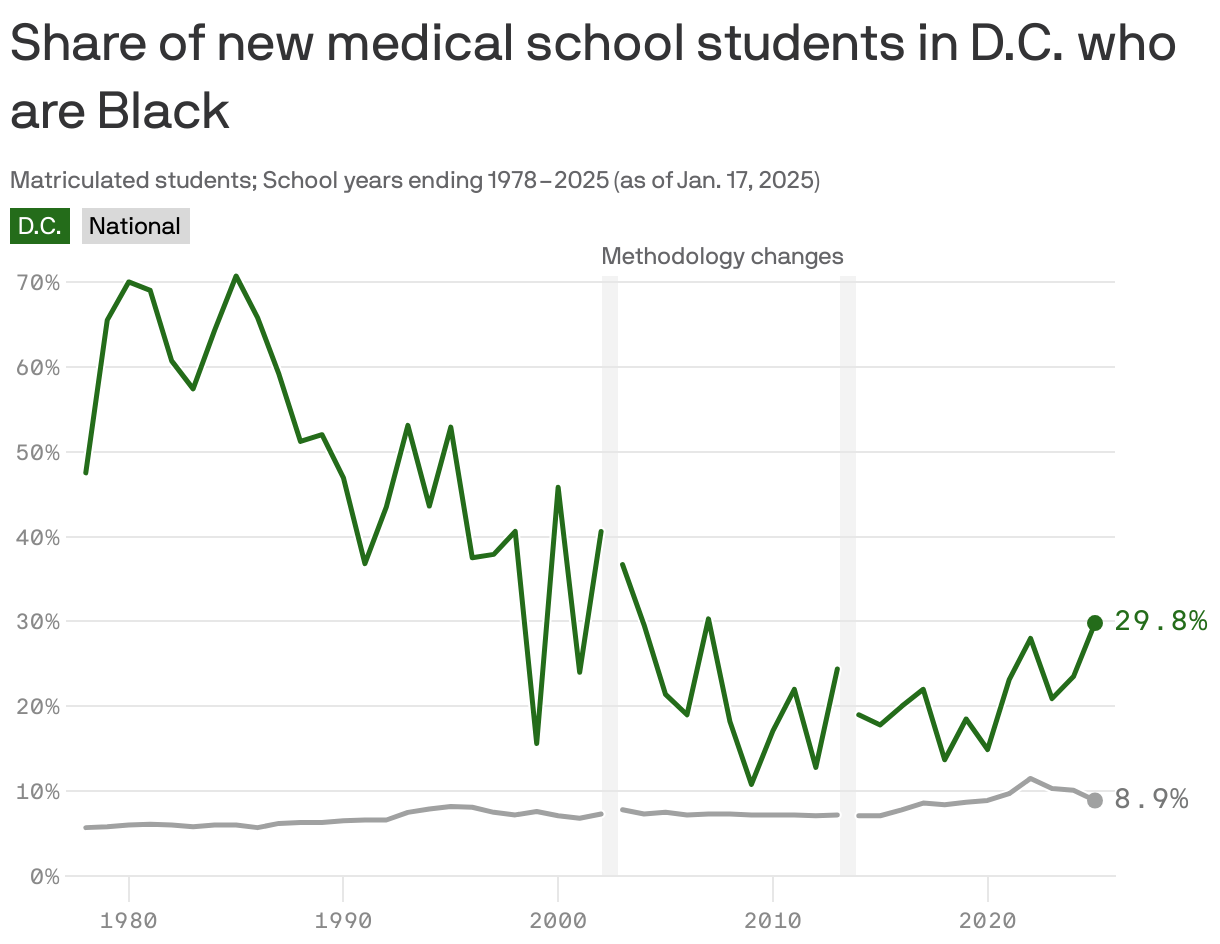
The number of enrolled first-year Black medical students has increased in D.C., new data shows.
Why it matters: Having doctors who resemble the patients they're serving can improve health outcomes and enable patients to feel more comfortable voicing health concerns, multiple studies suggest.
- Black patients being treated by Black doctors may experience less medical racism, whether that means better treatment in the emergency room or not having pain or other risk factors dismissed.
The big picture: This comes as enrollment of first-year Black and Hispanic medical students nationwide has fallen sharply after the Supreme Court struck down affirmative action in higher education, Axios' Maya Goldman writes.
By the numbers: In D.C., 29.8% of med school matriculants for the current academic year identified as Black, according to the Association of American Medical Colleges (AAMC), which has collected data on this topic since 1978.
- Last year, it was 23.5%.
- 11.8% of Virginia's current first-year medical students are Black, per the data. In Maryland, it's 19.3%.
Howard University's medical school is a major producer of Black doctors. And it got a $175 million donation from Bloomberg Philanthropies last year.
Nationally, only 5% of doctors in America are Black — compared with 14% of the general population.
- Between the lines: The data accounts for students who identified as Black or African American.
Zoom out: Over the years, factors that may have impacted Black med school student admission rates include:
- The influential 1910 Flexner Report. Without it, 29% more African American physicians would've graduated in 2019 alone, one JAMA study projects.
- The Civil Rights Act of 1964. It banned segregation in hospitals and higher education.
- The 1972 federal Health Careers Opportunity Program (HCOP). It led to a 70% increase in minority students in health professions between its launch and 1980, according to CDC data.
- The 2020 pandemic. That's when there was a national spotlight on the Black Lives Matter movement (and racism in medical institutions), health care was particularly top of mind, and there was a reduction in med school admission costs. The next year, there was an uptick in the number of Black med school students.
What they're saying: "That [national] number going down hurts my heart, because as I get older, I want someone that looks like me to take care of me," says LaTasha Seliby Perkins, a family physician and assistant professor at Georgetown University School of Medicine who co-chairs the school's Racial Justice Committee for Change.
- "I'm a Black woman with kinky hair. My tone is always like this, I'm not yelling at you. I'm from the Deep South, so if you don't speak to me, I'm gonna feel some kind of way — I need you to know that. If there's someone who's Black, at least half of that they get from the jump," she says.
The idea that Black physicians have a positive impact on patients is more than anecdotal.
- One study from GW's Milken Institute School of Public Health found that Black and Latino family physicians were more likely to treat patients with Medicaid than their white and Asian counterparts.