D.C. schools have a stubbornly high absenteeism problem

Add Axios as your preferred source to
see more of our stories on Google.
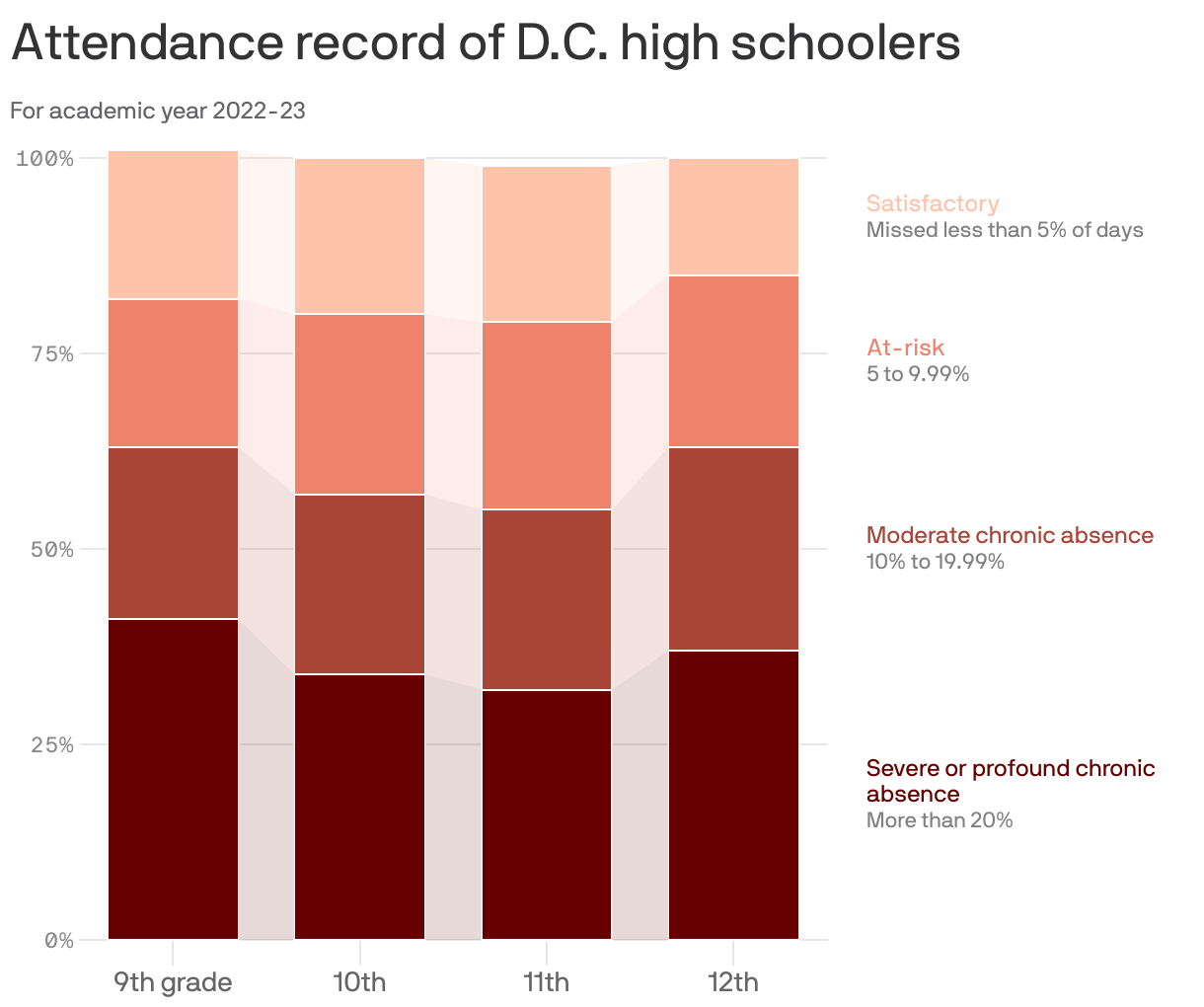
Here's a jaw-dropping number: 60% of D.C. high school students were chronically absent last school year.
Why it matters: Teenagers who consistently miss class not only lose out on schooling but also emotional support and life skills needed for college and the workforce.
The big picture: D.C. has struggled to bend the curve on chronic absenteeism and truancy to pre-pandemic levels.
- Chronic absenteeism improved slightly by 4 percentage points among high schoolers between the 2021-22 and 2022-23 academic years.
- But it's still up 9 percentage points since before the pandemic.
- And even that masks the scale of the problem: Before the pandemic, students were counted absent if they missed 20% of the school day. In 2022, that rule was relaxed — allowing a student to miss up to 40% of the day and still avoid being marked absent.
By the numbers: It's worst among seniors and freshmen.
- 37% of seniors missed at least 20% of schooling last year.
- For freshmen, the rate was 41%.
What they're saying: Schools and parents have become more forgiving with children missing school after the pandemic-era experiment with virtual learning.
- "There's a whole new perception among parents that missing school is OK. That they can make it up," said Yesim Sayin, the head of the D.C. Policy Center, which convened a group of 55 students, parents, and teachers to study the trend.
- Other reasons may include students arriving late due to taking a sibling to another campus or a lack of reliable public transit.
Catch up fast: D.C. last year contracted with a company to send attendance alerts via text message to families, paying $443,000 to a firm called EveryDay Labs Inc.
The bottom line: The 60% "data point itself is a high figure," said Christina Grant, D.C.'s state superintendent of education. "At the same time, there's a lot of nuance with the number," such as the fact that it includes excused absences as well as unexcused absences.