Minnesota's ducks don't want to be snowbirds anymore

Add Axios as your preferred source to
see more of our stories on Google.
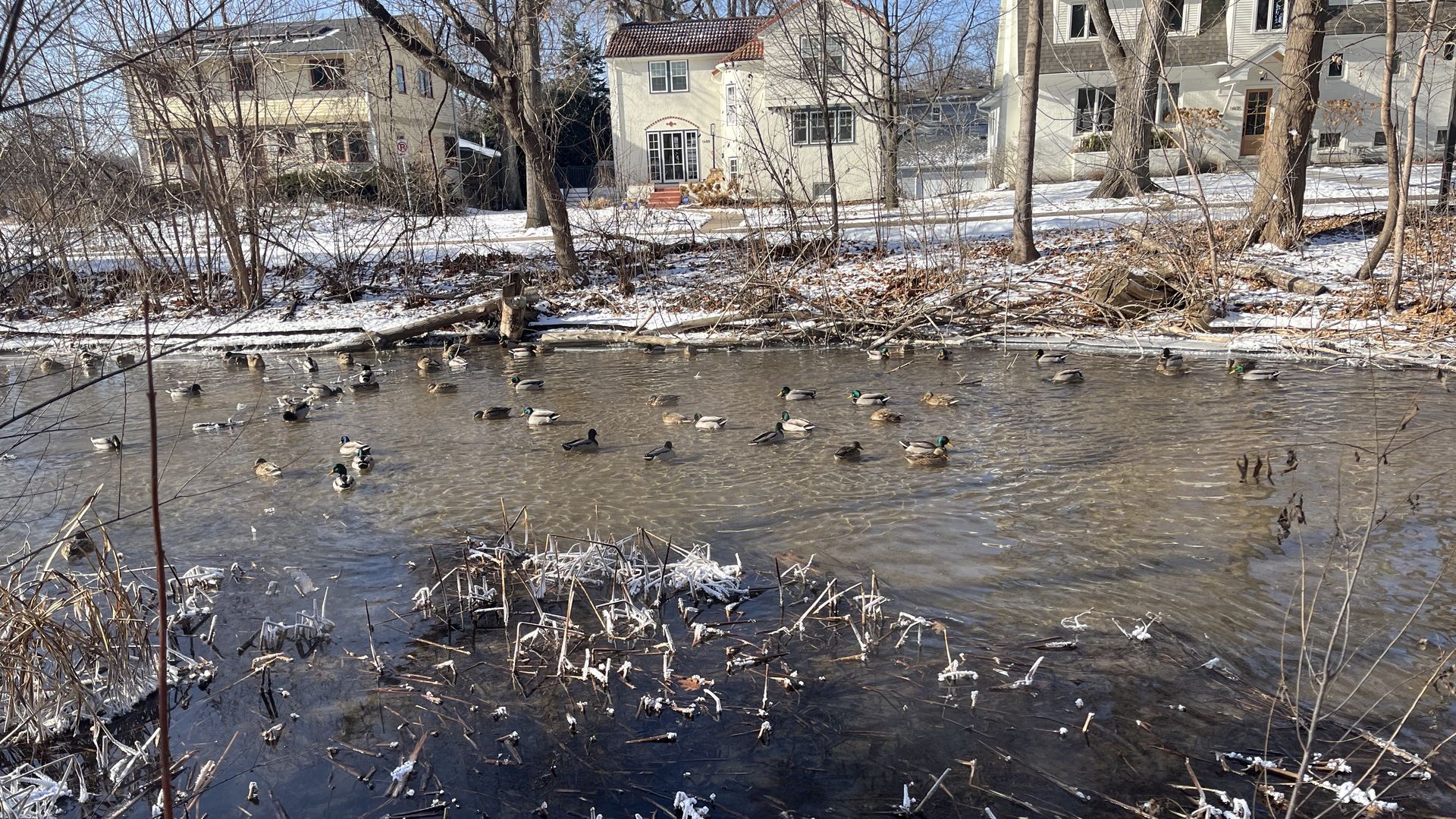
These ducks stuck it out in 20 degrees below zero temperatures. Photo: Nick Halter/Axios
Nick here. On my morning walks along the aqueduct connecting Lake Harriet and Minnehaha Creek, I've been surprised to see hundreds of ducks sticking it out in temperatures as low as minus 20.
State of play: It's not just my imagination. More ducks are opting against migration due to evolution and natural selection — and there's an association with warming winters caused by climate change, Dale Gentry, director of conservation for Audubon Upper Mississippi River, told Axios.
Why it matters: These hardy Minnesota ducks have puzzled me and my curious first-grade daughter because we can't figure out how they survive.
How it works: Ducks have an incredible ability to keep themselves warm, Gentry said. Their feathers are so good at insulation that people use them in jackets and they have a heat exchange system that keeps their legs from freezing.
- Beyond that, Gentry said, they become more omnivorous in the winter, forgoing food like insects, worms and fish for plants, roots and seeds.
- While ducks don't need to have open water, they prefer it. And fast-moving Minnesota rivers and streams provide natural open water all winter, plus there are warm-water discharges from power plants and other human-made open water.
Yes, but: It still begs the question: These ducks have wings. Why not fly somewhere warmer?
- "Migration is just incredibly challenging, and a lot of birds die in the process," Gentry said. "So if you don't have to migrate, it's probably advantageous not to."
- The ducks that stick around and survive breed more ducks that have the same inclination to stay home all winter.
Fun fact: This is basically the plot of the 2023 kids movie "Migration." The father duck, voiced by Kumail Nanjiani, is scared of migrating from New England to Jamaica, but his family talks him into it.
The big picture: It's not just mallards. The Audubon Society has been conducting an annual bird count around Christmas for 124 years that has also noted Minnesota robins and Canada geese are migrating less.
The bottom line: Minnesota retirees may be snowbirds, but our ducks, not so much.