The fastest-growing cities in the Twin Cities metro

Add Axios as your preferred source to
see more of our stories on Google.
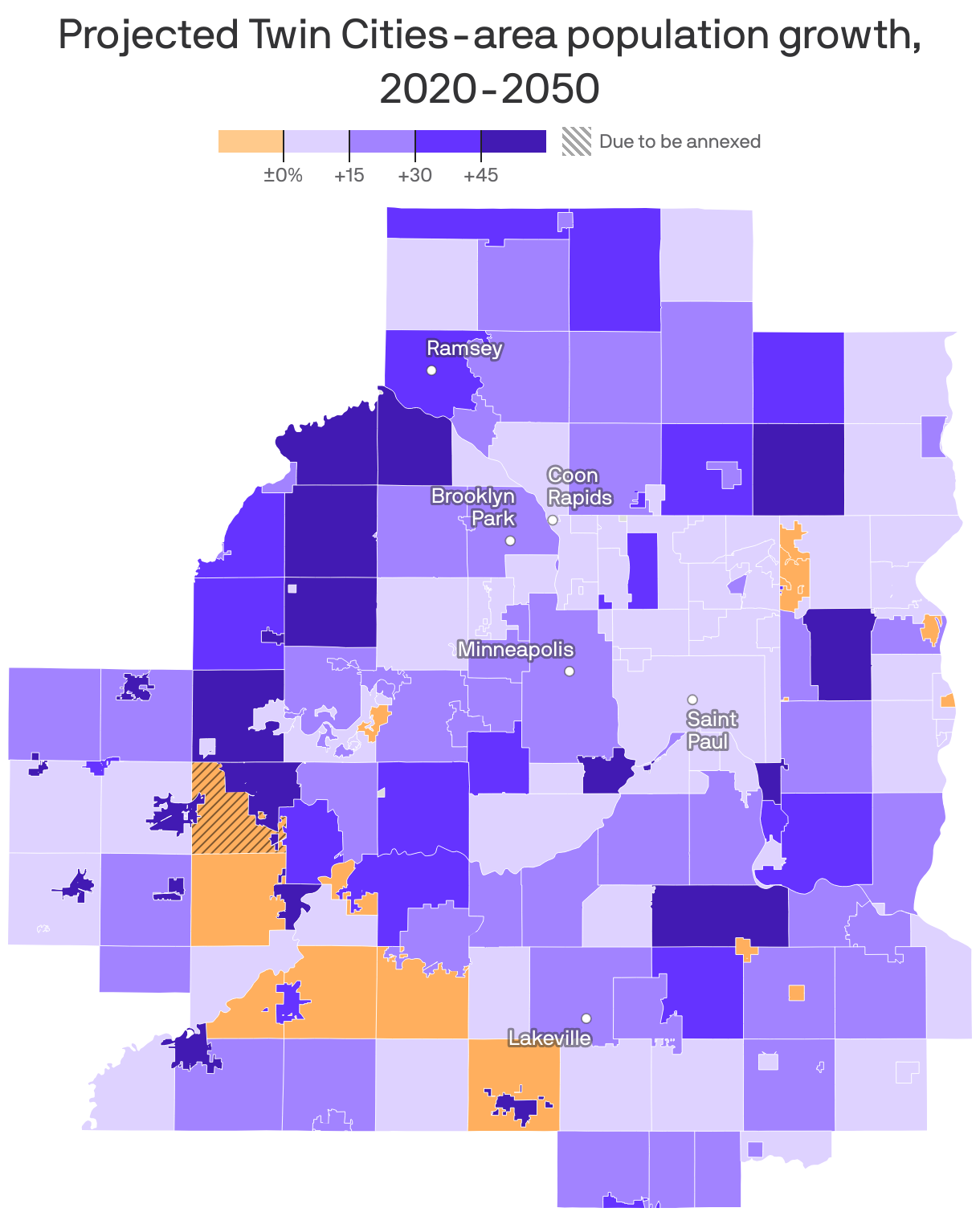
Get ready for more than half a million new neighbors.
Why it matters: The Twin Cities' population will continue to grow over the next 25 years — especially in outer-ring suburbs — according to the latest Metropolitan Council forecast.
- All these new residents will need housing, transportation, parks and — this is not a joke — functioning toilets. It's the Met Council's job to coordinate plans for all of that.
What they're saying: Population projections are "a foundational element of our regional plan," LisaBeth Barajas, the Met Council's executive director of community planning, told Axios. "Now that we have this regional forecast, how are we going to accommodate that [growth]?"
Driving the growth: By 2050, the city of Carver will nearly triple in population, while Dayton (+131%), Corcoran (+123%), Victoria (+96%), Rogers (+90%) and Waconia (+73%) will continue to boom, the forecast says.
Plus: The already-large suburbs of Eden Prairie, Lakeville, Blaine and Maple Grove will each gain roughly 20,000 new residents over the forecast period.
- Rosemount (+51.3%), Hugo (+49.1%) and Lake Elmo (+66.7%) can also expect thousands more people.
Yes, but: It's not only the outer-ring suburbs that are projected to grow.
- Minneapolis' population of 433,000 will eclipse half a million people by 2050 — a far cry from the largely stagnant '90s and 2000s, Barajas noted.
- St. Paul's population will also grow, but more modestly.
How it works: After examining economic and demographic trends, forecasters used a real estate model to project where new residents will settle, Met Council principal researcher Todd Graham told Axios.
- The models assume people are attracted to neighborhoods based on their socioeconomic makeup and proximity to transportation and amenities.
The fine print: The Met Council's forecast doesn't spell out how much of each city's population growth will come from immigration. However, Graham said that "central cities have been the gateway — an entry point to the region" for migrants.
- There also isn't enough data on remote work to determine how that will affect populations by 2050, Barajas said.
Friction point: Next month, the Met Council will vote on long-range plans that would push for more housing density in "suburban edge" communities to accommodate the expected growth.
- The Star Tribune reports officials in some of these communities, including Forest Lake and Lino Lakes, have raised concerns about realistically meeting the council's housing targets.
What's next: The Met Council is scheduled to vote on the "Imagine 2050" regional plan on Feb. 12.