Minnesota's days of swing U.S. House seats appear over for now

Add Axios as your preferred source to
see more of our stories on Google.
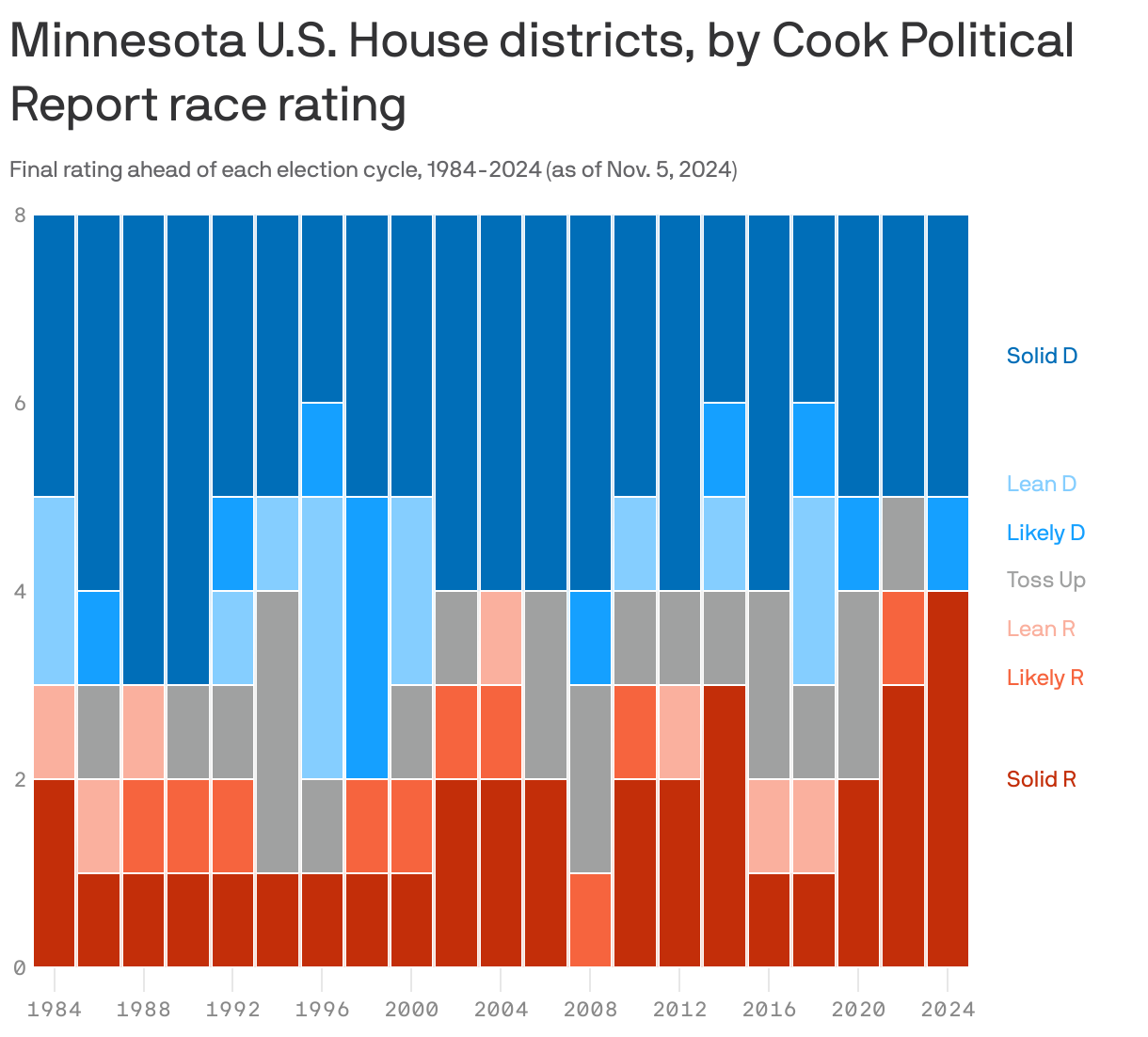
Minnesota may no longer be the land of competitive congressional races.
State of play: All eight of Minnesota's U.S. House districts were won by double-digit margins this year.
- DFL U.S. Rep. Angie Craig, the sole incumbent running in a swing district, sailed to a fourth term with a 13-point victory.
The big picture: The deepening urban-rural political divide has made the state's metro and suburban seats more blue and Greater Minnesota districts increasingly safe for the GOP.
Flashback: As recently as 2018, five of Minnesota's eight congressional districts were seen as in play.
- Outside groups spent record sums to flood the airwaves with ads in the metro that year.
Zoom in: The south metro's 2nd Congressional District, which Craig carried by just 2 points in 2020, started the cycle in election forecasters' "lean" Democrat column.
- But the levels of outside spending typical of a battleground race never materialized, and it was downgraded to "likely" Democrat in the final days of the campaign.
- Craig's margin of victory was more than double that of the Harris-Walz ticket in the district.
What we're hearing: "I would officially say I do not see her as a vulnerable incumbent," Christopher Chapp, a political science professor at St. Olaf College who conducts exit polling in the district, told Axios.
Between the lines: While Craig's moderate voting record shows she has a "finger on the pulse of the district," she also has "demographic change on her side" given population growth in parts of the district that lean Democratic.
- "With every passing election you're going to see the south metro — Eagan, Burnsville, Apple Valley — voters in those districts get a little bit bluer," Chapp said of the district's fastest growing areas.
Yes, but: If Craig decided not to run again, an open seat could veer back into more competitive territory, with stronger recruitment and increased spending, he predicted.
The intrigue: Incumbents are seen as most vulnerable in their first reelection and in their first race after redistricting.
- All seven U.S. House members who were on the ballot this year have cleared those hurdles.
What we're watching: Minnesota barely held onto all eight of its seats in the last reapportionment process, and experts believe we're all but destined to lose one after the 2030 Census.
- If that happens, and the maps are redrawn with just seven districts, "all hell breaks loose," Hamline University political science professor David Schultz told Axios at a recent Minneapolis Regional Chamber panel.
1 silver lining: While many see more competition as good for voters — and democracy — a dearth of battleground seats means fewer political ads flooding the airwaves.