Minneapolis considers an expansion of ShotSpotter — but with strings attached

Add Axios as your preferred source to
see more of our stories on Google.
Illustration: Brendan Lynch/Axios
Minneapolis is poised to extend its contract for gunshot detection technology — but only modestly expand where police use it.
Why it matters: The proposal before the city council Thursday is an attempt to balance skepticism that ShotSpotter locks in a pattern of heavy-handed policing in majority Black and Latino neighborhoods with officials' contention that it's a useful tool.
The big picture: Cities such as Seattle, Atlanta, San Antonio and Charlotte have abandoned the technology after investigations questioning its effectiveness as a tool for investigators or for curbing gun violence.
- Chicago's internal watchdog found just 9% of confirmed ShotSpotter alerts led police to actual evidence of a gun-related crime. That city's mayor vowed to end ShotSpotter's contract, but the technology remains in use for now.
What they're saying: "I'm convinced this is a tool we need," Minneapolis council member Jeremiah Ellison said at a hearing last month, "but I'm also convinced it's not a perfect tool. It requires evaluation."
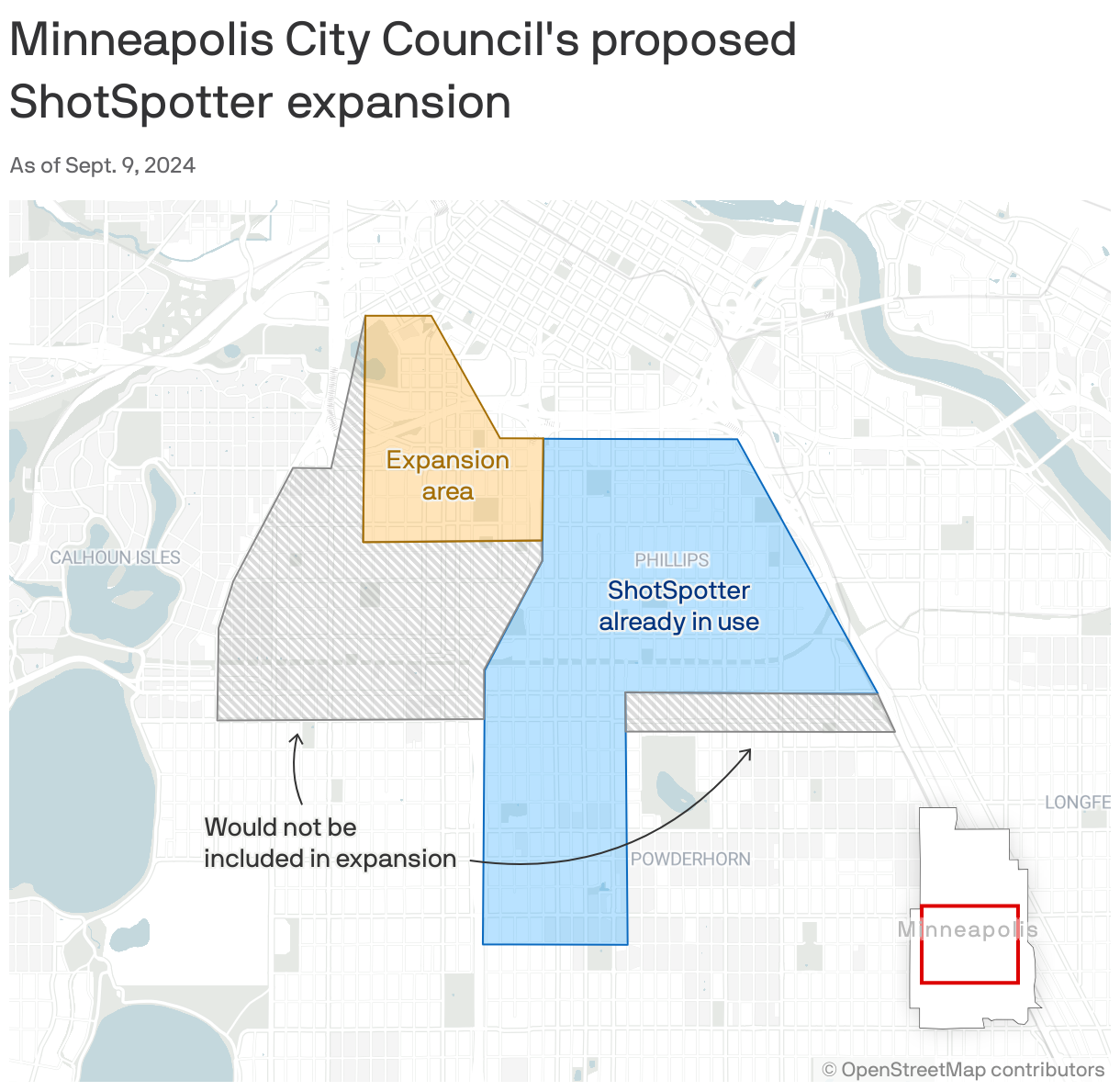
The latest: If the council approves the $2.6 million contract, Minneapolis would add ShotSpotter audio sensors to an area east and south of Loring Park, where reports of gunfire are frequent.
- However, a council committee rejected the original proposal, which called for adding sensors to Uptown.
- The committee also recommended a shorter contract extension — 18 additional months rather than 30 — and ordered the city to hire experts to study ShotSpotter's effectiveness.
Context: The city has used ShotSpotter since 2007. It now covers most of the North Side and parts of south Minneapolis.
How it works: ShotSpotter's makers say their computers filter out loud bangs from fireworks or backfiring cars. When computers suspect the noise is gunfire, human analysts review the audio before alerting the police — a change from earlier iterations of the technology.
Minneapolis police chief Brian O'Hara told the council that ShotSpotter can pinpoint the location of gunfire more accurately than a 911 caller — a virtue that "doesn't show up easily on a spreadsheet."
- He pushed back against audits like Chicago's, noting that 40% of ShotSpotter activations in Minneapolis were for a single shot — which officers are unlikely to spend much time investigating, O'Hara said.
- "It helps us develop the overall gun violence strategy," he said. "This is a tool. It is not the answer to our problems with shootings in the city."
Friction point: Research has found ShotSpotter is more often used in neighborhoods where Black and Latino people tend to live, and critics say that locks in a cycle of "over-policing" in these communities.
- O'Hara acknowledged the Minneapolis neighborhoods where ShotSpotter is used "have historically been over-policed and underserved" but that these areas also have historically struggled with higher rates of crime and gun violence.