Minneapolis' police chief aims to be an advocate for officers — and policing transformation

Add Axios as your preferred source to
see more of our stories on Google.
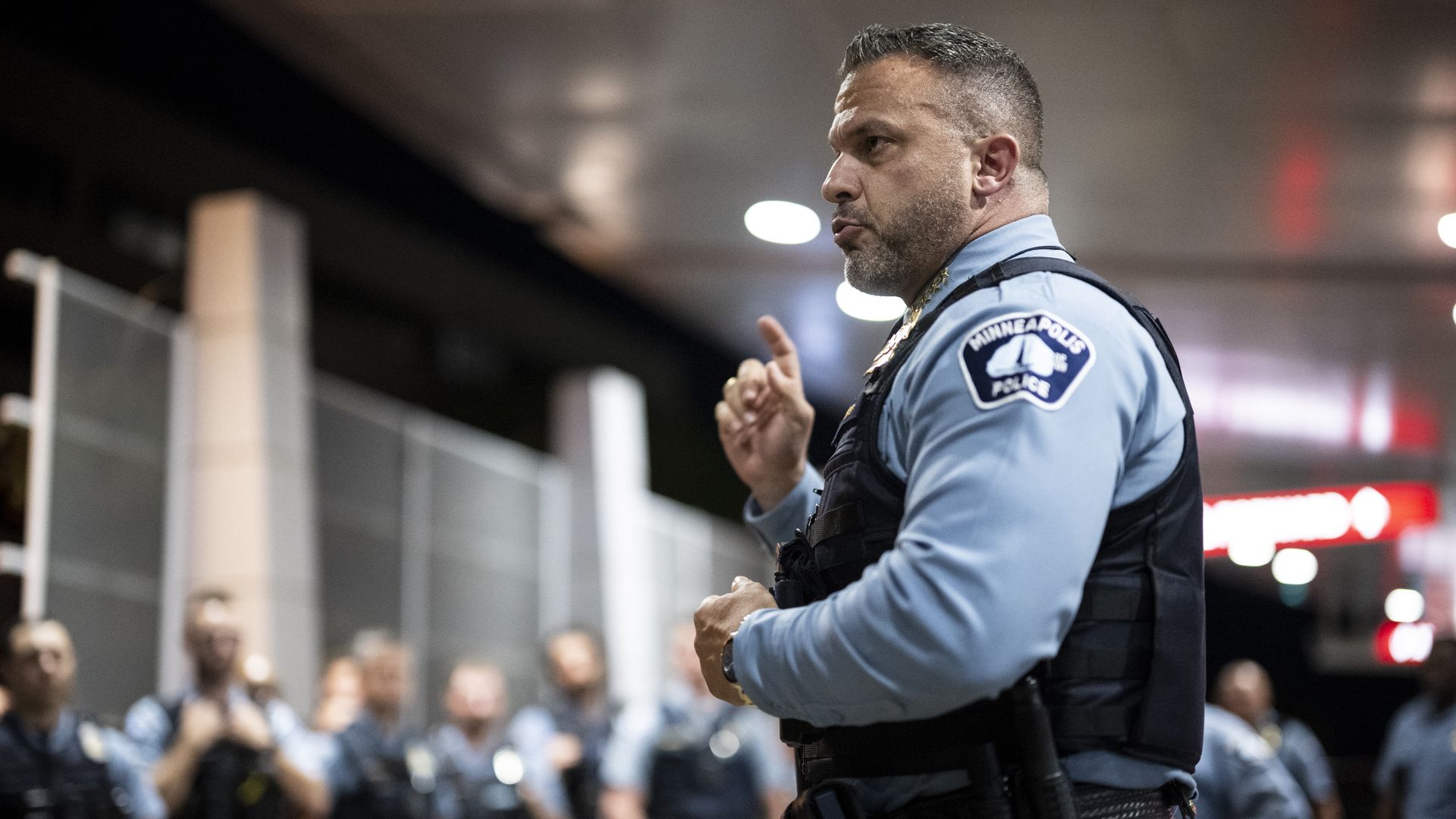
Police Chief Brian O'Hara speaks to officers in August 2023. Photo: Aaron Lavinsky/Star Tribune via Getty Images
One month before Brian O'Hara officially took the job as Minneapolis' police chief, he helped chase down a suspect in the Phillips neighborhood. On foot.
Why it matters: The incident is emblematic of O'Hara's approach to the job — including wanting to be present at crime scenes, he told Axios in an interview.
- He wants to be roused from bed for emergencies. His public advocacy has also won the trust of the rank-and-file, some officers say.
Flashback: As Sgt. Andrew Schroeder showed O'Hara around town in September 2022, they spotted a man they believed to have a gun.
- The future chief threw on Schroeder's vest — way too small for his broad-shouldered frame — and took off after him.
"Maybe it was muscle memory. Suddenly I realized … what the hell am I doing?" O'Hara recalled, laughing.
The big picture: Mayor Jacob Frey has identified the chief — hired for his experience implementing court-ordered police reform in Newark, N.J., as the official most responsible for transforming the Minneapolis Police Department's day-to-day operations.
- O'Hara will also be responsible for managing changes required by a new police union contract set for a vote on July 18.
Context: When O'Hara arrived, he said, he saw "a numbness" in a department that was reacting passively to crime, "like we were the fire department."
- Now in the middle of his second full year on the job, O'Hara is trying to shake MPD out of that stupor.
Between the lines: O'Hara assumed he'd be taking over a department ready for a new type of leader — but after a few months realized, "What people want is progress, no one actually wants change."
- "They just wanted a different result. They didn't want me to be someone different … They didn't want me to change things and do things in different ways."
O'Hara has already made policy changes to curtail MPD officers' use of force.
- He raised the department's bar for using 40-millimeter foam rounds — so-called less-lethal projectiles that have wounded and blinded protesters.
- He also banned the use of a restraint technique used against Floyd, as well as a related "hobble" device: "I just thought it was inhumane."
Reality check: Faced with historic declines in police officer staffing, O'Hara has the difficult task of replenishing MPD's ranks while remaking the department's approach to policing.
- He has not been immune from scrutiny, including after footage surfaced of an officer whose hiring he had signed off on using a stun gun against an unarmed man at a prior job.
- O'Hara fired the officer, ordered an investigation into MPD's hiring process, and told the Minnesota Reformer he planned to make "substantial process changes" on officer vetting.
What they're saying: Schroeder knows he won't agree with every change O'Hara makes, but trusts him to have officers' backs.
- "He doesn't think he's better than us."
"There is no way that we go through this reform without someone making hard decisions," the MPD veteran of 10 years added, "and I just feel like he's the boss."
Go deeper: Change slow to come four years into promised radical transformation of Minneapolis police