Your guide to San Francisco's June 2 primary


Add Axios as your preferred source to
see more of our stories on Google.
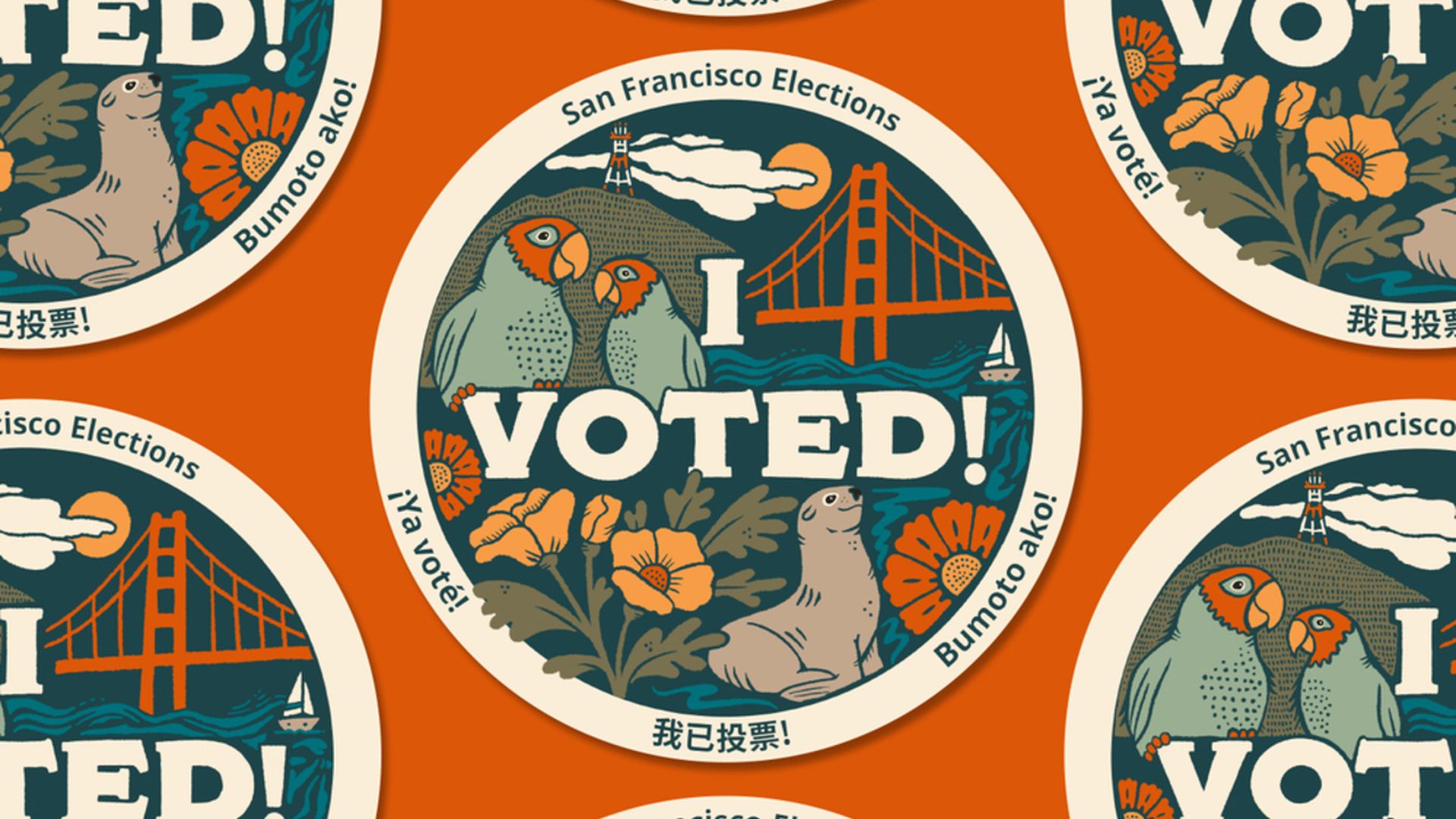
We really do have the best "I Voted" sticker in the country. Image: Courtesy of Hollis Callas
By now, every registered San Francisco voter should have received their mail-in ballot for the June 2 primary election.
Why it matters: This year's packed primary — with nearly 20 local, state and federal races — will shape City Hall power dynamics, decide key ballot measures and tee up high-profile November showdowns for Congress and the governor's office.
Expect to vote on:
🌁 Two supervisors: Consider these two elections proxy wars for Mayor Daniel Lurie's agenda, with his appointed supervisors facing voters for the first time.
- In District 2, incumbent Supervisor Stephen Sherrill faces off against community organizer and longtime Marina resident Lori Brooke. Their biggest disagreement: Housing and whether to build more or fight upzoning.
- District 4 incumbent Alan Wong is up against legislative aide Natalie Gee, educator David Lee, small business owner Albert Chow and campus coordinator Jeremy Greco in what's slated to be one of the most closely-watched local races. It'll be defined by a familiar westside flashpoint — a perceived "war on cars" — following bruising fights over the Great Highway.
Of note: Voters will also decide races in districts 6, 8 and 10 this November.
🏛️Two U.S. House seats
- In District 11, three congressional hopefuls are battling to succeed Rep. Nancy Pelosi for one of the most powerful Democratic strongholds in the country: State Sen. Scott Wiener, Supervisor Connie Chan and former AOC aide Saikat Chakrabarti.
- In District 15, which covers a sliver of the city's southeastern side, incumbent Kevin Mullin faces four challengers. Democrats include former tech executive Mantosh Kumar and Marine Corps vet Anthony Dang. Republicans vying for the seat include former cop Jim Garrity and retired UPS supervisor Charles Hoelter.
🗳️ Four local ballot measures
- Proposition A would let San Francisco borrow up to $535 million to fund emergency response and recovery projects, including earthquake safety upgrades. (Requires two-thirds voter approval).
- Proposition B would limit mayors and supervisors to two four-year terms for life. Currently, they can run again for the same position if they leave office for four years after two consecutive terms. (Requires a simple majority).
- Proposition C maintains the city's "overpaid executive" tax, but narrows which companies have to pay it. The expanded exemption would target businesses where the highest-paid employee earns 100 times more than the median worker. Currently, companies that make over $5 million in city revenue must pay the tax. The measure would allow businesses that make $7.5 million or less to avoid it while moving up a scheduled tax rate increase from 2028 to 2027.
- Proposition D goes the other direction. It would raise the "overpaid executive" tax rate and change how they're calculated — using a company's overall median pay instead of just what employees in San Francisco earn.
Between the lines: Props. C and D come down to a fight over how aggressively San Francisco should tax corporations and whether that risks pushing businesses out.
- Business groups argue Prop. D could drive employers away, while labor leaders counter that companies with massive pay gaps should contribute more, especially as the city faces a multibillion-dollar shortfall and risks cuts to public services.
- Whichever measure gets more votes takes effect, even if both receive majority support.
🍎 Board of Education member: It's been a turbulent few years for SFUSD, marked by leadership churn, budget woes and a historic teacher strike.
- A new board member will have to navigate the school district's plans to revamp its contentious lottery system and implement potential closures by 2030.
- Incumbent and school board president Phil Kim, nonprofit leader Virginia Cheung and director of the San Francisco Education Alliance Brandee Marckmann are all vying for the seat.
For statewide elections, the top two vote-getters — regardless of party — will advance to the general election.
- Find our breakdown of statewide races here.
What's next: After filling out those bubbles, drop your ballot off at one of 37 official boxes across the city or return it via mail, though it must be postmarked and signed by Election Day.
- Track your mail-in ballot here.
To vote in person, head to one of 501 neighborhood polling places open from 7am-8pm on Election Day.
- You can also cast your ballot at the City Hall Voting Center, now open for early voting.
- It's open 8am-5pm on weekdays except for Memorial Day, 10am-4pm the weekend before June 2 or 7am-8pm on Election Day.
If you're late to the game, you can still register online or in-person at the Department of Elections, post office or library until May 18.
- After that, register at City Hall or at your polling place through 8pm on Election Day.
- People experiencing homelessness can register using a cross street, park or shelter as an address.
Editor's note: This story has been updated to clarify that the school board race is for the seat of incumbent Phil Kim, who is the board's president.