What a weakened federal Voting Rights Act means for California

Add Axios as your preferred source to
see more of our stories on Google.
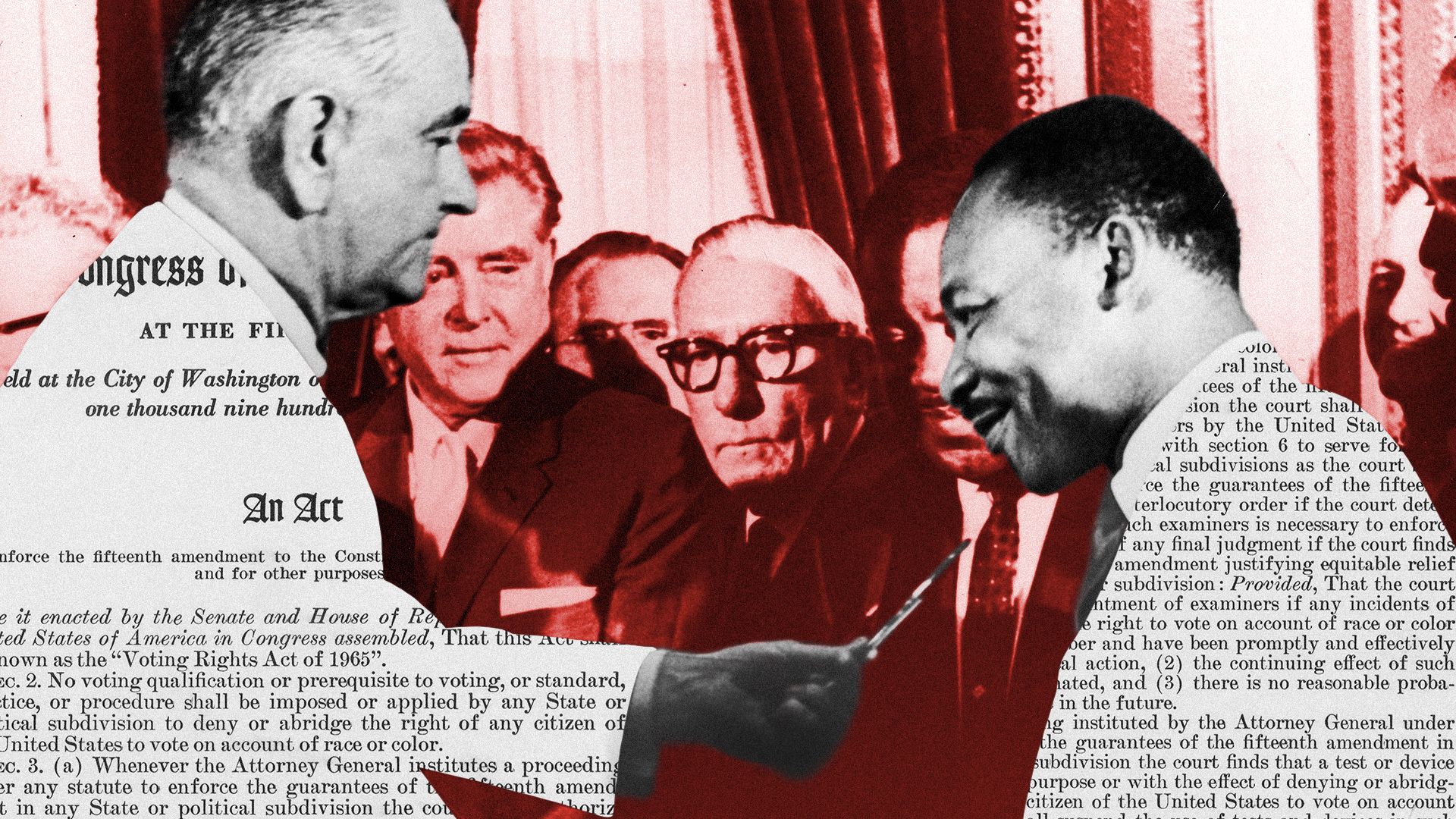
Photo illustration: Lindsey Bailey. Photos: Washington Bureau/Getty Images, National Archives
California has long relied on strong voting protections to expand representation, but a new federal ruling could chip away at that foundation.
State of play: The Supreme Court's narrowing of the Voting Rights Act last week weakens a federal backstop that helped challenge unfair electoral maps, threatens California's Voting Rights Act and potentially reverses gains in representation for voters of color, experts say.
- "We've seen a lot of progress being made on the diversification of elected officials — this is certainly not going to help," Emily Rong Zhang, a UC Berkeley assistant professor of law, told Axios.
Catch up quick: The court's 6-3 decision in Louisiana v. Callais narrowed Section 2 of the civil rights era law, the primary tool used to challenge racially discriminatory gerrymandering.
- The majority said Louisiana relied too heavily on race when it drew a second majority Black congressional district.
The big picture: States can now frame gerrymandering as partisan rather than racial to get new maps implemented — a key distinction because federal courts rarely step in on partisan redistricting.
- With Section 2 weakened, fewer federal checks are in place as states redraw political power.
Zoom in: California's Voting Rights Act — which expands protections for minority voters beyond federal law — could face new constitutional scrutiny and potentially be struck down because the Supreme Court ruling signals deep skepticism toward race-based protections in the political process, Zhang said.
- Zhang said opponents of California's law are already aware of the opening created by the ruling and challenges are likely to "start percolating."
Yes, but: California's independent redistricting system and newly drawn Proposition 50 maps are unlikely to change in the near term because they're already in effect, even as the ruling opens the door to new legal challenges.
- Longer-term effects could be significant in local elections for Latino, Asian and Black communities.
- The ruling "makes it much harder for minority voters at all levels of government to elect candidates of choice ... because that was what [the Section 2] protection was designed to enhance," Zhang added.
The bottom line: California's maps may hold for now, but the legal tools that helped make them more representative are eroding.