How Black communities shaped early San Francisco

Add Axios as your preferred source to
see more of our stories on Google.
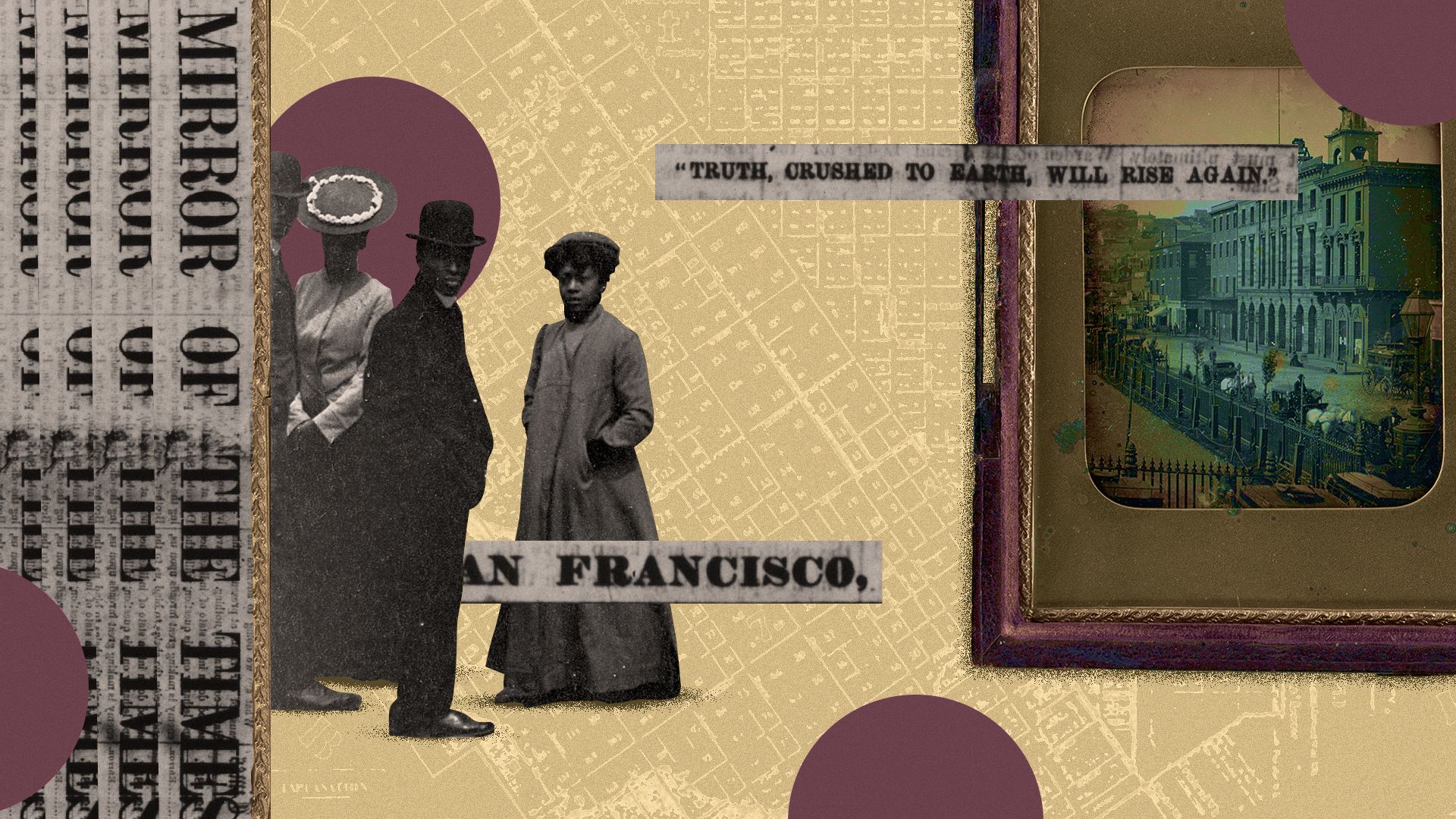
Photo illustration: Aïda Amer/Axios. Photos: LCorbis/VCG, Heritage Art/Heritage Images via Getty Images, Library of Congress/SN83027100, LC-USZ62-58812
Long before San Francisco became the City by the Bay, Black mariners, entrepreneurs and abolitionists were shaping its early identity.
Why it matters: In its 100th year since Carter G. Woodson's 1926 Negro History Week, Black History Month offers a chance to spotlight the feats of historic Black San Franciscans, especially as efforts to shrink institutions that preserve and teach that history gain ground.
- Here are some stories of Black San Franciscans you may not know about and the obstacles they overcame.
Early pioneers
Juana Briones, born in 1802 near what is now Santa Cruz to parents of Native American, African and European heritage, challenged church authority to gain clerical separation from an abusive husband and went on to become a successful ranch owner who sold milk and offered nursing and healing services.
- She supported 11 children on her own and expanded her business to a 4,400-acre ranch in the 1840s, tackling a lengthy legal process to retain ownership when California became part of the U.S.
George Dennis' white father brought him to California as a slave in 1849. Dennis, however, was able to buy his freedom after earning money as a porter at the El Dorado Hotel.
- Like Mary Ellen Pleasant (San Francisco's first Black millionaire), he went on to own several properties, including a horse livery business, lumberyard and coal yard, and used his wealth to fight for abolition.
Archy Lee was one of the first test cases involving an enslaved person after the California Fugitive Slave Act expired.
- The 18-year-old, who traveled to the state with his owner in 1857, escaped and hid in a Black-owned hotel. San Francisco abolitionists, including Dennis, worked to secure white legal services on his behalf. A federal court ultimately ruled in his favor in 1858.
When the center of the whaling industry moved from New Bedford, Massachusetts, to San Francisco in the 1870s, the large number of African Americans employed as crew migrated too, according to the National Park Service.
- Many became skilled mariners — including William T. Shorey, who in 1886 became the only Black West Coast ship captain — while others tried their luck in the gold fields.
- To assist newcomers with employment and housing, 37 African Americans founded the Mutual Benefit and Relief Society and rallied to build their own community.
African American press
The Mirror of the Times, the first African American newspaper on the West Coast, published pieces against racial segregation and exclusionary laws such as California's Testimony and Witness Laws, which barred Black people from serving as witnesses or providing testimony in court cases involving white people.
- Established in the 1850s by William H. Newby and Jonas Holland Townsend, the Mirror of the Times was a weekly newspaper that championed the motto "Truth crushed to the Earth will rise again."
- Other Black news outlets, including the Elevator and the San Francisco Vindicator, carried on its work.
Exodus to British Columbia
In 1858, a legislator introduced a bill prohibiting the "immigration" of people of African descent to California, including American-born Black people, from other states and U.S. territories.
- All African Americans residing in the state at the time would have had to register and carry identification papers at all times, facing "deportation" if they couldn't prove that they'd lived in California prior to 1858.
- Though the bill died in committee, many local African Americans had enough and made plans to emigrate to Canada. San Francisco wouldn't see a boom in its Black population again until after World War II, when the Fillmore became the "Harlem of the West."