How mahjong is reshaping holiday traditions

Add Axios as your preferred source to
see more of our stories on Google.
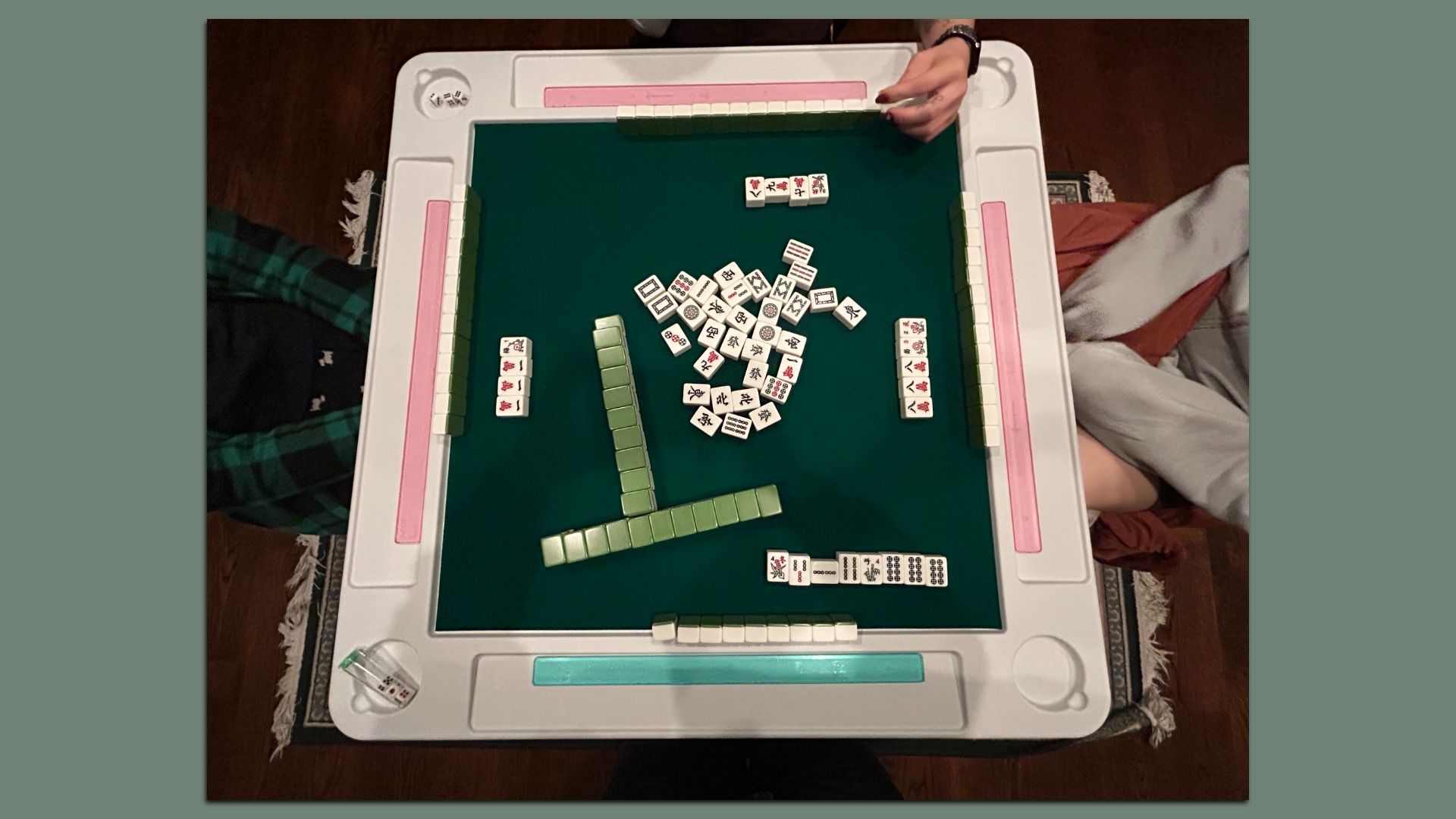
My mom taught my sisters and me how to play after returning from Taiwan a few months ago. Photo: Shawna Chen/Axios
As the holiday season descends upon us, an ancient Chinese game replaces Monopoly and Pictionary in some Bay Area households — including my own.
The big picture: Mahjong has enjoyed a surge in popularity across the U.S. over the last few years, and the number of mahjong events on Eventbrite surged 146% in San Francisco between 2023 and 2024.
Between the lines: Though the strategy game originated in China, it has evolved into multiple variations over the decades as different cultures adapted it with new rules and playstyles.
- My family plays the Taiwanese version, where each player starts out with 16 tiles instead of the traditional 13. To win, you must compile them into sequences of certain sets and/or runs, plus a matched pair.
Zoom in: Given I only recently learned how to play, I'm not best situated to explain the game (here's a quick explainer from Oakland-based Nicole Wong, author of "Mahjong: House Rules from Across the Asian Diaspora").
- I'm also convinced some of the rules my mother taught are specific to our family and not the broader Taiwanese variation. (She got annoyed by me repeatedly asking, "Why is it played like that?")
- That said, I can attest to how fun it is after you get the basics down.
As the child of Taiwanese and Chinese immigrants, I grew up associating the tactile game with older aunties and uncles whose voices would become increasingly aggressive as the sound of tiles clicking and clacking overtook the space.
- As a result, mahjong always intimidated me — an experience I'm told is common among second-generation Asian Americans.
Yes, but: My mother returned from Taiwan earlier this year with a beautifully polished set of tiles and was determined to teach us how to play, and I gave it a shot.
The intrigue: There's something deeply satisfying about the tactile nature of the game, which traditionally features tiles made of bone or bamboo.
- It also helps get you off your phone, something my sisters and I have benefited from.
- The first time one of us emerged triumphant over my mom, she was simultaneously disappointed and proud. Though she sternly forbade us from playing with money, it is traditionally a gambling game, a version I hope to try in the future — but strictly to honor my roots, of course.
Pro tip: You can also play mahjong on online apps if you don't have a set of tiles. My mom and I recently spent three hours of a flight taking turns playing, though we mostly lost against the computer.
New to the game? We got you. Mahjong establishments have taken off in the last few years as the game experienced a cultural revival, especially among young people.
- Mr. Mahjong's is a cocktail bar and lounge in downtown San Francisco that offers late-night bites and mahjong gameplay.
- 13 Orphans, a mahjong den and speakeasy that sits above Baba's House in Oakland, opened earlier this year after seeing high demand during weekly mahjong nights and provides dedicated coaching for beginners.
- Youth Luck Leisure (YLL) Mahjong Club also hosts bimonthly pop-ups with up to 200 guests in San Francisco.