The Vaillancourt Fountain fight, explained

Add Axios as your preferred source to
see more of our stories on Google.
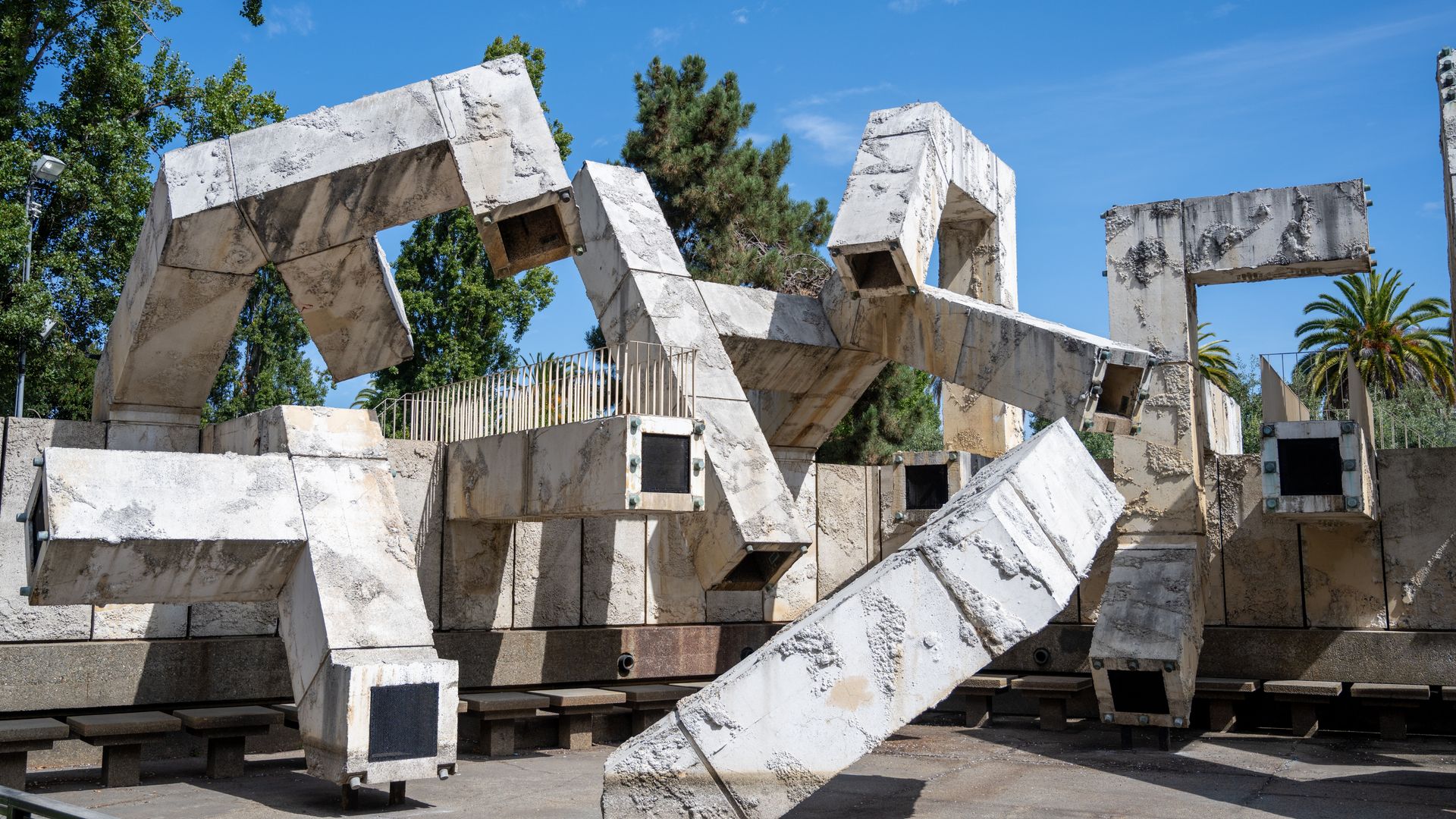
The work was once set against the Embarcadero Freeway — a pairing some found fitting. Photo: Smith Collection/Gado/Getty Images
Love it or hate it, the Vaillancourt Fountain will soon be departing San Francisco's waterfront.
Why it matters: The Brutalist artwork — in all its concrete glory — is slated for a $4.4 million demolition after a divisive vote last week sealed its fate, and the weathered maze of interlocking cement tubes will be removed in three months.
Driving the news: The city's Arts Commission voted 8-5 on Nov. 3 to disassemble the fountain — designed by Québécois artist Armand Vaillancourt in 1971 — as part of a $32.5 million redesign of Embarcadero Plaza.
- City officials say the fountain's angular tubes are in disrepair and contaminated with lead and asbestos, and that repairing it would nearly drain the entire project budget. It was fenced off indefinitely earlier this year after being deemed a public safety hazard.
- They say the plaza's proposed redesign reimagines it as a people-first gathering area with open lawns, shaded seating and clear views of the Bay — a shift from its current hard concrete aesthetic to a more inviting space.
The big picture: The fight over the Vaillancourt Fountain cuts right to the heart of San Francisco's identity. From the start, the artwork has stirred more argument than admiration.
- Its massive tangle of protruding concrete and cascading water split residents, with some hailing it as a bold symbol of modern art and others condemning it as an industrial intrusion on the waterfront.
- To preservationists, the fountain is an architectural relic of San Francisco's rebellious spirit. They point to the artist, who saw the piece as a defiant work of public art and named it "Québec Libre!" They blame the city for letting it decay, a claim officials rejected.
Now 96, Vaillancourt himself traveled to San Francisco earlier this year to make a passionate plea to keep the 54-year-old structure intact, emphasizing the fountain's historic significance and warning of possible legal action if it were dismantled.
- "I think my name will survive all of the turmoil, but my life has been poisoned," Vaillancourt said in an interview this week with CBC News.
What's next: The 710-ton structure will be stored for up to three years while the city decides whether to restore, relocate or permanently retire it, a move Vaillancourt told CBC News he'd rather avoid, preferring instead to bring it back to Canada for installation elsewhere.
The bottom line: The fountain's removal symbolizes a deeper civic struggle — a city that celebrates reinvention but resists change.
- Every redevelopment fight here exposes the same tension over how to modernize without erasing what makes San Francisco distinct.