Sam Altman on the promise and peril of AI

Add Axios as your preferred source to
see more of our stories on Google.
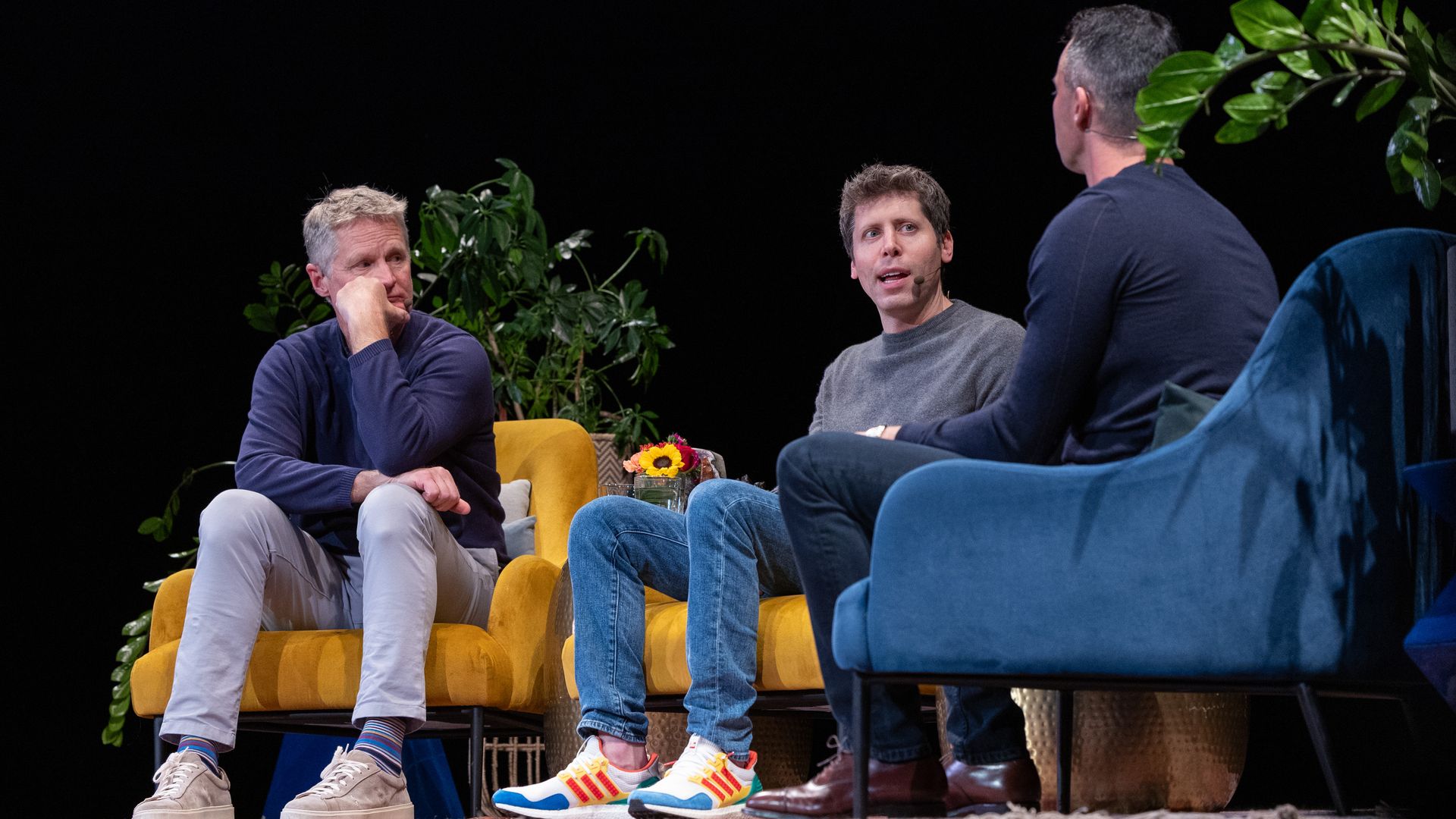
From left, Warriors coach Steve Kerr and Open AI CEO Sam Altman discuss innovation and leadership with Manny Yekutiel. Photo: Courtesy of David Schmitz
OpenAI CEO Sam Altman said AI's evolution will be "messy" and capable of curing diseases or creating new threats — a sober prediction made this week in San Francisco framing the technology as both humanity's greatest tool and its riskiest experiment.
Why it matters: How one of the world's most influential tech leaders views the promise and peril of artificial intelligence helps define the global playbook.
- Not only does it shape a company's decisions, but also the ethics, power structures and economies evolving amid the AI boom playing out across the city and the globe.
Driving the news: In a conversation Monday evening with Warriors coach Steve Kerr at the Sydney Goldstein Theater, Altman acknowledged the nascent technology's dual ability to help or harm humanity but stopped short of endorsing stronger external regulation.
- Instead, he suggested that good actors could counterbalance bad ones.
What they're saying: "One thing that's unusual about AI is ... like it could go really wrong," Altman said. "My hope is that there's way more good AI that can counteract the bad."
Context: The discussion, moderated by District 8 contender Manny Yekutiel, drew a packed audience and significant attention in a city wrestling with both technological innovation and deepening economic inequality.
The big picture: Altman's guiding principle — that technology should expand personal freedom, not limit it — underpinned much of his remarks, evident in his comments over OpenAI's decision to introduce "erotica" for adult users.
- "I really believe that technology needs to service users to do what they want," he said.
- He also described AI as an inevitable wave of continuous progress, arguing that the technology will redefine — not replace — human work, and said "the socioeconomic contract has to change very dramatically."
Between the lines: Perhaps the most telling — and stark contrast — between Kerr and Altman's positions in the wide-ranging conversation emerged after Yekutiel pressed them on their views over the widening wealth gap and the role billionaires have in addressing it.
- Kerr drew on his experiences as a coach and parent to show how economic life has shifted, particularly for younger generations.
- "So many people are now struggling to make ends meet — it doesn't feel like our country is heading in the right direction with this wealth gap and the disparity," he said.
Altman said creating great technology is "good on its own" but added that the wealthy should still attempt to "make the world better."
- He pointed to the lack of housing affordability as the main driver of wealth inequality, calling it "the biggest difference to what it takes to succeed in America."