Where America's oldest residents live


Add Axios as your preferred source to
see more of our stories on Google.
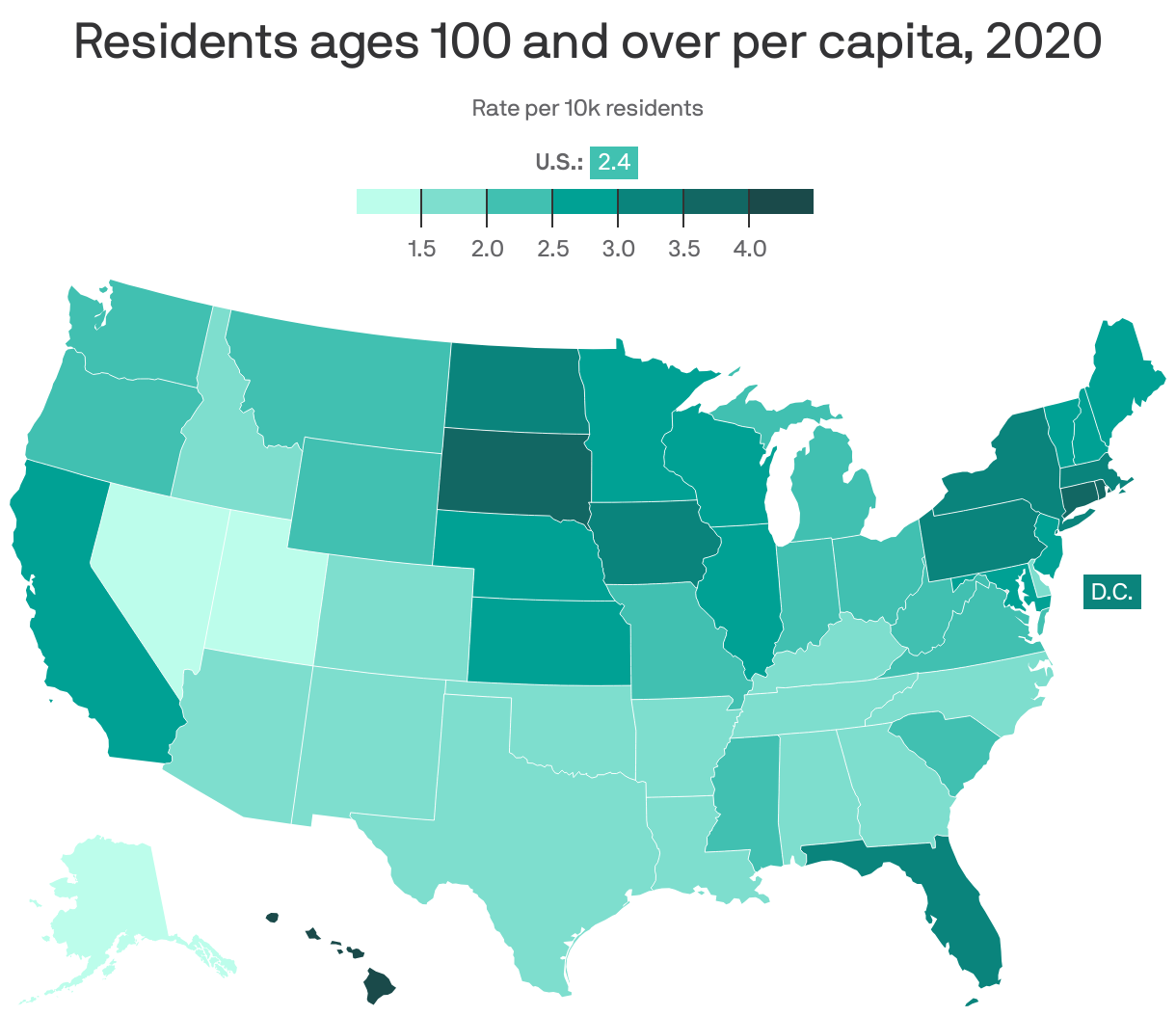
Our elders are hanging around longer than they used to.
The big picture: The number of centenarians — people aged 100 or older — in the U.S. grew by 50% from the 2010 Census to the 2020 count, per a new Census Bureau analysis.
Why it matters: The Bureau's new deep dive offers a comprehensive look at one of America's fastest-growing demographics, who represent a triumph of medical and scientific advancements but also have unique caretaking needs.
By the numbers: California had 2.7 centenarians for every 10,000 residents in 2020 — a total of 10,623.
- Hawai'i (4.4 centenarians for every 10,000 residents), Rhode Island (4.0) and South Dakota (3.9) had the highest rates.
- Utah (1.0), Alaska (1.3) and Nevada (1.4) had the lowest.
Zoom out: The 2020 Census counted about 80,100 centenarians, up from around 53,400 in the 2010 version. That's 2.4 centenarians for every 10,000 U.S. residents overall.
Between the lines: A whopping 78.8% of U.S. centenarians are female, the Census Bureau says — which tracks with the life expectancy gender gap.
- The 2020 cohort is slightly more racially diverse, with "white alone" members making up 74.6% of centenarians, down from 82.5% in 2010.
Caveats: Older people have been particularly vulnerable to COVID-19 — especially in the pre-vaccine era — and these numbers don't reflect the full toll of the pandemic.
- Moreover, efforts to get solid data on America's oldest residents have long been complicated by several factors, the Census report points out, including misreporting problems, data capture errors, proxy reporting (someone reporting information about someone else) and more.