Wolf recovery in California still fragile amid efforts to restore population

Add Axios as your preferred source to
see more of our stories on Google.
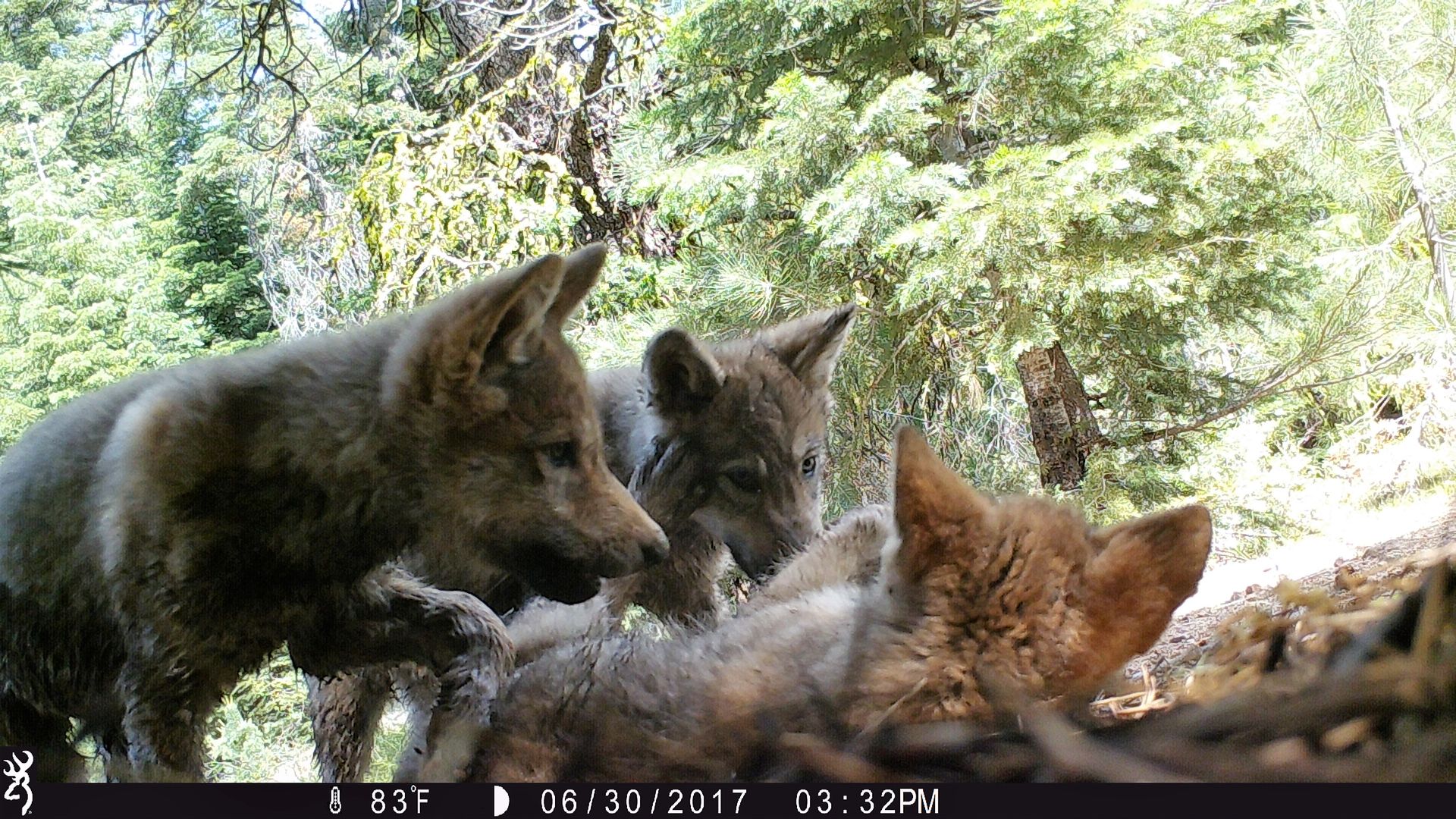
Pups from the Lassen wolf pack seen in 2017. Photo: Courtesy of the California Department of Fish and Wildlife
Only three of California's 10 active wolf packs had pups this year, per new state data.
Why it matters: Wolves restore ecosystem balance by keeping deer and elk populations under control, preventing "overbrowsing" — excessive plant consumption by herbivores — and allowing vegetation to rebound.
State of play: Recovery remains fragile. Small pack numbers, high pup losses, limited breeding pairs, low prey availability and threats from disease and habitat change can all slow their rebound.
What they're saying: "It's concerning that there's no indication the other seven packs have had pups," said Amaroq Weiss, a senior wolf advocate at the Center for Biological Diversity. "For recovery to stay on track there needs to be more wolves in more places."
By the numbers: 22 pups in California were born among three packs this year, per an Aug. 11 quarterly report from the California Department of Fish and Wildlife.
Between the lines: Some packs likely didn't breed because their alpha male and female are siblings. Other packs, which had recently bred in previous years, may have had pups the state hasn't confirmed yet, Weiss told Axios.
- A total of 50 to 70 wolves live in California, fluctuations that vary widely because pup mortality rates tend to be high — often 50% or more in the first year — due to various natural and environmental factors, she added.
Zoom in: Most of the state's wolves roam in and around Lassen National Forest in the northeast, but their range stretches from the Oregon border to Sequoia National Forest in the south.
Zoom out: Elsewhere in the West, there are about 1,800 wolves in Wyoming, Montana and Idaho combined; roughly 200 each in Washington and Oregon; around 280 in Arizona and New Mexico combined; and about 10 in Colorado, per Weiss.
Catch up quick: Gray wolves were wiped out in California by the 1920s amid a nationwide extermination campaign. Repopulation efforts began in 2011, when OR-7 — the first wolf identified in California in nearly a century — crossed in from Oregon.
- Today, California wolves are fully protected under federal and state endangered species laws, but long-term survival odds hinge on more breeding success.
The bottom line: "Wolf recovery is in its infancy here. There's still just so much public education to be done to help people understand why it's important to have them," Weiss said.