California could get hit hardest by Trump's NASA budget cuts


Add Axios as your preferred source to
see more of our stories on Google.
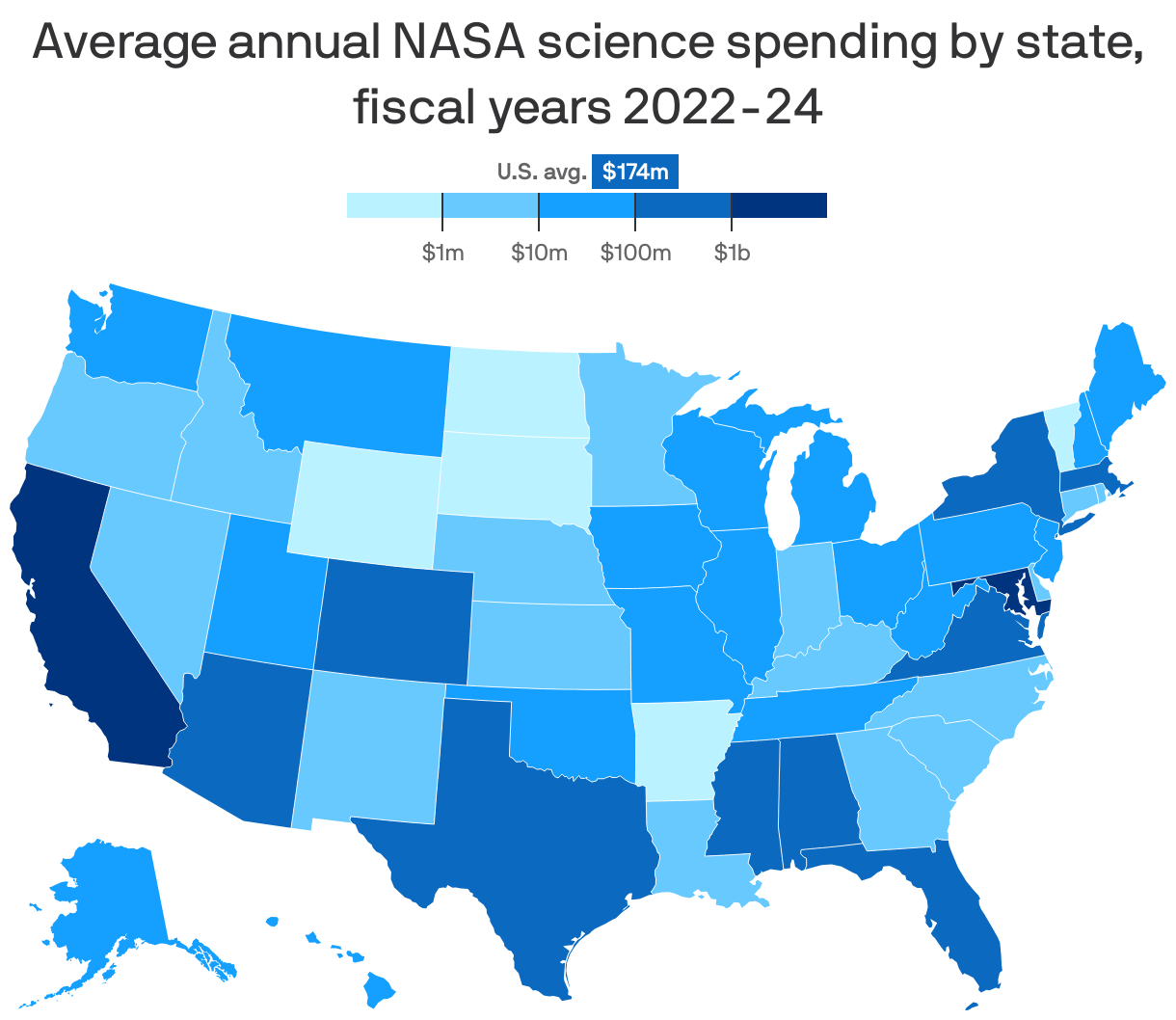
NASA spends an average of $3 billion annually in California on scientific missions — the highest of any state, per data from The Planetary Society, a pro-space nonprofit.
Why it matters: NASA's science efforts bear the brunt of cuts to the agency in the Trump administration's proposed budget, which would slash science funding by nearly 50% to $3.9 billion.
State of play: Science represents roughly 30% of NASA's budget, supporting missions like space telescopes, robotic probes and satellites that gather data about Earth's changing climate.
- While not always as headline-grabbing as human spaceflight, NASA's science activity has greatly enhanced our scientific understanding of both Earth and our celestial neighborhood.
Threat level: Trump's proposed cuts could lead to 13,975 job losses, $1.4 billion less in science spending for California and $3.9 billion of lost economic activity.
By the numbers: NASA supported 33,600 jobs in California and generated $8.3 billion per year in economic output between fiscal years 2022-2024, per a recent report.
Zoom in: Missions on the chopping block include the Mars Sample Return, an ambitious joint American-European plan to collect Martian soil samples and bring them to Earth for further study.
- Nearly 20 active science missions would be canceled in total, representing more than $12 billion in sunk taxpayer costs, per the Planetary Society.
Zoom out: Besides California, Maryland ($2 billion) and Texas ($614 million) saw the most average annual NASA science spending across fiscal 2022-24, the data shows.
The big picture: Trump's proposed NASA cuts fit into a broader pattern of pulling resources away from scientific endeavors and data collection, especially involving climate change.
The bottom line: Congress, not the president, sets NASA's budget — but Trump's proposal suggests he believes the agency should be focused on human spaceflight rather than a broader scientific mission.