Study: BART's fare evasion crackdown falls short on revenue recovery, equity

Add Axios as your preferred source to
see more of our stories on Google.
BART has touted cracking down on fare evaders as a solution to its looming fiscal cliff, but a new study shows the bang may not be worth the buck.
The big picture: The public transit agency has taken steps to bolster fare evasion enforcement operations amid budget shortfalls, perceptions of crime and pandemic-driven ridership declines.
Driving the news: Fare evasion-specific enforcement "does not appear connected to any measurable reduction in reported crimes, either related to physical safety or public disorder," states the the Center for Policing Equity's (CPE) new report.
- Most arrests from these stops are due to outstanding warrants for minor offenses, often unrelated to BART, and not violent crimes or actual fare evasion charges, the study notes.
Reality check: Only 6-12% of proof of payment citations were actually paid, per corporate finance advisory firm Stout's calculations as cited in the CPE study.
- Between 2018 and 2023, the highest annual amount of revenue collected from violations reached only $86,613 in 2019, substantially less than the $2.2 million allocated to inspection officers and the $25.5 million spent on sworn law enforcement in 2023.
Between the lines: On the BART system, both sworn and fare inspection officers can stop riders and issue a warning or a civil citation. They can also give a criminal infraction citation, which is issued when an adult fails to show proof of payment three times within six months.
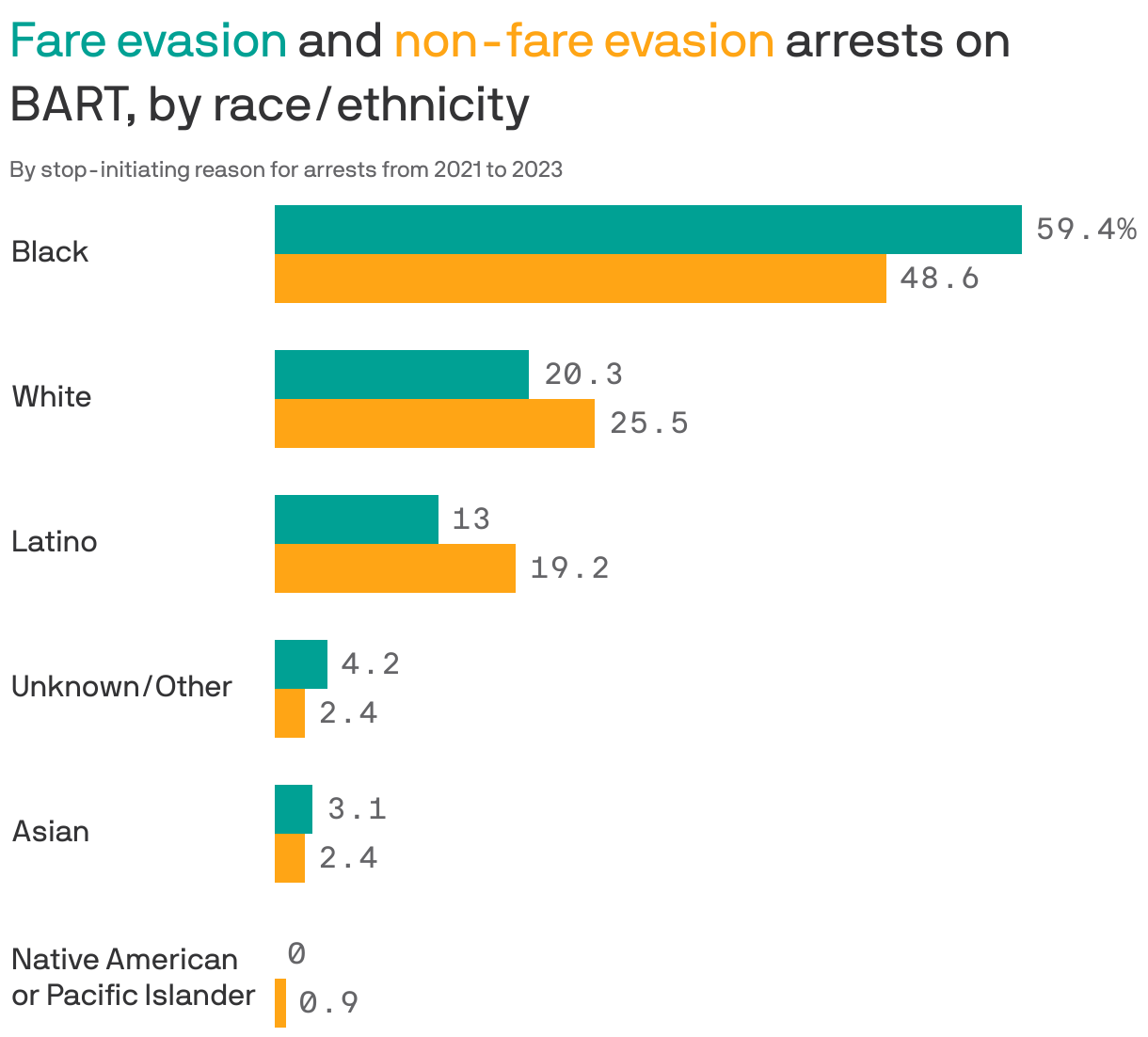
- Black people — who account for under 9% of the population served by the system — comprised 49.6% of fare evasion citations and 59.4% of arrests resulting from fare evasion stops, per the study.
What they're saying: "That's a lot of what advocates are concerned about: how much discretion are we giving armed agents of the state with the power to take away life and liberty?" Hans Menos, vice president of CPE's triage response team, told Axios.
- BART police officers are "empowered to just say, 'Hey have you paid your fare?'" Menos noted. "It could be because they looked unhoused or addicted, or they're looking for a weapon. Or it could be legitimate. But that allows for a lot of discretion."
The other side: Alicia Trost, BART's chief communications officer, told Axios via email that BART has "no plans to change our current efforts to replace fare gates and enforce our code of conduct, which includes ... an increase in the visible safety presence in the system."
- "These strategies are improving the rider experience and are key to our 17% drop in crime last year," Trost said, noting that the system has also expanded the use of ambassadors and crisis intervention specialists (CIT).
- Trost added that the study was conducted before BART switched to new jump-resistant fare gates, which she said addresses disparity concerns because they significantly deter fare evasion and reduce interactions between riders and officers.
- "We believe the findings are no longer valid as the BART station environment is now very different."
What's next: After the murder of George Floyd, BART followed a lot of municipalities in expanding use of non-police responders — a tactic CPE is urging BART to prioritize instead of fare evasion enforcement.
- Other recommendations include revising policy to explicitly require warnings for individuals stopped for fare evasion for the first time and establishing the ambassador and CIT program as a separate entity from BART police.
- "That's a big part of what we're communicating here, that there's another way to conceptualize this problem," Menos said.
What we're watching: BART fare is set to increase 6.2% next January.