Criminal justice reforms stall as SF shifts toward tougher policing

Add Axios as your preferred source to
see more of our stories on Google.
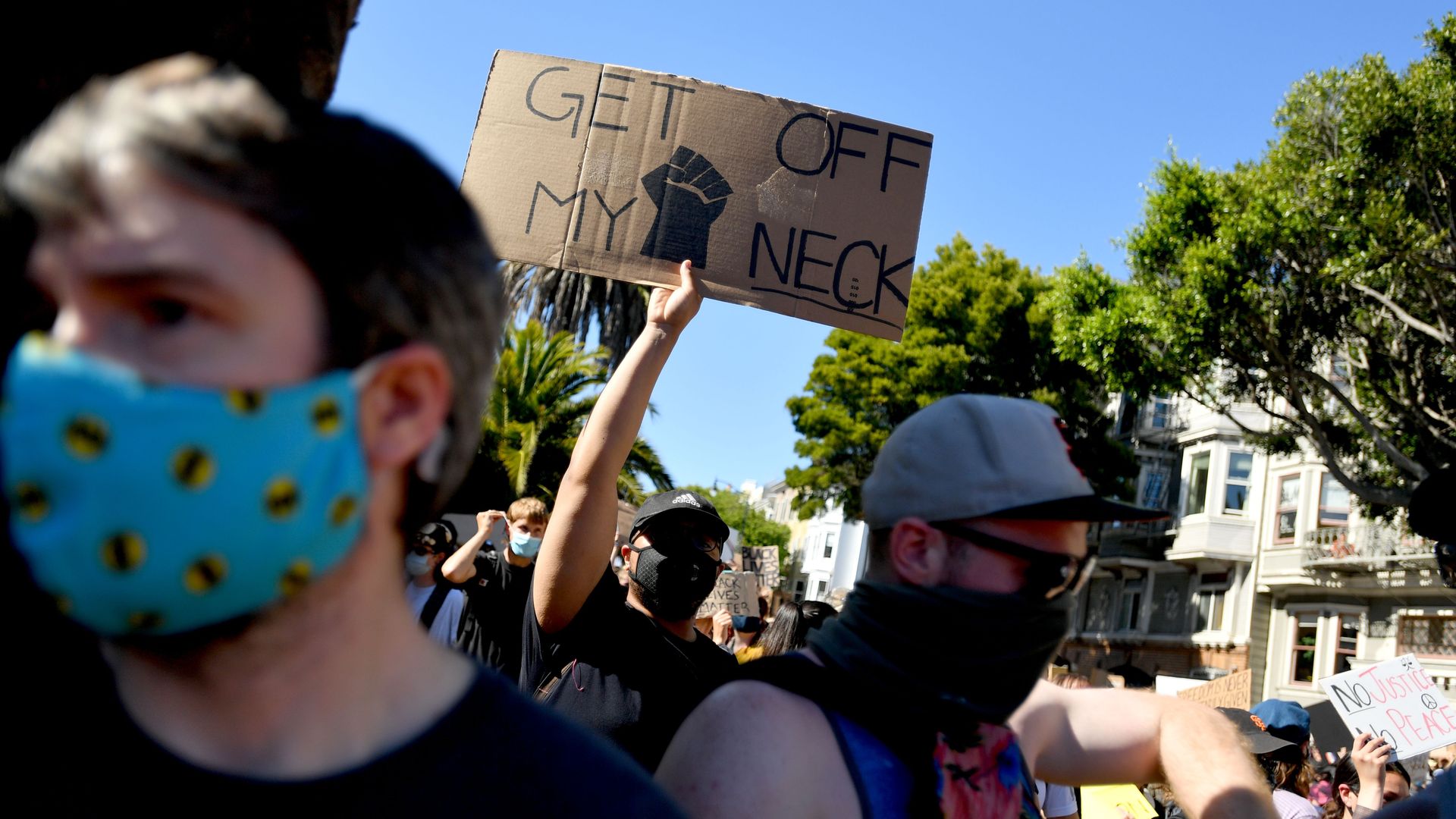
A protester raises a sign during a rally in support of George Floyd and against police brutality at Dolores Park in San Francisco on June 3, 2020. Photo:Josh Edelson/AFP via Getty Images
The 2020 George Floyd protests ignited a fervor for criminal justice reform in the Bay Area, but five years later, the pendulum appears to be swinging in the opposite direction.
Why it matters: While Floyd's murder led San Francisco to take steps to address racial injustices, many of those policies remain in limbo, especially as Mayor Daniel Lurie moves to beef up police staffing.
What they're saying: "That's a lot of what advocates are concerned about: how much discretion are we giving armed agents of the state with the power to take away life and liberty?" Center for Policing Equity's Hans Menos, whose recent study on BART's fare evasion enforcement indicated racial bias in citations and arrests, told Axios.
Low-level traffic stops
The San Francisco Police Commission voted in spring 2024 to restrict officers' use of pretext stops, which occur when police cite minor traffic violations — such as failing to properly use a turn signal — as a "pretext" to conduct a stop and pursue baseless searches.
- Civil rights advocates say these types of traffic stops promote racial profiling and disproportionately target Black and Latino San Franciscans.
- Black people account for 19% of police traffic stops in San Francisco despite only making up 5% of the city's population, per a 2022 analysis of 2019 data.
- Yet they are less likely to be ticketed or found with contraband compared to white drivers, according to a 2023 report by the city's reparations committee.
The other side: The San Francisco Police Association filed a lawsuit to block the policy last November, arguing that limiting stops for traffic violations "jeopardizes the safety and welfare of the general public."
Reparations
The city established the African American Reparations Advisory Committee in 2021 to issue recommendations for rectifying its historic abuse against Black people, such as the 1960s urban renewal plan that decimated the Black population.
- The committee's final report, released in 2023, included proposals like giving $5 million to every Black resident and adding at least one formerly incarcerated person to the police commission.
Reality check: Former Mayor London Breed nixed the idea of establishing an Office of Reparations to oversee policy implementation, leaving the issue unresolved.
- Lurie's office did not respond to Axios' query about whether he plans to revisit reparations.
Prosecutions
In November 2020, Chesa Boudin became the first district attorney in San Francisco history to file homicide charges against a police officer for the fatal shooting of a civilian.
- He was elected in 2019 on a progressive platform vowing to reduce incarcerations and reform law enforcement practices but was recalled in 2022 after critics accused him of being too soft on crime.
- Though crime fell while Boudin was in office, burglaries and homicides ticked up.
- His replacement, Brooke Jenkins, has since taken a more hardline approach and raised the city's conviction rate for the first time in eight years.
Yes, but: Jenkins took heat for declining to bring charges against a Walgreens security guard accused of fatally shooting 24-year-old Banko Brown, who was Black and transgender.
Homelessness
When city officials cracked down on homeless encampments last year, the increase in criminal penalties against unhoused people led to criticism from civil rights advocates.
- Black people are vastly overrepresented among San Francisco's population of unhoused residents.
- Because they're incarcerated at disproportionately high rates and often receive harsher punishments, they're more likely to cycle from the criminal system directly into homelessness.
- They're also more likely to be denied housing than white people, a continuation of historic segregation and redlining practices.
What we're watching: Federal funding for UCSF's Black Economic Equity Movement, a clinical trial operating a guaranteed income pilot for low-income Black young adults, was cut earlier this year as the Trump administration rolled back support for DEI-related research.
- California is among several litigants challenging the move in an effort to restore funds.