Advocates push to revive "Vision Zero" amid rising pedestrian fatalities

Add Axios as your preferred source to
see more of our stories on Google.
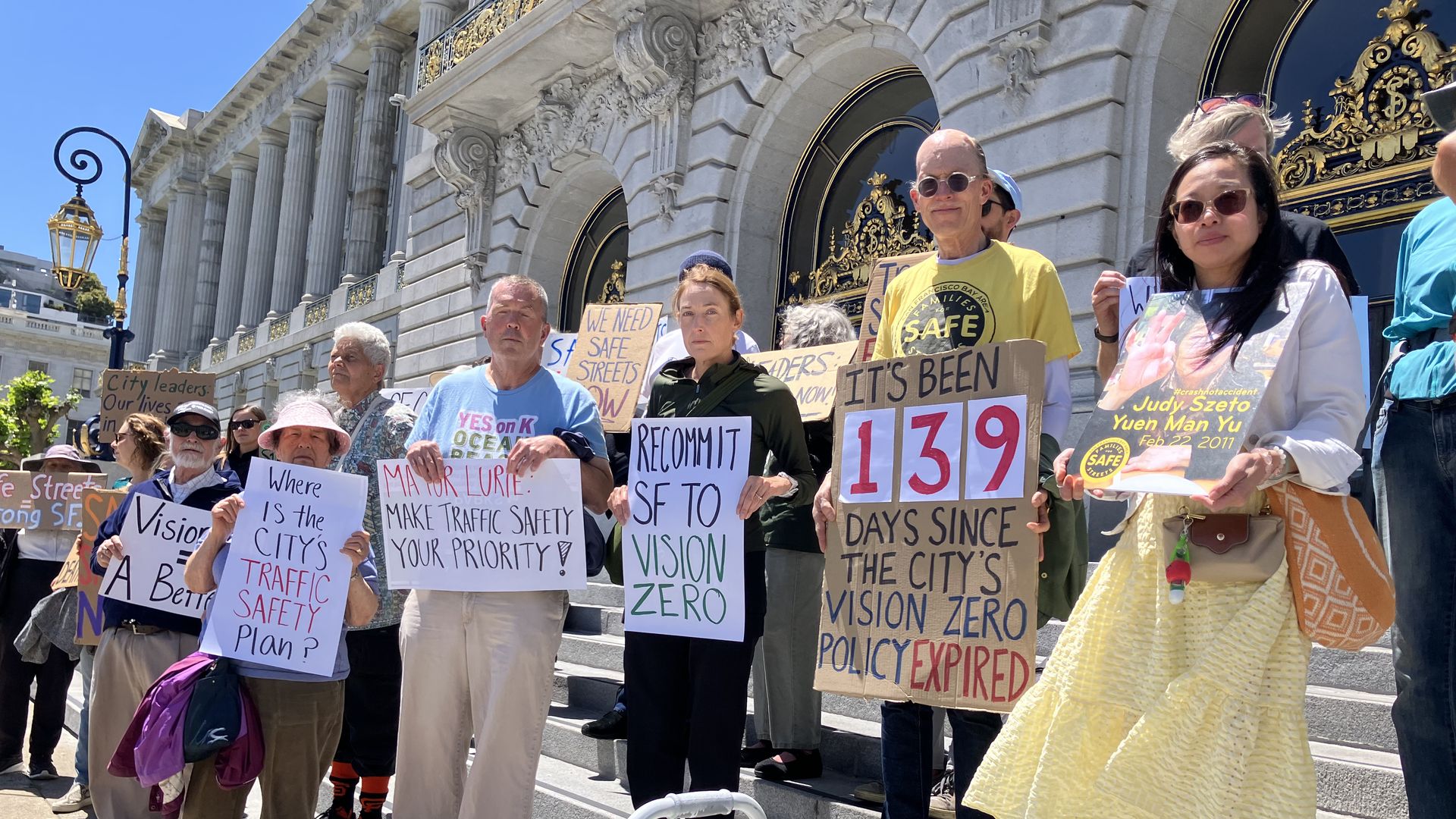
Street safety advocates rally at San Francisco City Hall. Courtesy of Marta Lindsey/Walk San Francisco
Transportation safety advocates are pushing for San Francisco's leaders to re-adopt a street safety plan to reduce pedestrian-related crashes and traffic fatalities.
Why it matters: 12% of San Francisco's streets account for 68% of the city's most severe and fatal traffic collisions, according to SFMTA.
- Excessive speed is the leading cause of injury and death, followed by drivers running red lights and failing to yield at intersections.
Driving the news: Street safety groups rallied at City Hall this week to protest the number of pedestrian deaths since the city's Vision Zero initiative expired in 2024.
- They're now calling on Mayor Daniel Lurie to implement a new policy by July 30 with seven actions, including lowering speed limits, increasing enforcement and installing "turn calming" infrastructure at intersections.
What they're saying: "If the mayor really does believe that street safety is part of public safety, how does street safety, when it comes to traffic violence, fit into that? Right now it's not clear," said Jodie Medeiros, executive director of Walk San Francisco.
- Increased delivery truck and rideshare traffic, more powerful vehicles and aggressive driving have contributed to the problem, she added.
By the numbers: 24 pedestrians died from vehicle collisions last year and six have been killed in 2025, five of whom were seniors, Medeiros noted, citing city data.
- Seniors are at much higher risk, representing 18% of the population but accounting for 38% of all traffic fatalities in 2023 alone, said Iris Tsui, an epidemiologist at the city's Department of Public Health.


Follow the money: Between 2018 to 2022, traffic fatalities totaled $2.5 billion – costs attributed to property damage, insurance payouts and emergency response, among other factors, per a recent city report.
- "It's not only a moral imperative, but it's a fiduciary imperative to address this issue," Emma Hare, a legislative aide for District 7 Supervisor Myrna Melgar, who held a committee hearing on the issue earlier this week, told Axios.
Catch up quick: Vision Zero, a global traffic safety initiative first adopted by San Francisco in 2014, was designed to eliminate traffic fatalities and reduce critical injuries through projects focused on street redesigns, education and speed management.
- Despite making safety improvements, the city was unable to accomplish its zero-deaths goal.
State of play: Lurie's office did not answer questions on whether he planned on readopting a new policy by the advocates' deadline.
- Instead, Axios was referred to comments he made at a May 15 rally, in which he said San Francisco leads the state in "deploying advanced technology to enforce safe streets" with new automated speed cameras.
- "We are going to keep doing whatever it takes to keep our residents and visitors safe and that means using every tool in our toolbox," Lurie added.
What's next: Melgar on Tuesday, during the Board of Supervisors meeting, requested the city attorney to draft legislation for a Vision Zero 2.0 policy.
- The hope is to create a more comprehensive plan that addresses safety on a wider scale rather than focusing on piecemeal strategies, Hare said, which can be "challenging to manage" when many city agencies are involved.
What to watch: In the meantime, Medeiros said they'll continue to rally every week at City Hall until a new policy is passed.