Whale deaths spike in Bay Area amid climate disruptions

Add Axios as your preferred source to
see more of our stories on Google.
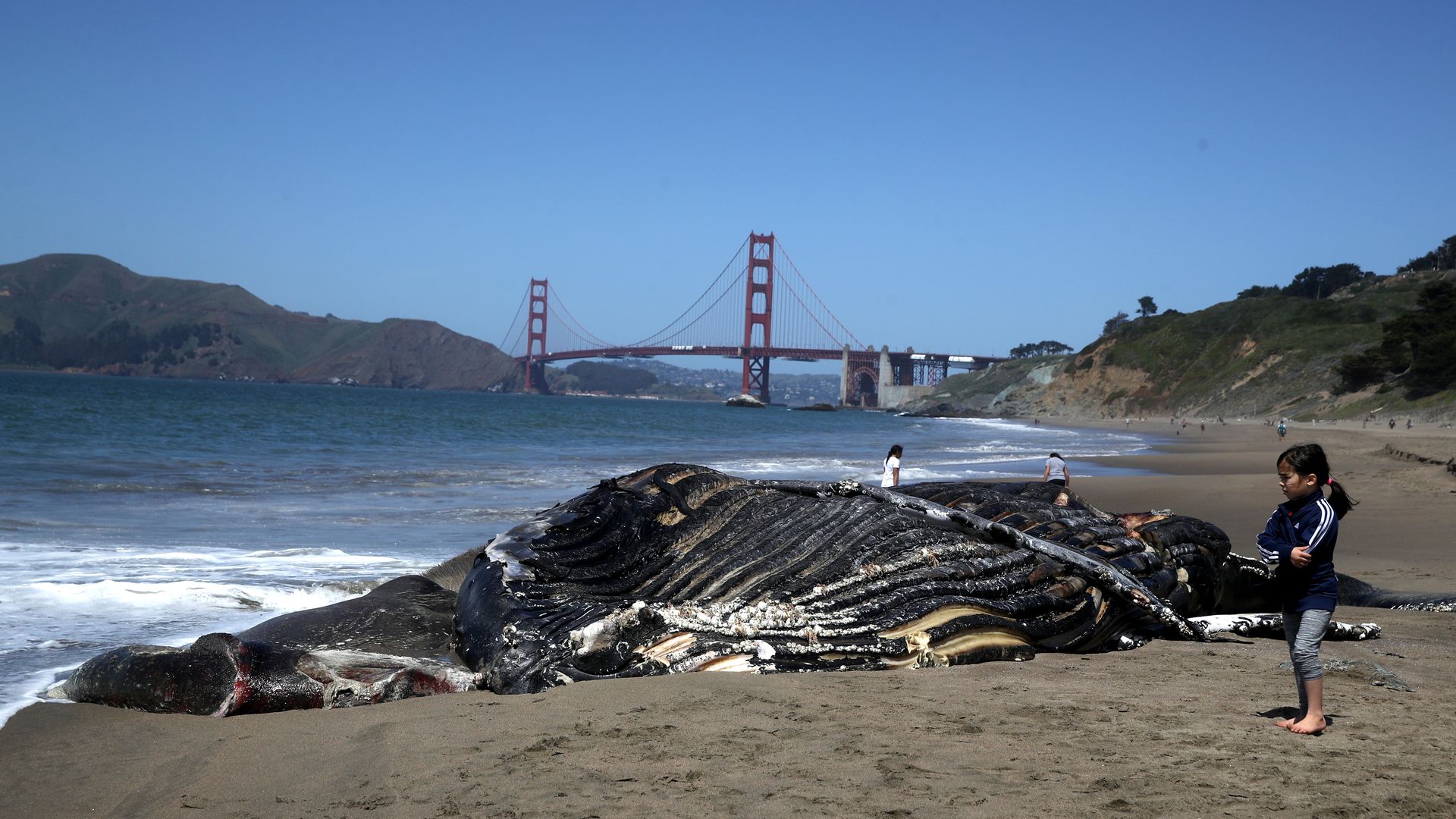
A young dead whale that washed up on Baker Beach in San Francisco. Photo: Justin Sullivan/Getty Images
At least five deceased whales (four gray) have appeared on the shores around the San Francisco Bay this year, prompting concerns from scientists about the increasing toll of climate change on marine life.
State of play: Three of the carcasses were reported in a single week in April, an unusual occurrence that hadn't happened in years.
- One of those deaths occurred after a rare minke whale found offshore near Emeryville was euthanized due to debilitating health issues.
- A total of eight whales have died between San Luis Obispo and Mendocino counties this year amid their 12,000 mile round trip from the Arctic to Baja California, according to the Marine Mammal Center.
The big picture: While the cause of death for at least four remains undetermined as necropsies continue, scientists say climate change is creating disruptions to migration and feeding patterns that have led to massive population declines among gray whales.
- Warmer Arctic waters have reduced food sources, leading to malnourishment and the animals needing to travel longer distances to find food.
Stunning stat: Food scarcity was largely responsible for causing the population to drop by about 45% between 2019 and 2023 alone, referred to as an "unusual mortality event," according to the National Oceanic and Atmospheric Administration.
What they're saying: "Skinny whales are not healthy," Kathi George, who is the director of cetacean conservation biology at the Marine Mammal Center, told Axios. "Reducing the impact that we are having on our planet and reducing the use of fossil fuels...is needed to help protect our ocean and minimize the amount of changes that it's experiencing."
Between the lines: Malnutrition has also made them more vulnerable to other risks as they travel further into areas with high vessel traffic to find food.
- More than 29 whales have been spotted in the San Francisco Bay so far this year, compared to just four all of last year, George said.
- Of the four dead gray whales in the Bay this year between March 30 and April 17, one of those found off Fort Point Rock Beach was determined to be killed by a vessel strike, according to the mammal center.
- "What we're seeing this year in the Bay Area is unusual in terms of the numbers of individual whales that are swimming into and staying in the San Francisco Bay," she added.
How it works: It's typical to see gray whales during the spring as they embark on their northbound journeys while returning to their summer feeding grounds after spending the winter in warmer waters for breeding.
Catch up quick: The gray whale population has not rebounded since experiencing massive losses a couple of years ago, though the most recent count showed there were about 19,000 whales that migrate on the West Coast during the 2023-24 winter season, according to Michael Milstein, a spokesperson at NOAA's West Coast Regional Office.
Yes, but: Though the numbers may seem alarming, there have only been 14 deceased gray whales this year on the West Coast, which remains "well within the usual range," Milstein said.
- 31 dead whales were found on the West Coast last year. The average is about 35 per year, "so the numbers at this point are not unusual," he added.
What we're watching: Emaciated whales and low birth rates are still concerning, particularly in the waters off Baja California in Mexico, Milstein said, who added that "we are continuing to monitor the population to learn how this migration continues to play out."
What's next: If you spot a dead whale, call the Marine Mammal Center at 415-289-7325 or the California Academy of Sciences at 415-379-5381.